For the last talk in my Top 10 sustainability related TED Talks list, we have Amory Lovins with "A 40-Year Plan for Energy." Lovins is the chairman of the Rocky Mountain Institute, a consultant, a physicist, and widely regarded as one of the most knowledgeable people in the world on the subject of energy and how we use it.
In this 27 minute talk (unusually long for TED) he lays out in plain English how we can fundamentally change the way we use and generate energy. The recipe is really quite simple: efficiency first so we are using much less, and then the transition to renewables is much easier.
As Lovins says in this talk, "our energy future is not fate, but choice." Here (and in many presentations like this one) he lays out a clear and simple road map for how to make the right choices.
Showing posts with label emmisions. Show all posts
Showing posts with label emmisions. Show all posts
Sunday, September 16, 2012


Sunday, September 9, 2012
Top 10 TED Talks - 9 - a Salient Conversation About Geo-Engineering
Second to last in my personal list of the top 10 TED Talks on Sustainability, we have David Keith, with what is probably the most salient conversation I have seen on the web on the issue of geoengineering (which should really be called macro-climate engineering, but I don't get to pick the words). For those of you new to the conversation, the basic principle of geoengineering is that we could counter the effects of climate change by doing something drastic to the atmosphere, like pumping a lot of sulfur dioxide into the higher levels. SO2 in the stratosphere would reflect light, very much not at all like a bunch of "tiny mirrors," reducing the amount of energy getting into the lower levels of the atmosphere and having a net cooling effect.
Most of the media on geoengineering falls into one of two camps. The first is people in favor of doing it radically and preemptively instead of solving emissions problems (like the Freakonomics guys, who lost all of my respect when they did) and call everyone who disagrees with them wimps and idiots who either can't face or don't grasp the facts. The second is people who think that any and all geoengineering is basically Jurassic Park, half-assed scientists messing with things they don't understand that are going to get us all eaten by dinosaurs.
The truth, as always, is a whole mess of gray. Keith, however, lays out some very logical analysis of what it is, how to evaluate if it is a good idea, and raises some very good points e.g. whether or not it is a good idea, shouldn't we at least have an international treaty that says no one country can do it unilaterally?
The fact is that geoengineering is an idea, and ideas don't go away. So we have to deal with it, like it or not. And what Keith is arguing for here, essentially, is having a grown up conversation about the idea of messing with things that we don't really, fully understand.
Sunday, August 19, 2012
Top 10 TED Talks - 8 - Just the Facts on Climate Change
Coming into the home stretch on our Top 10 TED Talks for the Sustainability minded, we have James Hansen describing very clearly what is going on with our climate -- Spoiler Alert, it is changing in ways that are not good.
This talk is really, really informative, and Hansen is one of the top researches in his field. That being said, make sure you have had plenty of coffee, because it is just a little dry.
This one speaks for itself, I think. The case is pretty clear. The timing was serendipitous for him too, because he sounds like an oracle when he talks about droughts in the bread basket.
Sunday, August 12, 2012
Top 10 Ted Talks - 7 - Food That is Good for People & Planet
Number 7 in our list of sustainability related TED Talks, we have Mark Bittman (food writer for NYTimes, author of How to Cook Everything and How to Cook Everything Vegetarian) brings us a very enlightening talk on diet. Specifically, the contemporary western diet and why is bad for the health of both people and the environment.
Bittman approaches the subject of food with love and wit, and makes plain some complex issues of how we arrived at the food system that we have and how we should change our diets to improve both our own health and the environmental impacts of our food systems.
Courtney and I have turned to How to Cook Everything Vegetarian for inspiration in our kitchen for years, and personally came to many of the same conclusions that Mr. Bittman recommends in this talk, but he does such a great job here of summarizing the issues and arriving at the correct conclusions.
Sunday, August 5, 2012
Top 10 TED Talks - 6 - Getting Real About Renewable Energy
Number 6 in my Top 10 Sustainability related TED Talks, we have a serious and sobering look at what it would actually mean to produce all of our energy from renewable sources by THeoretical Physicist and generally brilliant person David MacKay (asside from physics, he has a Ph.D in Computation and Neural Systems).
MacKay uses some very rough and simple calculations in this presentation to show that there are some very serious constraints to renewable energy technology available today, and even assuming that we can improve the technology significantly some of those constraints will never go away. For example: potential energy per unit area is drastically lower for renewables than nuclear, or coal.
I enjoy MacKay's candid, hard nosed look at what the options really are, and the practical return to what is really important: understanding how we use energy and trying to use less. Only then are renewable energy sources even viable as a replacement for fossil fuels.
Sunday, July 22, 2012
Top 10 TED Talks 4 - The Dirtiest Oil in the World
Top 10 TED Talks Number 4 (again, in no particular order): Garth Lenz tells us about the dirtiest oil in the world - the Alberta Tar Sands. Lenz begins by extolling the beauty and value of the ecosystems that are being carelessly turned over to get at the oil rich sand fields underneath, to give context to what is happening.
The Tar Sands of Canada are a very difficult subject, because while they produce the dirtiest, highest carbon fuel in the world, they are also the economic salvation of the Alberta Province, and currently one of the primary economic engines of the Canadian economy as a whole. Before these Tar Sands were being exploited, Canada was one of the most progressive countries in the nation when it came to environmental issues, today it is one of the least.
Lenz is passionate and articulate, and his story is both personal and global - a difficult balance that he handles deftly. This video is also rather timely, as the issue of the Keystone pipeline is once again up for grabs in the next election.
Wednesday, July 18, 2012
Top 10 TED Talks - 3 - Learning the Limits
Limits are frequently the theme of Sustainability conversations, and my third Top 10 TED Talk is precisely about the limits of environmental stability. Johan Rockstrom, director of the Stockholm Environment Institute and the Stockholm Resilience Centre, discusses his work identifying exactly what the environmental limits are, and where we are in relation to those limits. Rockstrom lead a group of researches in developing 9 "planetary life support systems" that are being stressed by human activity, and the limits of how much we can stress them before they collapse. The good news is, we've only crossed three of those limits! I think you can infer the bad news.
Rockstrom is both informative and persuasive, and uses some theatrical tropes and props to help get his points across. It is a very effective description of what exactly is meant by existing within the limits of a healthy planet.
Rockstrom is both informative and persuasive, and uses some theatrical tropes and props to help get his points across. It is a very effective description of what exactly is meant by existing within the limits of a healthy planet.
Sunday, May 27, 2012
To Dream of Less Energy - Quality of Life and Energy Consumption
Energy consumption makes all things possible. It allows us to extend our lives into the nighttime hours, it allows us to keep our homes warm or cool, it allows us to freeze food for preservation, or get it piping hot it in about a minute. Energy, in all its forms, is the foundation of our civilization. If an era is defined by the predominant technology (the stone age, the bronze age, the information age), then we are living, and have been for about a century, in the age of fossil energy: coal for electricity, oil for transportation. Information Technology itself would be impossible without abundant energy, and right now the only technology we have that can provide the amount of energy needed with the consistency required is mostly coal (there is a smattering of other: hydro-electric, nuclear, natural gas, but all of them together are less than a third of coal).
There are two primary problems with this system: resource and waste. The inputs, the raw materials, the oil pumped form the ground and coal dug out of mountains, are limited. They are finite resources that we will one day run out of. You can argue about when, about how much time we have left to keep burning through those resources, but you cannot argue about the fact that one day the wells will all be dry, the last heap of dirt will be devoid of useful coal.
The second problem, waste, is manifold. When these fuels are extracted, the process often involves polluting massive amounts of water and damaging land in a way that will not be repaired for generations. When the fuels give up their energy in combustion, they release several compounds that are degrading to the environment. CO2, Nitrogen- and Sulfur-Oxide compounds, and particulates take their toll on air quality, and various partially combusted hydro-carbons foul our streams and water-ways.
It is almost inconceivable that we could live up to our current standards without energy, and equally inconceivable, given current technology, that we could produce enough renewable energy to replace all of the fossil energy we use. That is why I am dreaming of less.
Technology holds many answer to a future of less energy, but human behavior is equally, if not more important. I dream of a culture that values the energy it uses in an emotional way, not just in price per kWh; where daylighting and passive cooling are as valuable to a home buyer as granite counter tops once were.
I dream of a society in which people care where their power comes from, how it got to them, and what happens in between and afterward. Where people see a light bulb burning and think, even just once in a while, about what it means that they can run their homes into the night, keep their produce cold 24-7, turn the thermostat up or down on a whim. Where people care not just about having energy, but the kind of energy they have.
A revolution in our energy production is still a long, long way off, but a cultural revolution, or at least a cultural shift in the way we perceive energy is already under foot. What was once a vanguard is edging into the mainstream, and today more than ever people care about energy. Not just that they have it, but where it comes from too. We are still a long way from a culture where everyone cares about energy, and is concerned with reducing energy consumption, but a change in the culture that uses the energy can be much, much quicker than a change in the infrastructure that delivers it.
Sunday, April 3, 2011
Nuclear Energy is Not a Sustainable Solution
 Image via Wikipedia
Claiming that this disaster (which now seems to be leaching extremely radioactive water in every direction) proves the safety of nuclear energy is quite simply absurd. First of all, it is premature since the extent of the damage is yet unknown and the disaster is by no means over. Furthermore, it grossly downplays the role that luck had to play in the narrow avoidance of a meltdown (not to diminish in any way the hard work of those involved in containing the disaster). As Elizabeth Kolbert argued quite elegantly in "The Nuclear Risk," The New Yorker, March 28 2011, the simple fact is that nuclear energy generation has never been as safe as we have been pretending. In reality, we have been extremely lucky so far, and we are ourselves only one or two natural disasters away from a nuclear catastrophe of horrific proportions. Amory Lovins, co-founder of the Rocky Mountain Institute, provides an excellent case against nuclear energy in this guest post on Green Tech Media, focusing on safety as well as financial feasibility.
Even setting aside the safety argument, however, nuclear energy does not make sense on a purely carbon emissions basis either. First off, nuclear is not carbon neutral: all nuclear power plants must be backed up by another form of generation, because they require backup power to avoid a meltdown during any generation downtime. The embodied energy in a plant is also significant, and is many times more than wind generation. Still, considering only these factors the carbon emissions per kwh are minuscule compared to coal based plants.
But there is one simple fact that really shoots the net carbon emissions of nuclear energy through the roof: nuclear waste is a powerful weapon. My father in law was the first to point out to me that military organizations around the world burn massive amounts of fuel in their efforts to secure nuclear waste and track down any waste which has evaded security efforts. In any honest assessment of the greenhouse gas emissions of nuclear energy, we must consider at least some portion of the emissions of the military. When one considers that the US military alone burns about 395,000 barrels of oil every single day moving people and materiel around the globe (and the number one thing by weight that they move is more fuel), that contribution is clearly significant.
Ultimately, nuclear energy is not a good solution, short term or long term, to climate change. The risk to human health in the form of potential radiation and weaponization is always downplayed by nuclear advocates, and the carbon footprint is never accounted for properly. None of the arguments for investing in nuclear energy will stand up to rigorous scrutiny.

Friday, August 20, 2010
Electic Vehicles: the Pros and Cons and Pros and Cons...
 Image via Wikipedia
It’s complicated. Cars are complicated. First, we want to stop burning fossil fuels, and for most of us the gasoline going into our tank is the only fuel that we actually come into contact with directly. You can look at a light bulb glowing and think abstractly about coal burning in a far off plant, but when you refuel your car you can smell it. So most of us have a visceral feeling about how our cars use fossil fuels which is somewhat disproportional to the actual carbon emissions they generate. Cars get vilified more than A/C units, even though cooling big office buildings generates much more pollution. Not to downplay the carbon emissions from cars; transportation (as a whole) is still among the top 3 sources of green house gasses. The result, however, is that we tend to feel worse about our cars than anything else.
Still, most of us can’t get around without a car. In other words, we want to be better but we feel like we can’t. Enter the electric vehicle; drive all you want and never deal with gasoline again. The trouble is, you haven’t actually solved the problem. Now your car is just one more light bulb; you plug it in and it juices itself up, but you are really just burning the fuel somewhere else. All you have done is stopped smelling it.
So we’re back to feeling like there is nothing we can do, right? Well... maybe. There is one thing that electric cars can do which conventional cars cannot, and never will. They can get their energy from anywhere. Most places in the US coal is the only option for energy generation, so that point can seem moot, but it isn’t. Where I live in the Pacific North West for example, a substantial percentage of the power comes from hydroelectric plants, so driving an electric car up here is really vastly more sustainable than an internal combustion vehicle.
In many states like California, the legislature has made a commitment (and appears to be keeping it against all odds) to steadily increase the percentage of energy production from renewable sources. So if you buy an EV in CA, it will get greener every year. That is a really big deal when you think about the fact that the sustainability movement is gaining steam. If more states commit to green energy, then EVs are suddenly a really great alternative.
However, when you really think about it, why does transportation require any energy at all? Sure, it is just about impossible to imagine getting across the country without burning fuel, but why is it that most of us can’t imagine getting to the grocery store and back without driving a car? Or to work? Or just out to a restaurant? Have we forgotten how to walk? Does anyone own a bike anymore and use it to get places, not just to exercise? Have middle class white people forgotten how to ride buses? It certainly seems so.
 Image via Wikipedia

Wednesday, August 11, 2010
An(other) Inconvenient Truth
Re-posted from the iPinion Syndicate
For greenhouse gases, like so many other things in our environment, too little and too much are equally problematic. Life is a balancing act, a tightrope walk, and anything which tips the balance one way or the other can lead to a show stopping, devastating end. Take salt, for example: you can’t live without it, but as any sailor knows drinking salt water will kill you quicker than thirst.
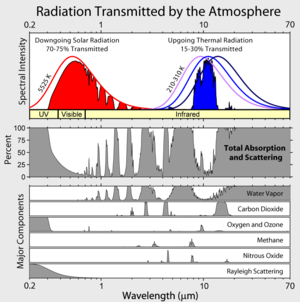 Image via WikipediaSimilarly, greenhouse gases play an important role in keeping the earth at temperatures that can sustain life. Too little means too cold, and too much too hot. No one (who understands it) questions the physics behind the greenhouse effect, and no one questions that carbon dioxide is a greenhouse gas, this was discovered long ago and has been tested repeatedly since. Starting with the industrial revolution, we have been pumping extra greenhouse gases into the atmosphere, more every year, and primarily carbon dioxide. The results: this summer is the hottest summer in the history of humans
recording temperatures on a global scale, with all of the crop failures and droughts that that record implies. So why don’t we just stop generating carbon dioxide?
Well, the answer to that question is the ‘other’ inconvenient truth alluded to in the title of this column: fossil fuels are awesome. As a friend of mine who is an engineer explained it to me: there is no other convenient way that we can store so much energy in such a tiny volume. And it is not for a lack of trying, believe me.
 Image via WikipediaBattery technology gets better every year, but even the most efficient electric vehicles rarely get more than 100 miles on a single charge. The average gas burner, on the other hand, can generally go 3 times as far on one full tank of fuel. As another example, solar technology and wind turbines (so far) cannot compete with coal power plants for energy output, and have pretty serious hurdles to overcome in the area of consistency. So while these sources are sustainable, infinitely cleaner, and overwhelmingly more efficient, when the desired result is a light bulb that comes on at the same intensity every time you flip that switch, coal is what provides the consistency to your grid. That is why roughly 2/3 of our electricity still comes from fossil fuels, and less than 1/10 from renewable, sustainable sources.
We can generate energy in much more efficient ways than by burning fossil fuels, which waste massive amount of energy in powering the grid. Hydroelectric plants, for example, are supremely efficient, generate plenty of energy, produce absolutely no pollution at all, and require less maintenance. The only downside is that the water supply is somewhat seasonal (which is usually evened out by dams), and there is no way to store excess energy.
If you were tasked with designing a system to store excess energy for later use, you would be hard pressed to come up with something as efficient (at storing energy), compact, transportable, and with such longevity as gasoline or coal. That is precisely why we are having such a hard time kicking our habit of burning through fossil fuels to run our increasingly high power life styles. When it comes down to it, it is very very difficult to generate the same amount of on-demand electricity with the same consistency and move the same amount of freight without burning fossil fuels. So what can we possibly do? The short answer: use less energy, reduce the amount of stuff we ship.
In the long term, it may be possible to generate the same amount of energy that we use today without emitting carbon dioxide, but it is not going to happen this year, next, or next decade most likely. So in the interim, reducing energy demand is the only way that we can reign in our run away greenhouse gas emissions. Living a more energy efficient lifestyle, in other words, is the only thing that will keep us balanced on the tight rope.
 Image via Wikipedia

For greenhouse gases, like so many other things in our environment, too little and too much are equally problematic. Life is a balancing act, a tightrope walk, and anything which tips the balance one way or the other can lead to a show stopping, devastating end. Take salt, for example: you can’t live without it, but as any sailor knows drinking salt water will kill you quicker than thirst.
 Image via Wikipedia
recording temperatures on a global scale, with all of the crop failures and droughts that that record implies. So why don’t we just stop generating carbon dioxide?
Well, the answer to that question is the ‘other’ inconvenient truth alluded to in the title of this column: fossil fuels are awesome. As a friend of mine who is an engineer explained it to me: there is no other convenient way that we can store so much energy in such a tiny volume. And it is not for a lack of trying, believe me.
 Image via Wikipedia
We can generate energy in much more efficient ways than by burning fossil fuels, which waste massive amount of energy in powering the grid. Hydroelectric plants, for example, are supremely efficient, generate plenty of energy, produce absolutely no pollution at all, and require less maintenance. The only downside is that the water supply is somewhat seasonal (which is usually evened out by dams), and there is no way to store excess energy.
If you were tasked with designing a system to store excess energy for later use, you would be hard pressed to come up with something as efficient (at storing energy), compact, transportable, and with such longevity as gasoline or coal. That is precisely why we are having such a hard time kicking our habit of burning through fossil fuels to run our increasingly high power life styles. When it comes down to it, it is very very difficult to generate the same amount of on-demand electricity with the same consistency and move the same amount of freight without burning fossil fuels. So what can we possibly do? The short answer: use less energy, reduce the amount of stuff we ship.
In the long term, it may be possible to generate the same amount of energy that we use today without emitting carbon dioxide, but it is not going to happen this year, next, or next decade most likely. So in the interim, reducing energy demand is the only way that we can reign in our run away greenhouse gas emissions. Living a more energy efficient lifestyle, in other words, is the only thing that will keep us balanced on the tight rope.
 Image via Wikipedia
Tuesday, July 27, 2010
One Thing You Can Do For Free
 Image via Wikipedia
Whether trying to cut costs or carbon emissions, more people are attempting to reduce their energy consumption every day. Most energy saving measures require some up front cost to initiate, and some can be extremely expensive. Although any good measure will pay for itself in energy savings over time, it can be difficult to come up with the capital to get the ball rolling. I love finding and sharing the things that are relatively cheap to implement, and my favorite energy saving measure are the ones that, like all the best things in life, are free.
With that in mind, here is one thing that anyone can do to reduce their energy consumption, which should save money without costing a dime: dress for the season. You have probably heard this one before, but it is worth repeating.
For most of us, the single biggest consumer of energy in our lives is the space we live in. This includes the electricity used to keep our food cold, the energy used to heat it up again, used to heat our water, run our computers and entertainment systems, light our dark rooms and dry our wet clothes. All of the above combined, however, is less (for most homes) than the energy used to heat our spaces in the winter and cool them in the summer.
Of course, to reduce your heating and cooling load, most people will tell you to replace your old windows, which is phenomenally expensive. But there is something much simpler, immediately effective, and free that you can do, which is heat and cool your spaces just a little less. You may think that a few degrees on the thermostat won't make much of a difference, but consider this: heat flows from a warmer space to a cooler space, which is obvious, but it flows faster the greater the difference in temperature between the two spaces. Each extra degree of difference requires more energy than the last, so the bigger the difference the more energy it takes to maintain a conditioned space.
In other words, the colder it is outside the more energy you are saving by turning your thermostat down just a little. I don't want to ask you to sacrifice comfort, however, so that is where dressing for the season comes in. Bundle up, grab a blanket, and turn the thermostat down as low as you can safely and comfortably manage. Wear layers, use slippers or woolly socks, and find comfortable sweats and long underwear. You will probably still need heat if you live north of about 35 degrees latitude or in higher elevations, but every degree helps.
Similarly, the hotter it is outside, the more energy it takes to cool your house down. So in the summer, instead of bundling up take it off. Light linen clothes, fewer layers, or a swim suit with a light shirt or wrap may make it comfortable to open the windows instead of cranking the AC. When your kids complain that they don’t want to see you in your bathing suit all the time, calmly explain to them that you are saving the planet by embarrassing them in front of their friends. Also, leaving windows open at night (if it does not sacrifice security) and closed during the hottest part of the day can reduce your cooling load. Finally, during the hottest part of the day try getting out of the house completely. Find a shady place, preferably near a body of water, and try to enjoy the summer sun.
It may sound like sacrifice on the face of it, but you might be surprised to find that when the ambient air is a little colder, standing next to the stove makes you feel even warmer than if the thermostat were set at 70. Similarly, a breeze blowing the curtains can be more refreshing than a sealed room conditioned to ideal temperatures. This is because the contrast is very pleasing to our senses. When the room is stable at the ideal temperature, that simply becomes the new baseline.
There are of course a number of things you can do to improve your home’s ability to retain heat, but pretty much every single one will cost you something. Many utility companies offer home owners free energy audits which recommend specific measures, so you can evaluate what you can afford, what is worth it, and what you can possibly save up for. And while you are saving up for those measures, you can pocket a buck or two by dressing inside more like you would outside.

Sunday, May 23, 2010
The 2,385 Watt Lifestyle: expressing your life in terms of wattz consumed
I read a really great article in the New Yorker magazine last week about Saul Griffith (who I mentioned in connection to his guest blogs on Boing Boing a while back). It was a really good article, but what I want to mention now is that it led me to one of Saul's ongoing projects, a site called WattzOn. Here, after filling out a pretty brief questionnaire, the site lets you know how much energy your lifestyle is consuming, and puts it into terms that help you visualize what that means.
I discovered that my lifestyle consumes 2,385 watts (although there are a few things left out of that figure, the site is not perfect) which is below average for an American, and a little below average for a WattzOn user. That wattage equates to burning 2 gallons of oil per day, or the power required to run 40 incandescent light bulbs non stop.
Mostly, my energy savings come in the housing category, as I live in a very efficient town house. My biggest consumer, however, came as no surprise to me. It was my car. We live in a kind of suburban area right now, which is far from my ideal lifestyle, and as a result we end up driving a fair amount. On balance, living in a very efficient house saves more energy than the extra fuel consumed by my car living in the suburbs, but I really wish that I didn't have to drive and lived in an efficient house. Then I could easily get that wattage down below 1800, which would equate to the power generated a 26x26 ft. solar panel, or a wind turbine with a diameter of 16 feet. That is actually a reasonable amount of energy for one person to use from renewable resources only. Much more than that, and you're gonna need coal fired electricity.
So in summation, check out WattzOn, it is a great site and it will really help you understand the way your lifestyle and power consumption interrelate.
Tuesday, April 27, 2010
Paul Krugman explains Environmental Economics: a good read
 Image via Wikipedia
I have a lot of respect for Krugman, who is particularly good at explaining complex economic models in layman's terms (he is also particularly good at explaining them in academic terms, and received a Nobel Prize for his efforts). And after reading this article, I must say, I have changed my mind about one thing: I previously stated that Carbon Credit Markets (CCMs) don't do anything, and after reading this article I understand two ways in which they could. When I talked about CCMs in my previous blog post, I suggested that the cap and trade model which was so loved by businesses and politicians alike was really just a more palatable version of mandated carbon reductions or pollution taxes, except the money goes to the private sector instead of the public. While that is still true, I see now that as a virtue of being more palatable they are more likely to make it into law and to be accepted by businesses.
Furthermore, even though the trading of Carbon Credits benefits private companies rather than government programs for environmental concerns, as Krugman points out, these credits could be auctioned off instead of being just handed out, which could result in some government revenue for environmental projects and programs.
Most importantly, however, Krugman dispels the myth that capping emissions through government mandate would be 'ruinous' to our economy, as we hear over and over again in the media. Just as the scientific community generally agrees that global warming due to the green house gas effect is real, so too apparently do economists agree generally that our economy, both as a nation and as a planet, would do just fine with mandated carbon emission reductions. Basically they all say it would slow growth a little, and enough to make it important to consider the alternatives, but not nearly enough to be 'ruinous.'
So then, from an economic point of view, we stand to lose a little from acting to stop climate change. What a good economist does next is weigh that loss against possible scenarios of ignoring climate change. So, what happens if we don't do anything? Business As Usual? The answer: potential for massive disruption of every market around the world. If you believe that the scientists are right about global warming, the cost of inaction obviously outweighs any costs of curbing climate change. Even if you are not convinced that global warming is real, if you believe there is a chance it is real, the potential cost of inaction is a very heavy risk compared to the alternative that reducing emissions will hurt a very small amount. If you, on the other hand, are absolutely convinced that global warming is a giant hoax then I probably cannot say anything to convince you otherwise.
I, for my part, am never 100% sure of anything. I am 99.9% sure that the sun will come up tomorrow. I'm 99% sure that global warming is real (I can't read every study and check every single fact), 98% sure that human actions are causing global warming and human actions can reduce it. I think anyone who is not willing to hear arguments that they don't agree with and never allows their mind to be changed is at least a little foolish. So if you are pretty sure that I am wrong about global warming, but you are not a fool, I ask you this question: how sure are you, and at what point is it worth gambling with our future? If a possible negative outcome is too terrible, I think there is a point at which it is not worth gambling no matter what the odds. Krugman, in his article, paraphrases Martin Weitzman (a prominent environmental economist at Harvard): "it's the non-negligible probability of utter disaster that should dominate our policy analysis."
In summation: the risks of inaction are too great, the costs of action are low, and the longer we wait the more difficult the situation becomes. Scientists agree that there is a problem, economists agree we can afford to fix it (or at least start to mitigate it), and now all we need to do is agree that it should be done.

Monday, April 5, 2010
Indoor Air Quality, Allergies and Air Purifiers
Although Los Angeles is not exactly known for its fantastic air quality (read: LA air sucks), the move to a colder climate and relocation to the Willamette Valley (which is known for it's many species of face itching sneeze making grasses) has somewhat inflamed the allergies of my wife and I. That being said, we have been very active recently trying to minimize our exposure to allergens and keep our indoor air as clean as humanly possible.
Indoor Air Quality is a section of green building that is often overlooked by most people (though architects and building professionals are likely to spend a good deal of time thinking about it). It is not as flashy an issue as global warming, habitat destruction, etc. But it is very important to our health and well being, and our ability to be productive and happy. As an allergy sufferer I can tell you, if you are not breathing properly when you sleep you feel like a zombie the following day, and all productivity and hope of happiness goes out the window. All you can do is shuffle along and think about biting anyone who gets close to you. In our research, we were somewhat surprised to discover that the air purifier we had been using was not actually doing anything useful.
HEPA filters are extremely efficient at arresting tiny particles in the air, measuring only micrometers in diameter. It is illegal for filters to be advertised as HEPA if they are not capable of arresting those tiny particles. However, for some unfathomable reason, cheaper filters which do not arrest any allergen particles at all can be called "HEPA Type," "99% HEPA," or "HEPA like." The Hunter purifier which Courtney bought many years ago was just such a product. So, we concluded that we needed a new one, with a "true HEPA" filter this time. Although I generally advocate getting stuff used as often as possible, when it comes to an issue of personal health you get the best product available.
In researching air purifiers before making a purchase, we were shocked to discover that the Ionic Air Cleaner types were basically worse than useless for allergy sufferers. They mask odors and make the air smell fresher by producing Ozone (O3). Now, while Ozone is a great thing in the upper atmosphere, where it filters UV light from the sun, here in the atmosphere that we breath Ozone is a very, very bad thing. It is toxic to pretty much all living things, including plants, animals and us. And while a little Ozone won't kill you, it will irritate your lungs and sinuses, exacerbating any symptoms of respiratory tract infection or allergic reactions. So in other words, they make your allergies and your indoor air quality worse. As if that wasn't bad enough, Ozone in the troposphere (where we live) is a green house gas, and unlike CO2 and other green house gasses, it can react with other pollutants to generate more Ozone in a cyclical reaction. In case you didn't get the message, do not purchase Ionic Air Purifiers or Air Cleaners, they are all but evil.
In summation: if you want an air purifier, get a true HEPA filter sized to the room that it will be in. Courtney and I got a Honeywell 50250 Round Air Purifier for the living room, and a smaller, quieter Honeywell 17000 HEPA QuietCare Air Purifier for the bedroom. Both came with permanent true HEPA filters. We have been sleeping much easier since. I really cannot overemphasize how awesome these things are. Since we purchased ours, we can't smell the cats litter box except for two seconds right after an "event," we don't have to dust as often, and I wake up feeling like a real human being, even when I forget to take my Aller-tec
 .
Aside from the air purifiers, we have a Dyson Ball vacuum with a HEPA filter, several house plants that filter specific VOCs out of the air (see this website), and do everything we can to reduce the amount of dust and other allergens in our home. It is a constant battle, but for now one we are winning quite decisively. Unfortunately, running two fans 24-7 means more energy consumption, but since our local utility (SUB) generates 80% of its energy from hydro-electric, I don't feel quite so bad about it.
Editing this, I realize that there are a lot of ads in this post, but learning how to control my allergies was a struggle for me, and I think that promoting the products that I found most useful in controlling my symptoms is an important thing to do. So I am unashamed about all the ads in this post, in other words. And no, I don't work for Honeywell (though if they wanted to pay me for the plugs I wouldn't complain).

Indoor Air Quality is a section of green building that is often overlooked by most people (though architects and building professionals are likely to spend a good deal of time thinking about it). It is not as flashy an issue as global warming, habitat destruction, etc. But it is very important to our health and well being, and our ability to be productive and happy. As an allergy sufferer I can tell you, if you are not breathing properly when you sleep you feel like a zombie the following day, and all productivity and hope of happiness goes out the window. All you can do is shuffle along and think about biting anyone who gets close to you. In our research, we were somewhat surprised to discover that the air purifier we had been using was not actually doing anything useful.
HEPA filters are extremely efficient at arresting tiny particles in the air, measuring only micrometers in diameter. It is illegal for filters to be advertised as HEPA if they are not capable of arresting those tiny particles. However, for some unfathomable reason, cheaper filters which do not arrest any allergen particles at all can be called "HEPA Type," "99% HEPA," or "HEPA like." The Hunter purifier which Courtney bought many years ago was just such a product. So, we concluded that we needed a new one, with a "true HEPA" filter this time. Although I generally advocate getting stuff used as often as possible, when it comes to an issue of personal health you get the best product available.
In researching air purifiers before making a purchase, we were shocked to discover that the Ionic Air Cleaner types were basically worse than useless for allergy sufferers. They mask odors and make the air smell fresher by producing Ozone (O3). Now, while Ozone is a great thing in the upper atmosphere, where it filters UV light from the sun, here in the atmosphere that we breath Ozone is a very, very bad thing. It is toxic to pretty much all living things, including plants, animals and us. And while a little Ozone won't kill you, it will irritate your lungs and sinuses, exacerbating any symptoms of respiratory tract infection or allergic reactions. So in other words, they make your allergies and your indoor air quality worse. As if that wasn't bad enough, Ozone in the troposphere (where we live) is a green house gas, and unlike CO2 and other green house gasses, it can react with other pollutants to generate more Ozone in a cyclical reaction. In case you didn't get the message, do not purchase Ionic Air Purifiers or Air Cleaners, they are all but evil.
In summation: if you want an air purifier, get a true HEPA filter sized to the room that it will be in. Courtney and I got a Honeywell 50250 Round Air Purifier for the living room, and a smaller, quieter Honeywell 17000 HEPA QuietCare Air Purifier
for the bedroom. Both came with permanent true HEPA filters. We have been sleeping much easier since. I really cannot overemphasize how awesome these things are. Since we purchased ours, we can't smell the cats litter box except for two seconds right after an "event," we don't have to dust as often, and I wake up feeling like a real human being, even when I forget to take my Aller-tec.Aside from the air purifiers, we have a Dyson Ball
vacuum with a HEPA filter, several house plants that filter specific VOCs out of the air (see this website), and do everything we can to reduce the amount of dust and other allergens in our home. It is a constant battle, but for now one we are winning quite decisively. Unfortunately, running two fans 24-7 means more energy consumption, but since our local utility (SUB) generates 80% of its energy from hydro-electric, I don't feel quite so bad about it.Editing this, I realize that there are a lot of ads in this post, but learning how to control my allergies was a struggle for me, and I think that promoting the products that I found most useful in controlling my symptoms is an important thing to do. So I am unashamed about all the ads in this post, in other words. And no, I don't work for Honeywell (though if they wanted to pay me for the plugs I wouldn't complain).
Saturday, February 6, 2010
The Failure of Zero Sum Carbon Credit Markets
In light of the recent scandals of scammers ripping off companies for millions of dollars worth of carbon credits, I thought it would be good timing to drag up this notion from a paper I wrote while in college.
Carbon Credit Markets don't actually do anything. Before you grab your pitchfork, hear me out. Businesses and governments rave about CCMs and the great good they are doing. They talk about how much they have accomplished with these markets, and how much they have reduced carbon emissions. However, a common sense analysis shows that the markets don't do anything at all, and in some ways could actually be slowing things down.
First of all, the Carbon Credit Market does not exist naturally. A CCM only exists when there is a mandatory government regulation on emissions. The government says that all companies have to reduce carbon emissions by x% by this date. So, it is the regulation that results in the carbon gas reductions, not the market. Then what does the market do? Well some companies aren't going to make the required reduction by that deadline, and others will surpass it. The CCM allows manufacturers who cannot meet the mandated reductions to purchase offsets against their failures to avoid paying fines. And who do they purchase these credits from? From people who exceed the required reductions.
This market may create an incentive for innovators to exceed the reductions, but guarantees that these innovations will not have a net positive effect at the same time, because exceeding the reductions is only incentivized to the extent that the overall mandated reduction is not met. In other words: good companies only do better than expected to the extent that bad companies don't play along. Therefore it is a zero sum market with no tangible positive result.
One of the reasons that this whole scam is so well loved by businesses, by the way, is that the value of a carbon credit must be lower than the cost of paying the equivalent in fines. Otherwise the company would just pay the fine instead. This has two results: the financial penalty for companies that don't meet the reductions is softened (which is bad), and that financial penalty is sent to the shareholders of the good companies instead of a dedicated government fund (which is bad if you are a socialist and good if you are a conservative capitalist).
Personally, I think that the companies that don't meet required reductions should just be fined, and the fines should be earmarked for specific green projects. You could still encourage exceeding mandated reductions with tax incentives. But ultimately, it just rubs me the wrong way when people claim that the Carbon Credit Markets are doing so much good in the fight against global warming, when it is the mandated reduction that is doing all the heavy lifting. The CCM is just a PR trick, because our culture prefers the word 'market' to the word 'mandate.'
Monday, November 30, 2009
Understanding Energy
[Update: I probably should have included this disclaimer originally, if you have a solid understanding of physics this will probably be redundant] I just finished reading this post by Boing Boing guest blogger Saul Griffith, and it is an absolute must read for anyone who is interested in energy, efficiency, sustainability, going green, or the way things work in general.
I recommend that you have a little spare time when you read this, so that you can follow the links and really get into what he is talking about. It is not light reading (I would call it medium) and gets a little technical, but mostly puts the information into plain English that anyone (English speaking, that is) can understand.
Mr. Griffith is clearly a person who both understands the realities of the situation and is not at all deterred by the complexity (which he shouldn't be, he has a PhD from MIT). Even when talking about trade-offs and the difficulties of alternative energy sources (like electricity for cars) there is no hint of despair or defeat, just the kind of straightforward analysis that leads to better problem solving.
Friday, November 20, 2009
Homegrown Electric Vehicles
So, yesterday I went to a little social event for greenies at Davis' Restaurant in downtown Eugene (I would have put a link to their website, but they have not one). It was hosted by Helios Resource Network, and co-hosted by Arcimoto, and the CEO (who I kind of hate for being successful at 23) gave a brief speech about their company.
Arcimoto is a start up producing electric vehicles, and they are doing it a little bit differently. They are working with technology that has been around for long enough to be cost effective to produce an affordable car, one that you can plug in to a conventional wall socket for all of its juice needs (they claim it charges fully in 6 hours), and they are making it look pretty spiffy too. While most electric cars have specially designed engines and crazy battery technology in order to move the weight of a full sized vehicle, Arcimoto is solving the problem by making a much smaller car!
This is a really simple, elegant and in hindsight obvious solution to the problem of engineering an electric vehicle. They went with a three wheel chassis (the car registers as a motorcycle, technically), and made a body just big enough to fit two comfortably. The result is a much lighter car that can be moved by a much smaller motor, and powered with a much more simple battery.
Now for the next part, which is possibly even cooler: they plan to manufacture and sell the cars locally. You may wonder (as I often have) why there aren't already electric cars everywhere, if it's so easy to make them. The answer is really stupid: big car companies can't figure out how to make a profit off of them. Currently most of the money in the car business is in service, and electric cars don't need any much service at all (a DC motor may need the brushes replaced once every seven years, and other than that it is good to go). Conventional autos need tons of service, so the car companies are willing to deal with marginal profits on the vehicles with a guarantee of years of necessary repairs (this is a gross over simplification, but it captures the basic idea).
So the Arcimoto solution: side step the existing auto industry entirely. Figure out the local market, set the price point for a decent profit, and let the consumer drive maintenance free for 7 years. Ford and the others are so locked into their current (lack of) profit models that they can't imagine doing anything like this (which is why they love hybrids so much: call it green without actually changing much).
The Arcimoto Pulse is not exactly perfect, a brushless motor would be better and the lead acid battery has its own ecological issues, but it is leaps and bounds ahead of an internal combustion vehicle in the sustainability department. Especially when the whole local production thing is taken into account. So I give the Pulse a huge thumbs up. If every city a company like this, generating electric cars locally, we would see a lot of innovation, a much more interesting market, and better air quality. Now if we could just stop getting our electricity from burning coal...
Thursday, November 19, 2009
I'm back! (where was I?)
Sorry to my many followers (that is, my family and a few old friends) for failing to post for so long. Lets face it, if there isn't money on the table it's hard to be reliable. So where was I for so long? Aside from the many illegitimate excuses for not blogging, there were a few good reasons (still trying to decide if being really sick was an excuse or a reason). Among them, I have been devouring the new LEED 2009 reference guide: "Green Building Design and Construction." I don't think I could explain it without boring the bejesus out of anyone who is not a LEED AP, but there are a lot of really good and important improvements in the new system.
That being said, I was very saddened today by a post on Boing Boing (the most read blog) about ClimateCounts, a dubiously motivated non-profit that rates fortune 500 companies on their 'greenness.' What saddened me was not the post, but the absolutely defeatist comments from the BB readers:
Capitalism is about economics, the green movement is about sustainability. Their goals might seem contradictory at times, but in reality they are two completely different fields which can be made to work together. The absurdity of the above argument is clear if you replace capitalism with other economic regimes: the statements 'green socialism is a fallacy,' and 'green mutualism is a fallacy' just don't make any sense. Economics and sustainability are not mutually exclusive in any way.
I am also a little tired of the concept that in order to be green you have to live in the wilderness, off the grid, and make clothes from the skin of dead animals (I wonder if that poster was imagining skins of domesticated food stock or hunting for those skins, either way not necessarily more sustainable than cotton fiber). Quite frankly, there isn't room in the wilderness for every person alive to have their own acre of farmable land, and there isn't enough natural groundwater to support that many farms indefinitely.
For better or worse, over half of the world's population are now city people, and that is why cities have become the focus of most green movements. We need a lot of infrastructure to support our current population, and spreading people out into the woods would mean more of that infrastructure, and all of it less efficient. That is why focusing on green development, renewable resources and sustainable energy is so important, and why this defeatist claptrap about it all being pointless is so damaging.
I admit that things look pretty bleak when you get down to it: CO2 has a long life in the atmosphere (exact numbers are difficult to come by) so even if we stopped burning anything right now, we would not reach stability for at least 50 years. Mercury has a much, much longer life in the oceans (it can cycle through the food chain many, many times before anything like safe deposition). But how could it possibly help to throw in the towel? So the solution isn't simple, isn't easy, and won't happen overnight. All the more reason to roll up our sleeves and get started.
That being said, I was very saddened today by a post on Boing Boing (the most read blog) about ClimateCounts, a dubiously motivated non-profit that rates fortune 500 companies on their 'greenness.' What saddened me was not the post, but the absolutely defeatist comments from the BB readers:
- "The very idea of "green" capitalism is a logical fallacy, and most of these companies have historically atrocious records of polluting the globe and abusing human rights. Those scores are useless, completely and uncompromisingly so."
- "The bottom line is that most of what we do to assuage our own environmental damage is pointless unless we are living off the grid in the woods growing our own food organically and wearing animal skins."
Capitalism is about economics, the green movement is about sustainability. Their goals might seem contradictory at times, but in reality they are two completely different fields which can be made to work together. The absurdity of the above argument is clear if you replace capitalism with other economic regimes: the statements 'green socialism is a fallacy,' and 'green mutualism is a fallacy' just don't make any sense. Economics and sustainability are not mutually exclusive in any way.
I am also a little tired of the concept that in order to be green you have to live in the wilderness, off the grid, and make clothes from the skin of dead animals (I wonder if that poster was imagining skins of domesticated food stock or hunting for those skins, either way not necessarily more sustainable than cotton fiber). Quite frankly, there isn't room in the wilderness for every person alive to have their own acre of farmable land, and there isn't enough natural groundwater to support that many farms indefinitely.
For better or worse, over half of the world's population are now city people, and that is why cities have become the focus of most green movements. We need a lot of infrastructure to support our current population, and spreading people out into the woods would mean more of that infrastructure, and all of it less efficient. That is why focusing on green development, renewable resources and sustainable energy is so important, and why this defeatist claptrap about it all being pointless is so damaging.
I admit that things look pretty bleak when you get down to it: CO2 has a long life in the atmosphere (exact numbers are difficult to come by) so even if we stopped burning anything right now, we would not reach stability for at least 50 years. Mercury has a much, much longer life in the oceans (it can cycle through the food chain many, many times before anything like safe deposition). But how could it possibly help to throw in the towel? So the solution isn't simple, isn't easy, and won't happen overnight. All the more reason to roll up our sleeves and get started.
Friday, August 7, 2009
MPG = N/A
I am sure you have heard people talk about biking and how great it is for the environment before, and most of you have likely thought, for some reason or another, that it would never work for you. I went through a similar process, living in Los Angeles, and I have to say, I was surprised at how easy it was.
When I started biking, I had a 7 mile commute, and I had my doubts that it would be possible. I was out of shape, having worked a desk job for about a year and half prior, and I had no idea how long it would take to bike seven miles, how fast I could expect to go, and whether or not I would be able to breath when I got to work. In short, I had drastically underestimated how easy it is to ride a bike.
Pretty much the first day I got on the bike I was averaging 10 miles per hour, and that is including traffic lights. The first week, after no working out for almost two years, I was a little winded after 7 miles, but the slight adrenaline rush and extra energy of a morning work out made up for it. It wasn't until a month of biking to work every day that I realized, driving in the city had slowly and quietly been ruining my life.
Everyone complains about driving in Los Angeles, and they are all right. It is stressful, and as most doctors will tell you, stress can lead to all sorts of health problems. Also, when you drive everywhere in Los Angeles, everywhere you go you arrive in a really bad mood. Biking, on the other hand, is really fun! Every time I get on a bike, for the first few minutes I feel like I am 15 again (only without all the social awkwardness, insecurity and acne).
On the green front, the only way to be more green than riding a bike is walking, and that is truly not a viable option for most people. More people biking, even part of the time, is a trifecta for LA: reduce emissions and improve air quality, reduce congestion on the roads, and improve your health both mentally and physically.
Los Angeles, despite what you may have heard, is a great city for biking, especially if you commute during rush hour. You might be surprised how easy a 10, or even 15 mile commute can be, and at the peak of rush hour, you might get to your destination faster on a bike than you ever could in a car. If you live in LA, I would get down to Orange 20 Bikes right away, and find out what it would take to commute by bike. While you're there, get lunch at Pure Luck (who knew vegan food could so, so, so, SO delicious), and then check out Scoops (not really green, but mmmmm).
DISCLAIMER: My wife and I used to live around the corner from Orange 20, and I just need to pay back that awesome little community for the many good meals and deals they have given us over the years we lived there.
Ironically, since deciding to become a green consultant, I have found it increasing difficult to avoid driving. My schedule is totally up in the air, and sometimes I need to get across town on short notice in the middle of the day. In that situation, riding is not really an option. For that reason, I have come up with the crazy plan of building an electric motorcycle (or more realistically converting an old motorcycle to electric), but that is the subject of another post.
Subscribe to:
Posts (Atom)