Showing posts with label Oregon. Show all posts

Sunday, June 10, 2012

Summer & All the Good Things that it Brings

Summer officially begins June 20th in the northern hemisphere this year, and I for one cannot wait.  In 10 days the solar azimuth, or the sun's path through the sky, will arc as far north and as high overhead as it gets before the days start growing shorter, and the sun slowly retreats to the south for next winter.  This will be the "longest day" of the year.  At my latitude in Eugene the sun rises at 5:30am and doesn't set until 9pm resulting in 15.5 straight hours of sunshine!  The farther north you go, the longer the daylight lasts, and above a certain latitude (in parts of Alaska, Canada and Northern Europe for example) the sun will not set at all.  Those nearer the equator will hardly notice the difference in the day's length.

The Peas Are Taking Off

The summer's approach brings many good tidings in general, and this year a few specific good tidings for me.  Not only are the long days and fair weather conducive to a more active lifestyle, and the general quality of recreation improves significantly, but the long hours of sunshine make the garden grow fast and strong.  You may recall some of my disaster stories from the last two years of gardening, well this year we are starting to figure it out.  I have been turning a compost pile since April of last year, and at the beginning of spring I tilled up the vegetable patch in our yard and turned the compost into the patch.  So far, the vegetables we have planted love it.

We also have a few little planter boxes of herbs right by the kitchen door that are doing very well, and our one survivor from previous years, the blueberry bush, has more little green fruits than ever before.  We are about to plant a few tomatoes and plan to add some lettuce and other leafy green along the fence (which doesn't get nearly as much sun).

But this year, the best thing that summer brings with it is my wife, who has completed the Master's of Architecture program at UO and has her commencement in a week.  After three long years in Design Jail, she is a free woman once again.  The last two quarters have been fantastic (she got the studio teacher she most wanted and it was everything she hoped it would be) and her final review went extremely well.  Considering the fact that final reviews are usually a bloody affair consisting of a group of cynics tearing apart your hard work and design aesthetic, I think Courtney's face at the end of her review says it all.

Courtney in Front of Her Final Presentation
So for the rest of the summer, (in addition to my usual stuff about going green) you can expect a lot of posts about gardening, barbequing, and for the first time in a while probably some posts about traveling around Oregon, which Courtney and I are very excited about.  So I leave you with a Eugene send off, what everyone here says instead of goodbye when it is not raining: "enjoy the weather!"

Sunday, September 12, 2010

A Few Surprises for My Nothing New Month

This week, I was taken on a surprise camping trip (which is why I have been incommunicado for most of the week).  If you are not familiar with the concept of a surprise camping trip, that is because it is not actually a thing.  It is not a thing because camping requires lots of planning, and making a camping trip a surprise makes planning impossible.

Of course I am exaggerating.  My wife and I had been talking with her parents for a few months about camping before the summer was over, but we have had a great deal of trouble working out our schedules.  When we stayed with them last month (while I was attending IFBC), we had all vaguely agreed that it must happen soon, or not at all.  Just last weekend, when we realized that we all had some time off, it was suggested that camping might happen.  Still, on Sunday at 3pm, when my wife informed me that her parents were driving down right now, and we would be camping as of tomorrow, it felt quite a bit like a surprise camping trip at the time.

My first thought was "how does this fit into my month of nothing new?"  Followed quickly by "they are driving all the way down here, is it rude to demand that they follow my arbitrary rules for my blog?"  Well, as it turned out, I hardly had to bring up the blog and my Nothing New month, because both they and us owned sufficient camping gear, and we really only had to buy food (which doesn't count) for the trip to be a success.

There were a few hiccups, of course.  The first was simply that I had not thought about whether gasoline counted as buying something new.  I am still not certain, but I must disclose that I purchased a full tank of gas.  Next, we were camping just north of Newport, and Courtney really wanted to go clamming, as the season is just about over and we could not conceivably go again until next spring.  All well and good, but I would need some serious waterproof boots.

Well, the local Salvation Army was our salvation on this trip, because they had exactly one pair of knee high waterproof boots that fit me like a hand-me-down glove.  As we were checking out, the cashier said "boy, you really lucked out with those, they don't last long here."  Since Newport is a coastal town on a bay, known for it's abundance of razor, butter, soft shell, gaper, and cockel clams (and even the odd geoduck), scallops, bay shrimp, and crab, I was  not exactly surprised to learn that good second hand galoshes were a hot commodity.

After a few days of camping, clamming, and taking in Newport (which I will surely write about soon, as it is home to the nicest people on earth), the in-laws and we (in-laws and us? anyone?) returned to Springfield with several clams and a surprise agenda.  If you are not familiar with the concept of a surprise agenda, that is because you don't have the same in-laws as I (as me? I am having pronoun trouble today).

Apparently, my father in law had heard through the grapevine about our efforts to fix up and sell the Honda, but had not heard about my moderately ambitious plan to not purchase anything new this month.  The result is that I found myself overwhelmed with a plan to fix up the paint job and some body damage which involved buying lots of little new things.  It was a sound plan financially, of course, the idea was to spend a very small amount of money to get the car into the next condition bracket, but it was antithetical to my plans for September.

My wife Courtney came to the rescue. While I was embarrassed to say that their reasonable, helpful plan didn't fit in with what I was blogging about this month, Courtney explained to her parent that I was trying to fix up the car in the "greenest" way possible, and we ended up adhering to the rules that I set out in my first post.  Nothing has been purchased, still, to fix the car.  My father in-law borrowed a trickle charger to re-charge the battery, which turned out to be in perfect condition.  We also found a mechanic that would charge only $10 to put the battery on a charger for a day or so, so if we couldn't borrow a charger we could have done that.  The car (after a good wash) is now running great and ready to sell, body damage, faded paint and all.

The last week, in other words, presented me with some completely unique and bizarre problems, but so far I have not broken the rules as they were originally laid out. Of course, the month is only 1/3 over, and anything can still happen.
Enhanced by Zemanta

Monday, August 16, 2010

The Lovely Town of Oakridge, and What To Do With Fresh Eggs

Tributaries of the Willamette RiverImage via Wikipedia
This past weekend the wife and I visited some friends in Oakridge (featured in a recent NPR show: State of the Re:Union), a beautiful little town an hour outside Eugene/Springfield.  Nestled in the Cascade Mountains, this former logging town is fast becoming known as one of the best mountain biking/ hiking locations in central Oregon.  The quiet, natural beauty of the mixed deciduous and evergreen forests crisscrossed with rivers and creeks of clear snow melt is remarkable.  We soaked it in with our friends and their family while visiting a swimming hole that is part of the Middle Fork Tributary (I think) to the Willamette river.  The ice cold water was a perfect complement to the 100 degree weather.  A few large rock formations did a fair job of impersonating diving boards.

After a swim and picnic by the river, and after picking up more trash than we made (apparently other swimmers had been a little less conscientious), we packed up and headed back to our friends' place to visit with their chickens.  Hens which are raised and socialized by people are very friendly, and love to be held and pet.  They make sounds kind of like purring cats when you scratch their neck.  They also, as you may have heard, lay eggs.

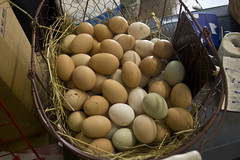
When you see eggs from chickens on a small farm or from a home garden it suddenly becomes very odd that eggs in the grocery store are all white or uniformly brown, and all exactly the same size.  This is most unnatural.  Our hosts in Oakridge provided us with a dozen eggs, most of which were either brown or speckled brown, and one of which was green.  No two eggs were the same size or color.

2/3 of a dozen fresh eggs
(the four missing were used in today's breakfast)
White hens lay white eggs, brown hens lay brown eggs, and green hens... you get the idea, I think.  The point is that the eggs resemble their hens, and a dozen eggs that are all identical speaks to our drive to master nature, make it uniformly productive and predictable.  Several shelves of cartons and flats of eggs from several different 'farms' that are identical speaks volumes, and is a pretty good picture of what industrial agriculture is all about.

Fresh, organic eggs taste quite different as well.  I don't really know how to describe it except to say that they taste 'cleaner.'  The best way to experience this difference in flavor is to poach the eggs, and serve simply with a dash of salt and pepper with (or on top of) buttered toast.  Poaching has the least influence on the flavor of the eggs, and is the easiest way to get perfectly cooked whites with completely soft yolks.  It can be a little stressful if you have never done it before, but the results are well worth it.

Eggs should be poached in just barely boiling water which has been slightly acidified with a bit of plain white vinegar.  The Cooks Book (my kitchen bible) recommends cracking the eggs onto a saucer one at a time and gently sliding them into the water, to minimize the splashing effect.  Then, using a slotted spoon, gently roll the white over the yolk until it is enveloped.  Repeat with the next egg, up to about 4 at a time.  Cook them for 2 minutes or so, and then plunge them into a simmering pan of salted water to remove the vinegar and season a little.  Set on a dish towel to drain for a few seconds and serve immediately.  With fresh eggs, very little seasoning is required, and Hollandaise sauce is kind of overkill (though delicious overkill...).

Unfortunately, fresh organic eggs are pretty expensive, so we are very lucky to have friends producing their own.  Still, for a special occasion, perhaps to impress your significant other on valentines day, fresh eggs are a relatively inexpensive and effective splurge.  You can find them at most Farmer's Markets.
beautiful basket of chicken eggsImage by woodleywonderworks via Flickr
Enhanced by Zemanta

Wednesday, May 19, 2010

Alternatives to Beef as Barbecue Season Approaches

Up here in the Pacific North West, when the sun shines you notice.  You don't just notice in fact, you suddenly feel like wearing shorts and firing up the grill, even if it is still in the mid 50s outside.  So as BBQ season fast approaches, I thought I would try to inspire my handful of readers with a few grilling ideas which do not involve beef or pork.

Now don't get me wrong, I love hamburgers and ribs.  I just feel that it is important to limit how much livestock I eat.  As good as beef is, feed lot beef is wasteful in a number of ways.  But at the same time, I don't want anyone to feel that their barbecue is in any way compromised by the lack of beef.  So here are some ideas for successful grilling in a slightly greener fashion.


Vegetables seem to be an afterthought for many 'Qers, but certain veggies for certain people make the meal.  Courtney's favorite (and one of mine too) is corn, grilled on the cob and in the husk.  It is really easy to do, very low maintenance, and delicious.  You literally just throw it on, husk and all, and when the outer layer of the husk is just about burned through, the corn should be done.  Other vegetables that can be grilled whole are any kind of peppers (they cook quickly, so keep an eye on them), asparagus (always place them perpendicular to grill), and long string beans (choose big, thick beans for best results).  Coating any of these veggies lightly in oil will help them keep their moisture, but is not necessary.

Any kind of zucchini or summer squash is great on the grill too, but should be cut into long, thick slabs first.  Eggplant gets the same treatment.  Since you are cutting into these vegetables, you should coat them well with oil to keep them from drying out too much on the grill.  For the same reason, cook them quickly on the hottest part of the grill for best results.  Onions, garlic, or anything similar are great grilled, and after grilling can be used to make sauces and salsas smokier.

Last word on vegetables: you can cook almost anything else in a tinfoil pouch.  This is particularly good for root vegetables like sweet potatoes, carrots, beets, etc.  Cut larger vegetables into rough cubes so they will cook a little faster, and rub the inside of the tinfoil pouch with oil to seal in the moisture.  This is really more like steaming or baking than it is grilling, but since the coals are already hot/ the propane is already burning, why not throw it on.  My brother Nathan, who is possibly the best chef who never got paid to cook, does sweet potatoes whole wrapped in tinfoil  You can tell when they are done by inserting a toothpick right through the foil on the grill.  If it goes all the way through easily, they are ready.  And remember, when you are done that tinfoil is recyclable, no matter how dirty it got during its use.

Yeah, but where's the beef?  I have a little secret that I want to let you in on: ground beef tastes like nothing.  Don't believe me, do you?  Try a little experiment.  Cook a hamburger with no seasoning, no sauce, no oil, just beef and grill.  Eat it like a steak, no bun, no condiments.  The result: blander than tofu.  My first experience with a garden burger was a real eye opener: if the bun and the condiments are the same, the garden burger tastes just about as good as the real deal.

I draw the line at tofu hot dogs, though.  Partially because they really are less flavorful than their meaty counterpart (hot dogs are made with tons of salt and delicious but deadly nitrates), but also because it is a pretty sorry end for some tofu.  I think tofu should be treated like tofu, marinated in an Asian or Hawaiian sauce, and grilled in big square slabs.  Tofu has its own great tradition, and by trying to make it something it is not we just further convince carnivores that it is bland and boring.


Grilled Tofu w/ Homemade Spicy Teriyaki sauce
To get those perfect grill marks, turn 30 degrees halfway through cooking each side

So to sum up the meat replacements, it is all about the sauce.  I recently posted my Cross Country BBQ Sauce on Foodista, and I think it is just about the perfect sauce for anything grilled.  It also happens to be quick and easy to prepare, and very versatile.  Simply adjusting the proportions can make it more sweet, spicy, tangy or salty.

And finally, if you absolutely must have meat, try cooking chicken instead of the bigger polluters: beef and pork.  Tomorrow I will post a recipe for cooking a whole bird on the Q.

Cross Country Bbq Sauce on FoodistaCross Country Bbq Sauce

Friday, April 30, 2010

The three Rs of environmentalism - Reduce, Reuse, Recycle

The Waste Hierarchy is an established model for thinking about how to reduce waste, and divert it from incinerators and landfills.  Most people have heard the simplest version of this over and over again: Reduce, Reuse, Recycle.  This has become a mantra of the green movement.  It is very effective as a mnemonic device and people have widely accepted it as a rule of thumb.  Something that is lost in the repetition of the mantra, however, is that this is a hierarchy.  It is meant to be read: reduce, reuse, recycle, in that order.  It seems that in the mind of the average consumer this has too often been reduced to recycle, recycle, recycle, because that is the easiest thing to do to reduce the amount of stuff in your trash bin.

Why is this important?  Because different strategies have varying degrees of impact.  Recycling something does keep it out of the landfill, but most recycling processes use energy.  Often not as much energy as the initial process of creating it from raw materials, but still a non-negligible amount.  At the very least, that material has to be transported to some distant place to be reused.  So what if that piece of recyclable waste didn't exist?  Or what it if was smaller, or lighter?  What if instead of three layers of packaging made from three different materials, there was one layer of one type of material?  Less packaging usually means less raw materials consumed, less energy used, less waste in the production process, and less waste at home when you use the product.  The overall impact is much greater, and it exists in every level of the life of the product.

The difficulty here is that it is harder to control the reduction of materials.  Often, it just comes to you 'as is' at the point of purchase.  But there are a few simple things you can do.  If you buy vegetables at the Farmer's Market, and bring your own bag, you can get a weeks worth of food with hardly any packaging materials at all.  Some items like mushrooms will often come in a paper bag to control humidity, but that bag is going to be recyclable or compostable (there appears to be ambiguity about whether or not 'compostable' is a real word, but it is very useful, so I am sticking with it).

This is preferable to getting a separate plastic bag for each vegetable and then putting all those bags into other plastic bags, and getting some items in Styrofoam trays wrapped in cellophane.  Not that I am judging, that is what I end up doing when I go to a regular grocery.  You don't know where that cart has been (or more accurately what has been inside it).  Also, for some reason, I am embarrassed to bring my own bag into Ralph's (I still do, it's just harder), but it seems natural as breathing at the FM or Trader Joe's.  Why is that?  I guess it is because I am afraid of being labeled a loony by the 'normal' people at the super market, but I feel like I might be the most conservative person at the TJ's, and there the bags are proof that I am hip enough.

To get a little broader perspective of the hierarchy, here is a graphic produced by Lane County as part of their Recycler's Handbook, with the relative importance of each strategy represented by it place and the size of its level on the pyramid (used without permission, but I think this is 'fair use'):

If that is hard to read, you should be able to click on it and see a larger version.  There are also many other versions of this hierarchy with different or additional steps, and there is a lively debate about which one is best, but generally everyone agrees that reduction is most important, reuse is next, recycling is a decent alternative, and waste should be avoided.

All of these issues are in fact more complicated, and I intend to go further into each of them.  I will post something later with more detail about how to reduce and reuse materials, but for now I will provide you with a few links about how to recycle, because that topic is pretty well covered by people who have been generating these resources for longer than I have been thinking about them.

For a good overview of what can and cannot be recycled, check out the Consumer Recycling Guide.  It covers the basics about which plastics are recyclable (because not all are) and where you can recycle them (because your municipality may not take certain kinds).  The link above is a guideline however, and each city and county chooses what they will recycle and how they will accept or collect it.  In Lane, for example, there is the Recycler's Handbook.  Search for your local waste management website, and they will tell you everything that you need to know about recycling in your area.

If you want to know where you can drop off batteries for recycling, check out Call2Recycle (serves the US and Canada).  Batteries of all sizes frequently contain heavy metals like lead, sometimes contain mercury, acid, or some other toxic substance, and that stuff can get out if you just toss your batteries in the trash.  Different types of batteries need to be recycled in different ways, but generally speaking big chains that specialize in electronics will take most batteries, and any place that sells car batteries is required to take used car batteries.

Many cities and counties cannot accept used electronics and computers.   Luckily, there are many programs, some local and some national, that accept these products.  The EPA has a web page with links to many of these organizations.  Here in Oregon, the DEQ is working with manufacturers to bring us the Oregon E-Cycles program.  It is very important to recycle these items, because many of them have small amounts of toxins which will end up in the environment if they are just thrown out.  Mercury is particularly nasty, because it can stay in the ecosystem for a long time, poisoning plants, animals and humans all the way up the food chain, and cycled back through the same chain over and over before it achieves anything like safe deposition.

Speaking of mercury, all fluorescent light bulbs contain a little.  Home Depot recycles the CFLs that are being promoted for home use to replace incandescent bulbs, and most local recycling programs accept all other types of fluorescent lights.
Enhanced by Zemanta

Monday, April 5, 2010

I am presenting at HOPES 16: Panel on Brownfield Remediation

For any readers who happen to be in the vicinity, The HOPES Conference is this weekend at the University of Oregon.  HOPES (or Holistic Options for Planet Earth Sustainability) is a creation of the Ecological Design Center, part of the school of Architecture and Allied Arts.  This year will be the 16th HOPES conference, and the topic is "Designing in the post-industrial era."

I will be part of a panel discussing Brownfield Remediation, the process of cleaning up a site which has been contaminated as a result of its previous use.  These sites range from former gas stations which have leeched hydrocarbons or MTBE into the soil to an office building contaminated with asbestos, and many other kinds of sites besides.  The strategy of cleaning up the contamination varies greatly based on the type of contaminant.  Most of these sites cannot be used as they are for any purpose before being cleaned up, and are currently sitting unused.  They may be empty lots or abandoned buildings, but usually they are dark, unmonitored, and tend to attract crime.  Almost every big city in America has several such sites, and they tend to be a blight on their neighborhoods.  Typically they are more concentrated in working and middle class neighborhoods, especially those that were centers of industry in years bygone.

There is a movement called New Urbanism which holds that well designed cities are in fact much more sustainable than any other way of organizing habitations (such as suburbs).  Although it is not explicitly one of their principles, brownfield remediation is essential in efforts to make cities more sustainable, livable, walkable, healthy and happy places that can be the centers of a new sustainable society.  And while it has been expensive in the past, currently government grants and insurance products that mitigate risk are making this process more economically attractive to developers.

I am excited to attend the event, not just to participate in the panel but also to see the other presentations.  I hope to give lots of updates real time, and I have set up the ability to update my blog from my iPhone so that I can quickly post any interesting material that I consume there.  For anyone who may attend, my panel will be at 1:30 on Saturday.  Details for registration are on their website.

Monday, February 1, 2010

Feed lot Beef that is Good For the Environment?

I don't believe it.  I didn't believe it.  I'm still a little suspect, but it seems to be true.

Courtney and I took a trip to Long's Meat Market this weekend to pick up our weekly chicken (likely the only meat we will eat this week), and on the way there we saw a horse drawn carriage, driven by two men in complete western regalia with requisite handlebar mustachios, loaded with several cases of Ninkasi beer.  I felt a little like I was living in some weird holiday beer commercial for a moment, but it passed.  When we arrived at Long's, we were surprised by a long line outside.  At first I thought they were really busy, but soon it became obvious that the line was not to get in, it was leading to a pop up tent where some men were grilling hamburgers and handing out samples of beer.  All for free.  Needless to say, we got in line.

As we learned eventually, the event was a launch for a new beef company called Oregon Natural Meat.  They claimed that their product is more environmentally friendly, because they upcycle grain to feed their cattle.  I was highly skeptical, but willing to eat the free food all the same.  Shortly before we got to the front of the line, the beer commercial caught up with us.  Turns out those cases of Ninkasi we had seen on the way were headed for us.  The horse drawn cart pulled into the parking lot, and the cases of beer headed for the sample stand.


I stated in a previous post that Concentrated Feed Lots are really damaging to the environment, and that grass finished beef was significantly more eco-friendly, but sure enough, as soon as you make a rule there is an exception.  ONM fattens their cattle on grain before slaughter, but they do it very differently.  First of all, they are a small company which only distributes locally, so there isn't the pollution issue of concentrated feed lots.  Because they are small and family owned, there is more oversight in the process, and the health of the animals is observed rather than assumed.  They are fed a grain diet for richer meat, but unlike the concentrated feed lots the diet is 100% vegetarian, with no antibiotics or growth hormones, no animal byproducts, and (the most disgusting CFL practice, in my opinion) no manure.

A substantial portion of the feed comes in the form of malted barley that has been used to brew beer, a byproduct of the brewing industry (in fact it comes from Ninkasi, hence the horse connection).  So the primary ingredient in their diet is something that would be waste, isn't fit for human consumption, but is good for them.  They explained this whole concept with a very informative seeming info graphic which actually was just pretty and not really very informative:


Aside from 'upcycling' the used grain, ONM seems to do everything else right as well.  They are devoted to sourcing all of their cattle and suppliers locally, and only distribute locally as well.  They handle the cattle as humanely as possible, and don't engage in the breakneck speed processing that most large meat packers do (the pace of conventional meat packers reduces quality control and increases the rate of human injuries).  The result is beef that is good enough for the finest steak house, produced in an ecological and healthy manner.

Eye fillet of grass-fed beef.Image via Wikipedia
While grass fed and grass finished beef is still the simple rule for determining environmental impact, it is clear that there are some grain fed cattle that also score excellently on the ecological report card.  This is
really great, because while grass fed beef is delicious, it is leaner and a little more gamey.  If you know this going in, it is a perfectly wonderful taste, but many restaurants shy away because their customers expect the flavor and texture of grain fed beef.  A company like Oregon Natural Meat is a perfect solution, because they produce a product that is superior to conventional beef in every way and is much closer to being sustainable.
Enhanced by Zemanta

Friday, November 20, 2009

Homegrown Electric Vehicles

So, yesterday I went to a little social event for greenies at Davis' Restaurant in downtown Eugene (I would have put a link to their website, but they have not one). It was hosted by Helios Resource Network, and co-hosted by Arcimoto, and the CEO (who I kind of hate for being successful at 23) gave a brief speech about their company.

Arcimoto is a start up producing electric vehicles, and they are doing it a little bit differently. They are working with technology that has been around for long enough to be cost effective to produce an affordable car, one that you can plug in to a conventional wall socket for all of its juice needs (they claim it charges fully in 6 hours), and they are making it look pretty spiffy too. While most electric cars have specially designed engines and crazy battery technology in order to move the weight of a full sized vehicle, Arcimoto is solving the problem by making a much smaller car!

This is a really simple, elegant and in hindsight obvious solution to the problem of engineering an electric vehicle. They went with a three wheel chassis (the car registers as a motorcycle, technically), and made a body just big enough to fit two comfortably. The result is a much lighter car that can be moved by a much smaller motor, and powered with a much more simple battery.

Now for the next part, which is possibly even cooler: they plan to manufacture and sell the cars locally. You may wonder (as I often have) why there aren't already electric cars everywhere, if it's so easy to make them. The answer is really stupid: big car companies can't figure out how to make a profit off of them. Currently most of the money in the car business is in service, and electric cars don't need any much service at all (a DC motor may need the brushes replaced once every seven years, and other than that it is good to go). Conventional autos need tons of service, so the car companies are willing to deal with marginal profits on the vehicles with a guarantee of years of necessary repairs (this is a gross over simplification, but it captures the basic idea).

So the Arcimoto solution: side step the existing auto industry entirely. Figure out the local market, set the price point for a decent profit, and let the consumer drive maintenance free for 7 years. Ford and the others are so locked into their current (lack of) profit models that they can't imagine doing anything like this (which is why they love hybrids so much: call it green without actually changing much).

The Arcimoto Pulse is not exactly perfect, a brushless motor would be better and the lead acid battery has its own ecological issues, but it is leaps and bounds ahead of an internal combustion vehicle in the sustainability department. Especially when the whole local production thing is taken into account. So I give the Pulse a huge thumbs up. If every city a company like this, generating electric cars locally, we would see a lot of innovation, a much more interesting market, and better air quality. Now if we could just stop getting our electricity from burning coal...

Tuesday, October 6, 2009

The Sweet Life

So on top of getting the tour for free ($5) and getting some free slices from La Perla (~$10), I also got a gift card to Sweet Life Patisserie, value $10, for volunteering at EWEB last weekend. At first I thought this gift was a Trojan Horse, a nice idea but full of sad Courtney later (pastries and wheat allergies usually do not mix), but it turns out that Sweet Life has several gluten free options!

Now, gluten free is not their specialty, but like many shops in this area, they are definitely hip to it. So, I just wanted to write a quick post about them, and include a photo of what $10 bucks can get you when you only stick to the GF stuff.

Flourless torte, GF brownie, truffle, and "Venus Nipple"

I haven't told Courtney yet that I bought all this today, so she should be very pleased when she gets home.

Monday, October 5, 2009

EWEB green and solar homes tour

Yesterday I had the pleasure of helping out at EWEB for their Solar and Green Building Tour (part of the Solar Oregon program. I asked to help out early, so that I could take one of the tours and see some of the green homes Eugene was highlighting.

The first stop (for my group) was the Inkwell Building in Cresent Village, which won LEED Gold certification for the Core and Shell and LEED Platinum for the interior of their office. They followed LEED pretty much to the letter, and the result was a comfortable, beautiful office space. The rest of the tour consisted of three homes, each with completely different approaches to being green.

It was a really fun day, and I especially enjoyed talking with the builders and architects about what strategies they implemented to go green, and why they chose those over other possibilities. It was interesting to learn that many of my favorite methods for energy efficiency in Southern California were not always easy or effective to implement here.

For example, solar thermal water heaters are a snap in SoCal, but you have to purchase really high tech expensive ones in climates that drop below freezing for long periods in the winter. While one house chose to go with this option, the In-Law unit designed by Rainbow Valley did a cost analysis which showed that for their project it would take forever to pay off the initial expense (largely because it was a home for one person who only lived there part of the year). They chose a tankless water heater which was very efficient at providing the small amount of hot water needed.

In speaking with Alec from Rainbow Valley Design, he was lamenting how difficult it is to find valuable information about many of the "green" products available for builders. For example, he told me about a door they sourced which touted that it used locally harvested, sustainable wood. After he bought it, he found out that they did use local wood, but shipped that wood to China to be cut and assembled with cheap labor and then shipped it back. Well the point of local is that you aren't burning oil to ship it across the globe!

I told Alec about another builder on the tour who informed me that the hardwood floors in his house were green something or other certified, I had never heard of the certification he mentioned. I asked what that meant, he said "it's supposed to be better." I asked if it was FSC certified, he replied that he had no idea. So what's green about new maple if it isn't FSC certified?

My favorite home aesthetically speaking was the Sage House, by Arbor South Architecture. It was LEED Platinum, the highest rating offered by the US Green Building Council. The floors and some of the exterior features were done in beautiful re-purposed wood, and the structural beams were a glue lam product that I had not heard of before, which uses the chips and scraps from milling. They also used it as an interior design element to wonderful affect. The exterior features were redwood that was salvaged from the seats of an old theater through BRING Recycling, a fantastic local non-profit.

The In-Law I mentioned above, however, was great because of its extremely efficient use of a tiny square footage. Smaller homes are inherently green because they use less materials, cost less to heat and cool, and generate less waste. This place was 585 square feet, and it felt like at least 800. That is just good design.

The presence of a disabled man on the tour highlighted the issue of accessibility, which is usually not thought of as being a green issue. People get old. Sorry, everyone, that was a downer I know, but it is unavoidably true. People get old, they get injured, they slow down, sometimes they have children who are born with different abilities. Any honest assessment of the life cycle of a building should take this into account, plan for accessibility and easy mobility with a cane, a wheelchair, and even potential space for a care taker. It's not just about the current client, either, it is about resale and future owners.

The best house in terms of accessibility was definitely the "Earth Advantage House" built by David E. Smith. With wide hallways to accommodate wheel chairs and a roll in shower (no curb, just extra tiled floor for a wheelchair or walker to roll right in) in one bathroom, this house was certainly suited to the needs of any potential residents.

The tour finished up at La Perla, a new Pizzeria in town (of the fancy pizza variety) with really excellent, traditional wood oven cooked pizza. Their food was pretty fantastic, and I tortured Courtney by eating several slices in her presence (they had some wheat free food too, so she wasn't starving).

Thinking about the differences in local climate here and in SoCal and how they affect construction choices reminded me of some studies I had done for a sustainability class at UCLA that focused on Los Angeles City's practices, and looking back over them, I think maybe they deserve to see the light of day. So I think I may brush them off, fix them up, and publish them with google docs. If I follow through, I will link to it later.

That's it for now, bravo EWEB, and thanks to everyone who opened their homes and offices for us to see.

Saturday, October 3, 2009

Why wait for a holiday?

Today, at the local farmer's market, I went a little over board. Now that I am home, I ask myself, do I really need two different kinds of wild mushrooms? That one wasn't entirely my fault, there was a mushroom pusher there, and she got me hooked with a free sample of Lion's Mane (the fuzzy behemoth pictured below). And when you say no to a pusher they can get violent. Some of you will probably say that yes, everyone needs as many wild mushrooms as they can get their hands on, but I am a recent convert to fancy mushroom eating so lay off.

A sample of today's take from the Lane County FM

My most frivolous purchase of the day, I think, was a tiny baby sweet bay tree at $12.50 (an expensive item by farmer's market standards). It was a total impulse buy, but I have a feeling I am going to be very happy with it, and possibly quite soon. I wasn't sure when I bought it, but it turns out that you can use bay leaves fresh as well as dried, and unlike most other herbs, it has more flavor fresh. A quick google search also revealed that bay was named herb of the year by the International Herb Association (it also revealed that there exists an International Herb Association, who knew?). So, even though national plant a tree day is still a ways off (I have no idea when it is actually, does that make me a bad environmentalist?) I am going to plant a bay tree in my back yard.

The Bay Tree is the tall fellow on the right

After running completely out of cash, I decided it was time to come home. On the way back, unfortunately, I realized that I had accidentally parked next to a wine shop that specializes in local organic wine, and my walk to the car took an unexpected 90 degree turn to the left. I inexplicably found myself inside the wine shop, and somehow accidentally purchased the bottle of Oregon made Chardonnay in the picture above. If this bottle turns out to be good, I will probably accidentally park in front of the same wine shop every week for the rest of the farmer's market season (after that, I will have to admit it's on purpose).

The rest of my take was pretty normal: corn, squash, tomatoes, sweet peppers, hot peppers, and (I can feel my beard growing faster as I write this) an organic cotton bag to carry it all home in. I am thinking of turning the tomatoes into sauce, and testing the theory that fresh bay has more flavor...

In whatever form, this produce (along with some beans and wheat free pasta that we already have handy) will make something like 10 vegetarian meals for Courtney and I (that is, 20 meals total). The price tag was $53, including the wine and the cotton bag (which was 8.00 dollars! Come on, I know its organic cotton, but really?), which means that each farmer's market meal we make with this stuff will have cost us roughly $2.65 plus the cost of beans. That is a pretty darn good deal, especially considering that I splurged a lot on this trip.

Food grown by traditional means to be sold locally is usually quite cheap (the wild mushrooms were spendy, but they taste so good), and heirloom vegetables frequently taste much better because they were selected for flavor over hundreds of generations (conventional farming favors breeds that transport well over flavor-licious heritages). On top of that, much less energy goes into the production.

Take the case of the tomato, do you know how to grow a tomato? Well, conventionally, you start by purchasing genetically modified tomato seeds with the terminator gene, right? Of course. Next, you till the soil and add synthetic fertilizer (a petroleum byproduct) and spray highly toxic herbicides that kill everything except crops genetically modified to survive, right? Obviously. Plant the seeds. Water. Spray regularly with highly toxic pesticides that kill everything except crops genetically modified to survive. Finally, harvest the tomato, wrap in plastic, and put it on a truck bound for Mexico. Soon, a different tomato will arrive on a different truck from Mexico, and you purchase it at a local grocery store (supporting local is good, right?). Drive the tomato home, cut it up and top with olive oil, fresh basil, salt and pepper. Serve on a slice of buffalo mozzarella. That's how you make petroleum caprese.

Alternatively, the dirty fruity hippie way: plant the seeds from an organic tomato (which doesn't have the terminator gene) in your back yard, fertilize with compost (made from stuff that would otherwise be trash), water, weed with your hands, and finally harvest. Carry (not drive) the tomato into the kitchen and follow the directions above to make zero energy caprese, so called because you used literally no energy to grow the tomatoes. The slightly less dirty, less fruity hippie way? Buy a tomato grown using similar methods at the farmer's market. No work, no fuss, no Mexico.

If the pasta sauce comes out good (assuming I actually make it), I will add the recipe tomorrow, and I will also keep you updated about the Oregon wine. Apparently, Authentica (that wine shop) specializes in Oregon Pinot Noir, which I never knew was a thing until just today. Finally, I just looked up plant a tree day, by the way, and it turns out that it is called Arbor Day, and the date differs from state to state and country to country, based on the best time to plant trees in a given climate. The nationally recognized Arbor Day is the last Friday in April. Cue music, "The more you know..."

Friday, October 2, 2009

Oregon Trail Part VI: Sweet Home

The final day of our trek up the coast, we wake up in another extremely cute little motel in Klamath, CA, the Ravenwood. We departed from this location after being advised by some locals to stop for lunch in Grant's Pass, OR. The advice came with a warning that in Oregon they love their one way streets, trying to be more European, probably. There was a just a hint of nose turning toward those uppety Oregoneans by the locals here in Northern NorCal. I refrained from asking if they had ever been to San Francisco.

The 199 forked off from the 101 shortly after Klamath, to cut across country and bring us back around to the 5. I don't know if it was just the fresh perspective of a new day, but it seemed to me that the Redwoods along the 199 were even more beautiful than those along the 101.

Within an hour of driving, we crossed the state line in a thoroughly underpopulated patch of forest halfway between the 5 and the 101. Despite there being no obvious change in the landscape, the road signs made it perfectly clear that we were not in Kansas anymore. You can't always put your finger on it, but a subtle difference in the wording of comands gives you the sense that you have entered a different place, like we had driven across the border into Canada.

At the advice of the Klamath locals, we dutifully turned off the freeway at Grant's Pass to get lunch. Unable to make a decision in such a big town, we pulled into the largest and most obvious restaurant near the freeway, and this is what we found:

The Taprock restaurant, right on the Rogue River (unrelated, as I was sad to discover later, to the Rogue Brewery, which is on the coast in Newport, OR). As lunches go, it was 'spendy,' as the locals say, but worth the money. Actually, the view and the ambiance was worth the money, the food was just the icing. After the meal, we walked around the little manicured footpath which serves as a line for the riverboat tours that launch from the restaurant's little dock.

The rest of our trip was a short journey through Normal Rockwell's America, a perfect pastoral landscape book-ended on either side with a perfect pastoral landscape. We were tired and anxious to get home, but we drove a little slow anyway to take in the view.

Driving through the country brings some dormant patriotic feelings out in city dwellers like us. Being close to working farms reminds us of our roots, where this country came from. I have never lived on a farm. I have never worked on a farm. I have never even attempted to garden before moving up here (we are just getting started now, stockpiling compost for next spring and a few hearty winter crops). But the idea of the self sustaining farmer is so deeply embedded in the American subconscious that it is impossible not to feel a kinship, at least with the idea.

Since arriving at our new home, we have been making an effort to buy local, organic food as much as possible. I used to think that organic was just some fruity hippie thing, but the more I look into it, the more I realize that at the least, conventional farming is not sustainable. It kind of boggles the mind that in farming, conventional means planting genetically modified seeds with the terminator gene, spraying them with massive amounts of pesticides and herbicides that they are specifically bred to withstand, and shipping the product all over the world while importing tons of produce along parallel routes. Growing vegetable with natural fertilizer, weeding instead of using herbicide, and selling them locally is what we call the 'fruity hippie' way of farming.

We have also started buying 'grass finished' meat, which is more expensive, but we eat less meat than most anyway. Grass fed and grass finished means that the animal never spent any time in a concentrated feed lot, which seems to be the source of most current food safety concerns (all of those recent vegetable scares can be traced back to original contamination from feed lot waste). Also, it might just be psychological, but I think grass fed beef tastes much, much better than feed lot beef.

It is a little leaner, and I know it has a much higher concentration of omega 3 fatty acids, and it doesn't have that smell that beef from the supermarket usually has. I hate that smell. I got a cut of NY from one of the many local butchers (Springfield is a hunting town, and most hunters don't want to do the labor of butchering their catch) Longs, and grilled it up the way I usually grill a steak: rubbed with pepper and paprika, 4 minutes per side on an extremely hot grill (turning 30-45 degrees halfway through each side to get that crisscross look). It was one of the best steaks I have ever cooked. In my opinion, this is the only way to cook steak, other cuts you can cook however you like, but steak must be seared on a grill. (Note: if you use red pepper, it will turn into pepper spray on the hot grill. I always do this, and end up coughing and hacking through the rest of the meal prep)

This Saturday, we are looking forward to the Lane County Farmer's Market, where we can continue our support of local farmers. There is really no downside to fresh, traditionally grown vegetables and pasture grazed meat from local farmers: it tastes better, it's healthier, and it supports the community you live in. Win, win and win.

Saturday, September 5, 2009

The Oregon Trail: Part I

So what's green about driving two cars, packed to the roof with random stuff, one with two bikes strapped to the trunk, from Los Angeles to Eugene OR? Nothing! But sometimes you get stuck.

As much as I would like to pretend that I live a perfectly sustainable life, the reality is that we were not about to abandon our cars. We tried to sell my wife's Honda Prelude, but in Los Angeles the car you drive is a statement about your self worth, and no one wants an old car with some body damage (even though the engine has another 100k in it).

So, upshot: we took a 5 days to drive up the California coast, through the redwoods, and through southern Oregon, and it was a beautiful experience. Watching the climate change from the chaparral of southern California to the forests of the pacific north west was a unique experience, and the vistas along the coast were unbelievable.


The long hours of driving also gave me a lot time to meditate on some things that have been kicking around in my head recently, and I have decided to try and distill them into a few blog posts, one for each day, loosely paralleling our journey up the coast. Also, it will be the first five posts of a new plan: post at least one entry to the blog every day for the rest of September.

I realize that this is a new blog, and most new blogs fail very quickly, so now that most of my excuses are in the past (the move, a weird schedule, etc), I am going do dive into the deep end and get this ball rolling. If those metaphors mix.

So, a post a day, every day this month, starting with a new post today: The Oregon Trail Part II.