Moving is never easy, but when you choose to move into a smaller space it is nearly impossible. Courtney and I, in an effort to put our money where our mouths have been, have opted to move into a home that is half the square footage of our last place, in a neighborhood that is vastly more pedestrian friendly. Let me repeat that: HALF the square feet. We now share, with our two dogs and two cats, a 550sq.ft. two bedroom home just west of Amazon Park, which has a Walk Score of 91.
You may think that we are crazy to willingly, and not for monetary reasons, choose to live in a much smaller space (and some days recently I would be inclined to agree with you). But the fact is that most of us, by far, have much more space than we need. As you may remember from my Dream of Less, we have been thinking about fitting our lives into less space for some time. The goal is to find out how much space we really need instead of constantly trying to "upgrade" to a space which is bigger than the last. This time, we upgraded to a home that is better and smaller, so we are really getting a lot more for our money. Why would we endeavor to do this you ask? Aside from forcing us to pare down, keep less junk, live more simply, etc. there is a primary environmental motivation: smaller spaces consume less energy, by far, than larger ones. The Oregon Department of Environmental Quality (or DEQ for short) recently published the results of a long study on housing types, and living small was on the top of their list of ways to reduce your carbon footprint. To take a look at the whole report, click here. A few other quick take-aways from the report: carpet has the highest embodied energy of any building material and sharing walls, whether in a duplex, townhouse, or apartment, drastically reduces your carbon footprint.
As you can imagine, the process of paring down to fit in a space half the size has been pretty intense. It began weeks before the move, as we went room by room through the house, measuring furniture and emptying storage spaces to sort what we would keep and what we could fit. About a hundred Craigslist posts and one garage sale later, we thought we had done a pretty good job. As we began to bring our stuff into the new place (with much needed help from Courtney's parents, who came down to Eugene just to give us a hand), it quickly became clear that we had not done nearly enough.
We are now about 80% done getting rid of stuff and fitting in the new space, and as soon as it is presentable (currently there is at least one half empty box per room, except the bedroom which is actually coming along quite nicely), I will post some pics with explanations of what we did to fit our oversized lives into this undersized space.
That may sound like a lot of unnecessary stress to you, but there are two things that have made it not only bearable, but actually quite rewarding: one is the sense of elation and freedom that comes from getting rid of something after deciding that it is not adding any value to your life. On the day we had our garage sale, some kids who came by regularly to request the presence of our dogs in the common area came to pick over our wares. Courtney made a decision in that moment about a box of toys that she had been carrying since her childhood. They served no purpose in our life right now, but she couldn't bare to just drop them at Goodwill. She brought out the box and one by one gave her teddy bears and trinkets to the kids as a kind of reward for exercising our puppies so many times. Everyone involved was quite pleased with the outcome.
Second, the ability to walk to everything has been a constant source of joy. We now live across the street from a butcher shop that carries only meat from local, sustainable farms (as well as some provisions like artisan cheese, olive oil, beer and wine, both local and from afar). We are literally next door to a fantastic cafe and deli, which serves delicacies rarely seen on the west coast like knish and bialies. On our block there is a sushi restaruant, a hardware store, a high end kitchen store and, should we ever feel the urge, a knitting store. Just around the corner is a very well reviewed veterinary office, a bicycle supply and repair shop, and a few more boutique shops. Within a 10 minute walk is a dog park, a Market of Choice (like Whole Foods with Ralph's prices, for those not from Oregon), a liquor store, and more restaurants than we could eat at in one week, ranging from McDonalds (which are not likely to frequent) to Rabbit (which we wish we could afford to frequent more frequently).
Living where we do, on the edge of a residential/ commercial zone change, being able to walk to everything, makes both of us immensely happy. We have moved from having to get in the car, for some reason, almost every day, to going for four or five days in a row without starting the car once. I have been promoting small living and car free living for some time; I have been dreaming of having less space and using less energy. Now I really feel that we are beginning to live the dream.
Showing posts with label home. Show all posts
Showing posts with label home. Show all posts
Friday, May 20, 2011


Wednesday, March 2, 2011
GreenSwitch: The Vampire Power Slayer
 Image via Wikipedia
Essentially, GreenSwitch is a home automation product, which allows the home owner to control what appliances are getting power and when. GreenSwitch differs greatly from other home automation systems in its extreme simplicity, however. Instead of a complicated remote control or internet based control interface, there is a single physical switch that you flip when leaving the house or going to bed that cuts power to all vampire electronics.
The switch uses a wifi signal to control specialized outlets in your house, cutting power to anything plugged in at that point. You can get a remote control as well as the master switch for more precise control, if you are a tech geek like me, but even the most devout Luddite will be comfortable with the master switch option.
The specialized outlets and switch have a tiny, minuscule standby power draw, which is an order of magnitude smaller than most TVs, Computers, DVD players, VCRs, etc. When you have several of these appliances plugged into the same outlet, the energy savings really pile up fast. This means, however, that not every outlet in your house should be replaced, just those with a heavy standby power load.
One customer who installed GreenSwitch and got a hot tub in the same month said their energy bill went down significantly afterward. Considering the huge energy load that a hot tubs heating element can generate, that is quite an endorsement for the GreenSwitch system.
But GreenSwitch is not just for the home. It is also an ideal solution for small businesses with high power bills. Most business energy solutions are for large scale operations, but businesses in mid sized offices are frequently playing very close to the margins financially, and saving up to 30% on your energy bills can have a huge impact on positive cash flow. Particularly in offices with scores of computers and printers, vampire power can be a huge drain.
Basic packages start at $415 for home kits, which includes a simple thermostat control as well. That may seem like a pretty steep buy in, but with energy savings from 20-35% (by their reporting), installing GreenSwitch could pay for itself in a matter of months (depending greatly on where you live).


Wednesday, February 9, 2011
Clean+Green - a Miracle Cleaning Product for Pet Owners
 I don't use the word miracle very often. Truth be told, I didn't really believe in miracles until recently, when I got a package in the mail containing these two aerosol cans of Clean+Green cleaning products [legally, I have to disclose that they sent me free samples to review their product]. Even upon inspecting the cans, I was skeptical, especially since the directions instructed me to spray the mess and then do nothing, no wiping no blotting, nothing. You can imagine, then, why I use the verbiage of a religious experience when I first had an opportunity to use this brilliant product and it worked better than anything else ever. And when I say that it worked, I mean I didn't do a thing, the product literally did all of the work.
The word 'aerosol' in the last paragraph may scare some people, as CFCs which deplete the ozone have been used as aerosol propellants in the past. But please, do not be alarmed, because CFCs are not the only effective propellants. In fact, the folks at Clean+Green use nitrogen as their propellant, which does not deplete the ozone, is not a green house gas, and has no toxicity at all. Nitrogen is already the most abundant element in our atmosphere, and spraying it out of a can has just about exactly zero impact on the environment.
 The most impressive thing about this product, however, is not that it works miracles with pet waste and odors, nor that it comes in recyclable packaging or uses nitrogen as its propellant, no. The most amazing thing is that the cleaning agents are completely non-toxic as well. No chlorine, no ammonia, no alcohol, no oxidants, it is not bleach based or enzymatic in nature, it is not even perfumed (aromatic compounds can irritate some people, especially those with severe allergies). Everything that goes into this cleaner is biodegradable, and completely safe for pets (who have a tendency to lick interesting smells on the floor), kids, and the environment.
So in short, if I was prone to using a star system, this product would get as many as I can give. It handled multiple different kinds of pet stains and odors from my dogs and my cats, leaving no residual smell or stains in carpets or upholstery. We even tried it on an old ink stain on a sofa, and to our utter shock and amazement, it reduced the visibility of the stain significantly (they don't make any claims about ink though, so don't hold me or them to that). Marry that performance with a non-toxic, biodegradable product packaged in recyclable materials, and you have one great, green product that I am happy to promote. In shorter: Clean+Green is one of the best cleaning products I have ever used.

Thursday, September 16, 2010
Nothing New -- Half Way There
Today is the 16th, which means that the month is just about exactly 1/2 way over. There have been one or two challenges, but mostly the wife and I have sailed through the month of nothing new with hardly a hiccup. My thinking has changed in two pretty major ways, however, as a result of making this pledge and thinking about it every day.
The first is that I now walk around my house and look at every object in a new light. What would I do if this thing broke, or if I didn't have it in the first place and decided that I needed it? Where would I go to replace it? Where did I purchase this item in the first place? How difficult was it to find?
Looking around my living room now I think that about 90% of what I see was purchased second hand or inherited. The other 10% was mostly gifted to us by family. I only really see a handful of things that we bought new: the Dyson Ball Vacuum (which our allergies dictate we must own), a steel H2Ozone water canister, and one purchase that I regret immensely: some white curtains from Walmart that are not quite actually opaque enough to disperse the southern sunlight properly. In the past 15 and 3/4 days I have been staring at those curtains thinking "if we had only kept looking in thrift stores, if we hadn't given up, we would have something even better now."
I realize it is pretty indulgent to be kicking myself for the one thing in the room that is not easily justified, but maybe that was the point of this challenge in the first place: to hold myself to a higher standard. And now, whether or I like it or not, I cannot help but feel that I cheated before I even began. That is because of the second shift in my thinking.
I now realize that I had been so well stocked on disposable goods before I even began this challenge that a serious threat to it's success never materialized. This was not by design, I was this well stocked before I even came up with the idea. I have a years supply of razors in my medicine cabinet (which is not hard, a razor lasts me several months since I only shave the edges of my beard). We have practically a pallet of Kleenex from Costco, because we both have dust allergies that require year round daily nose blowing. And now every time I use one of these things, I realize that if I had not already stocked up, and then ran out, I would pretty much be forced to buy something new.
 Image via WikipediaOf course I could start blowing my nose in a washable handkerchief, or purchase a used straight razor (which isn't quite so creepy as it sounds, I could soak it in bleach for a day before using it), but I have to ask myself if
I would actually do these things if push came to running out of razors. And the answer is: I don't know. I would like to think that I would, but perhaps I would be weak.
At the midway point, I am now thinking that one month is really not sufficient for a lasting change or in depth analysis of how I live. There have been one or two interesting dilemmas, but I feel that the most important realization that I have had is that it is easy to feel like I am making a change without actually doing anything of substance, and at the midpoint of this month long challenge I am already thinking of how to extend it, how to modify the rules, how to go further.
For now I am only thinking, and the only action that I am taking is to finish the month by the rules, and continuing to examine how my life would be different if this challenge were permanent.

The first is that I now walk around my house and look at every object in a new light. What would I do if this thing broke, or if I didn't have it in the first place and decided that I needed it? Where would I go to replace it? Where did I purchase this item in the first place? How difficult was it to find?
Looking around my living room now I think that about 90% of what I see was purchased second hand or inherited. The other 10% was mostly gifted to us by family. I only really see a handful of things that we bought new: the Dyson Ball Vacuum (which our allergies dictate we must own), a steel H2Ozone water canister, and one purchase that I regret immensely: some white curtains from Walmart that are not quite actually opaque enough to disperse the southern sunlight properly. In the past 15 and 3/4 days I have been staring at those curtains thinking "if we had only kept looking in thrift stores, if we hadn't given up, we would have something even better now."
I realize it is pretty indulgent to be kicking myself for the one thing in the room that is not easily justified, but maybe that was the point of this challenge in the first place: to hold myself to a higher standard. And now, whether or I like it or not, I cannot help but feel that I cheated before I even began. That is because of the second shift in my thinking.
I now realize that I had been so well stocked on disposable goods before I even began this challenge that a serious threat to it's success never materialized. This was not by design, I was this well stocked before I even came up with the idea. I have a years supply of razors in my medicine cabinet (which is not hard, a razor lasts me several months since I only shave the edges of my beard). We have practically a pallet of Kleenex from Costco, because we both have dust allergies that require year round daily nose blowing. And now every time I use one of these things, I realize that if I had not already stocked up, and then ran out, I would pretty much be forced to buy something new.
 Image via Wikipedia
I would actually do these things if push came to running out of razors. And the answer is: I don't know. I would like to think that I would, but perhaps I would be weak.
At the midway point, I am now thinking that one month is really not sufficient for a lasting change or in depth analysis of how I live. There have been one or two interesting dilemmas, but I feel that the most important realization that I have had is that it is easy to feel like I am making a change without actually doing anything of substance, and at the midpoint of this month long challenge I am already thinking of how to extend it, how to modify the rules, how to go further.
For now I am only thinking, and the only action that I am taking is to finish the month by the rules, and continuing to examine how my life would be different if this challenge were permanent.
Wednesday, September 1, 2010
Second Hand Retail Therapy
Re-Posted from the iPinion Syndicate
This past weekend [first weekend in August] Courtney and I celebrated our 2nd anniversary. We decided, instead of gifts, to indulge ourselves to the highest possible degree at the local thrift stores. We did so not because we are broke (although we are not exactly sizing up multi-million dollar yachts and coastal states with no sales tax yet), but rather because buying things second hand is the best way to buy things, and not just because you get more things per dollar.
Being good, law abiding citizens, we self medicate with that wonderful drug sometimes called ‘retail therapy’ just like all our fellow Americans. But because we are trying to be environmentally conscious, and we have seen “The Story of Stuff” (which you should too; if you haven’t seen it, watch it right now before you finish reading this; it’s free online), we want to buy as much stuff as we can while minimizing the energy, waste and pollution that results from buying lots of stuff. While most solutions for buying low impact stuff involve really expensive techniques for making new stuff, one low budget solution is to buy stuff that simply is not new.
If you have a choice between new and used, and you go for used, you are actively reducing demand for new stuff, which means (added up across many individuals and over time, of course) less raw materials used, less fuel burnt, less water turned into toxic sludge, and less waste.
You may think (especially if you do not frequent thrift stores) that shopping would not be the same without getting a bunch of new stuff, but new stuff is not the best thing about shopping. Consider: how often do you enjoy the item you purchased at home as much as you enjoyed picking it out? Since 99% of new stuff is no longer in use just 6 months after it is purchased, I am guessing the answer is somewhere around 1 percent of the time. It isn’t the stuff that you like, it’s buying it.
We are a nation of consumers, and we love to shop. Men just as much as women: many men may hate shopping for clothes, but ask the average dude about his ideal BBQ, and you will discover that he loves buying certain things just as much as the average female. This is due, at least in part, to the feeling of control that being a consumer provides. When you walk into a store, there are people being paid to serve you, answer your questions, get another one from the back, and tell you ‘that looks great on you.’ They are doing so because they want your money, but that’s okay; its understood that you have chosen to shop there.
You can get dumped on all day at work, get no respect from your family and friends (not describing my own life here, everyone calm down) but when you are ready to pull out the check book, everyone treats you like a king (or queen). Pretty much all those positive emotional experiences are just as good at second hand stores. The amenities may not be quite so classy, the staff not quite so motivated, but you are still in control of your money and how you spend it. Also, just as ‘new stuff’ stores range from Sears to Saks, so second hand ranges from Goodwill to Crossroads. So whatever your needs, retail therapy is available second hand.
When my wife and I want anything, even if we can afford it new, we always look for it used first, and that is just one more method of experiencing that control. We do it because it is our darn money and we will it spend how we darn well see fit. And I would encourage you to consider doing the same (though of course, I would never dream of telling you to).
Tuesday, August 31, 2010
Nothing New -- Courtney and I Vow to Make No New Purchases for One Month
While turning over the Dream Of Less in my head and discussing it with my like minded wife Courtney, we developed a little challenge for ourselves: purchase not one new item for an entire month. At the end of the month, I hope to write the next installment of the dream: To Dream of Less Stuff. Also, if the month goes better than expected, maybe we will extend the challenge for an even greater period of time. For the first installment, however, we will begin on September 1, and attempt to buy nothing new until October 1.
Of course, a challenge like this would be meaningless without some clearly defined terms, some ground rules, and some expectation up front of a reasonable amount of failure. So I describe for you now the plan:
I think that about covers it. I can tell you right now that at some point we will fail, and most likely because of my wife's car, which we are in the process of fixing up to sell. But the failures are an anticipated part of the experiment, and we will not be deterred by a few set backs.
The purpose of this exercise is to actively monitor the amount of stuff we buy, and the amount of waste that we generate, and furthermore attempt to actively reduce those categories. I am very optimistic that we will achieve some success in this endeavor, and I hope against hope that you will find this either a little inspiring or least somewhat entertaining. Either way, I am really doing this for your benefit, so you better read!

Of course, a challenge like this would be meaningless without some clearly defined terms, some ground rules, and some expectation up front of a reasonable amount of failure. So I describe for you now the plan:
- First: food is not counted here, for obvious reasons. What is counted, however, is any kitchen utensil, crockery, flatware, or other durable good associated with the preparation of food.
- Second: semi-durable and disposable goods do count, including napkins, towels, clothing, shoes, kleenex, etc. Also counted are things purchased for us in the process of a service we pay for, such as car maintenance.
- Third: Cleaning products are to be avoided unless absolutely necessary. We will try to use what we have sparingly, and find alternatives (vinegar and baking soda, e.g.) when we run out.
- Fourth: items essential to health care (medicine, bandages) for both ourselves and our pets do not count at all. I will not put myself, my wife, or any of our furry children in harms way for this or any other experiment.
- Fifth: "new" shall be here defined as anything which is not previously owned, not re-purposed or recycled, not refurbished or re-anything-ed in any way.
- 6th: when the need for some stuff arises, we shall follow this rubrick for satisfying the need:
- Try to repair the broken stuff (reuse/repair)
- See if we can make something else work for the same purpose (re-purpose)
- Try to borrow or barter for it
- Try to find it used or refurbished
- Reconsider if we can do without it
- Finally, break down and buy it new
I think that about covers it. I can tell you right now that at some point we will fail, and most likely because of my wife's car, which we are in the process of fixing up to sell. But the failures are an anticipated part of the experiment, and we will not be deterred by a few set backs.
The purpose of this exercise is to actively monitor the amount of stuff we buy, and the amount of waste that we generate, and furthermore attempt to actively reduce those categories. I am very optimistic that we will achieve some success in this endeavor, and I hope against hope that you will find this either a little inspiring or least somewhat entertaining. Either way, I am really doing this for your benefit, so you better read!
Tuesday, August 10, 2010
To Dream of Less Space
My wife is designing a very tiny house on a very tiny lot for her studio project this term, so both of us (because she has to bounce every idea and every design choice off me, sometimes to the point of driving me crazy) are thinking right now about the least amount of space you could possibly fit a family into. I have the unusual benefit of growing up in a house that is, by American suburban standards at least, minuscule. The house in Laguna Beach that my father designed and built is located on a little wedge of land that was divided from a larger lot. Also, the wedge is mostly on a steep hill, with just a little flat area at the street. My parents fit a family of five into that postage stamp space and still had plenty of room leftover to play host to a surprising number of friends and family on special occasions.
When I was younger, perhaps to compensate for having less personal, private space than some of my friends, I would dream of one day living in a mansion. I imagined having a huge living room, dining room and kitchen to entertain. I dreamed of having collectible cars in an over sized garage. I wanted a big bedroom with a walk in closet and big bath room with walk in shower. All of this would be nestled, of course, in enormous and multi-layered private gardens. Basically, I wanted to be Bruce Wayne. But hey, I was 15, what do you expect?
The older I get, though my dreams don't get any smaller, the size of my house in my dreams does. This is due, at least in part, to the location of my dream home. Once nestled in layers of private gardens, perhaps in some coastal town yet undiscovered by the relentless developers of CA, my dream home has packed its bags and moved to the center of a big city. It has lifted itself off the ground, and found its way into the upper floors of a low rise building. As such, it has of necessity folded in upon itself, sacrificed some extra space, doubled up purposes of other spaces, and generally shed a few pounds (even as I gain a few). The gardens have been replaced with public parks, the garage full of fancy cars completely sacrificed, and the over-sized rooms scaled down to average human size (and sometimes even below average).
When you have space, you feel the need to fill it with things. Nature abhors a vacuum, as my father is fond of quoting, and when you have more space than you need, you will fill it. If you did not need the space in the first place, then it stands to reason that you will not in any real sense need the stuff that you find to fill it. So the question that we should ask ourselves is "how much space do I need?" No one seems to ask this question these days. Instead everyone seems to ask "how much space could I use?" And the answer to that question is almost always another question, "how much space can I afford?"
You could use more space. We all could. I could have an exercise room, a home office, a pool, a home theater, a game room. And if I had them, I would use them. Of course, if I lived in a city of any size, it would have a movie theater, a pool hall, a gym. If I lived in a large enough residential building in an urban area, it is likely that my building would have half of these amenities that I covet. So I have to ask, do I need any of these things? Another important question: how much would it cost me to have all that space, to fill it with the associated stuff, and to maintain it? Is the value that I would get out of that extra space equal to how much it would cost me? The answer is almost certainly no.
Space and stuff are directly linked, as well. In every home, a certain percentage of the space is devoted entirely to storage. Linen closets, clothes closets, cabinets, shelves, chests, armoires, and don't forget garages, which are usually equal parts car park and storage for random junk that you can't stand to look at inside of your living spaces. If you have less space, it follows that you will need to have less stuff. There are few feelings more liberating than getting rid of stuff that (after considering it) you realize you just do not need.
And so I have been dreaming, instead of more space, of having just enough. Just enough to be happy, to feel content and uncluttered, to have some privacy and full utility, but just that much and no more. I dream of having that space in a context, in a place that is as important to me as the space itself. I dream of loving a city, a neighborhood, a building, and my space within each of those contexts as well as loving the space for itself.
I dream of having storage that restricts me from accumulating stuff I don't need. I dream of a space in which every object has a purpose and a place. I dream of a space so well utilized that a single useless object feels like a burden not worth bearing (I'm looking at you, waffle maker).
I dream of spaces that feel bigger than they are. I dream of spaces with double and triple uses, in which each use feels so appropriate and right that you couldn't imagine any other.
In short, I dream of maximizing utility and harmony, of wedding efficiency with comfort. I am asking myself this question: 'how much space do I need to be happy, healthy, and sane,' and I hope to find the answer.
Friday, April 30, 2010
The three Rs of environmentalism - Reduce, Reuse, Recycle
The Waste Hierarchy is an established model for thinking about how to reduce waste, and divert it from incinerators and landfills. Most people have heard the simplest version of this over and over again: Reduce, Reuse, Recycle. This has become a mantra of the green movement. It is very effective as a mnemonic device and people have widely accepted it as a rule of thumb. Something that is lost in the repetition of the mantra, however, is that this is a hierarchy. It is meant to be read: reduce, reuse, recycle, in that order. It seems that in the mind of the average consumer this has too often been reduced to recycle, recycle, recycle, because that is the easiest thing to do to reduce the amount of stuff in your trash bin.
Why is this important? Because different strategies have varying degrees of impact. Recycling something does keep it out of the landfill, but most recycling processes use energy. Often not as much energy as the initial process of creating it from raw materials, but still a non-negligible amount. At the very least, that material has to be transported to some distant place to be reused. So what if that piece of recyclable waste didn't exist? Or what it if was smaller, or lighter? What if instead of three layers of packaging made from three different materials, there was one layer of one type of material? Less packaging usually means less raw materials consumed, less energy used, less waste in the production process, and less waste at home when you use the product. The overall impact is much greater, and it exists in every level of the life of the product.
The difficulty here is that it is harder to control the reduction of materials. Often, it just comes to you 'as is' at the point of purchase. But there are a few simple things you can do. If you buy vegetables at the Farmer's Market, and bring your own bag, you can get a weeks worth of food with hardly any packaging materials at all. Some items like mushrooms will often come in a paper bag to control humidity, but that bag is going to be recyclable or compostable (there appears to be ambiguity about whether or not 'compostable' is a real word, but it is very useful, so I am sticking with it).
This is preferable to getting a separate plastic bag for each vegetable and then putting all those bags into other plastic bags, and getting some items in Styrofoam trays wrapped in cellophane. Not that I am judging, that is what I end up doing when I go to a regular grocery. You don't know where that cart has been (or more accurately what has been inside it). Also, for some reason, I am embarrassed to bring my own bag into Ralph's (I still do, it's just harder), but it seems natural as breathing at the FM or Trader Joe's. Why is that? I guess it is because I am afraid of being labeled a loony by the 'normal' people at the super market, but I feel like I might be the most conservative person at the TJ's, and there the bags are proof that I am hip enough.
To get a little broader perspective of the hierarchy, here is a graphic produced by Lane County as part of their Recycler's Handbook, with the relative importance of each strategy represented by it place and the size of its level on the pyramid (used without permission, but I think this is 'fair use'):
 If that is hard to read, you should be able to click on it and see a larger version. There are also many other versions of this hierarchy with different or additional steps, and there is a lively debate about which one is best, but generally everyone agrees that reduction is most important, reuse is next, recycling is a decent alternative, and waste should be avoided.
All of these issues are in fact more complicated, and I intend to go further into each of them. I will post something later with more detail about how to reduce and reuse materials, but for now I will provide you with a few links about how to recycle, because that topic is pretty well covered by people who have been generating these resources for longer than I have been thinking about them.
For a good overview of what can and cannot be recycled, check out the Consumer Recycling Guide. It covers the basics about which plastics are recyclable (because not all are) and where you can recycle them (because your municipality may not take certain kinds). The link above is a guideline however, and each city and county chooses what they will recycle and how they will accept or collect it. In Lane, for example, there is the Recycler's Handbook. Search for your local waste management website, and they will tell you everything that you need to know about recycling in your area.
If you want to know where you can drop off batteries for recycling, check out Call2Recycle (serves the US and Canada). Batteries of all sizes frequently contain heavy metals like lead, sometimes contain mercury, acid, or some other toxic substance, and that stuff can get out if you just toss your batteries in the trash. Different types of batteries need to be recycled in different ways, but generally speaking big chains that specialize in electronics will take most batteries, and any place that sells car batteries is required to take used car batteries.
Many cities and counties cannot accept used electronics and computers. Luckily, there are many programs, some local and some national, that accept these products. The EPA has a web page with links to many of these organizations. Here in Oregon, the DEQ is working with manufacturers to bring us the Oregon E-Cycles program. It is very important to recycle these items, because many of them have small amounts of toxins which will end up in the environment if they are just thrown out. Mercury is particularly nasty, because it can stay in the ecosystem for a long time, poisoning plants, animals and humans all the way up the food chain, and cycled back through the same chain over and over before it achieves anything like safe deposition.
Speaking of mercury, all fluorescent light bulbs contain a little. Home Depot recycles the CFLs that are being promoted for home use to replace incandescent bulbs, and most local recycling programs accept all other types of fluorescent lights.

Why is this important? Because different strategies have varying degrees of impact. Recycling something does keep it out of the landfill, but most recycling processes use energy. Often not as much energy as the initial process of creating it from raw materials, but still a non-negligible amount. At the very least, that material has to be transported to some distant place to be reused. So what if that piece of recyclable waste didn't exist? Or what it if was smaller, or lighter? What if instead of three layers of packaging made from three different materials, there was one layer of one type of material? Less packaging usually means less raw materials consumed, less energy used, less waste in the production process, and less waste at home when you use the product. The overall impact is much greater, and it exists in every level of the life of the product.
The difficulty here is that it is harder to control the reduction of materials. Often, it just comes to you 'as is' at the point of purchase. But there are a few simple things you can do. If you buy vegetables at the Farmer's Market, and bring your own bag, you can get a weeks worth of food with hardly any packaging materials at all. Some items like mushrooms will often come in a paper bag to control humidity, but that bag is going to be recyclable or compostable (there appears to be ambiguity about whether or not 'compostable' is a real word, but it is very useful, so I am sticking with it).
This is preferable to getting a separate plastic bag for each vegetable and then putting all those bags into other plastic bags, and getting some items in Styrofoam trays wrapped in cellophane. Not that I am judging, that is what I end up doing when I go to a regular grocery. You don't know where that cart has been (or more accurately what has been inside it). Also, for some reason, I am embarrassed to bring my own bag into Ralph's (I still do, it's just harder), but it seems natural as breathing at the FM or Trader Joe's. Why is that? I guess it is because I am afraid of being labeled a loony by the 'normal' people at the super market, but I feel like I might be the most conservative person at the TJ's, and there the bags are proof that I am hip enough.
To get a little broader perspective of the hierarchy, here is a graphic produced by Lane County as part of their Recycler's Handbook, with the relative importance of each strategy represented by it place and the size of its level on the pyramid (used without permission, but I think this is 'fair use'):

All of these issues are in fact more complicated, and I intend to go further into each of them. I will post something later with more detail about how to reduce and reuse materials, but for now I will provide you with a few links about how to recycle, because that topic is pretty well covered by people who have been generating these resources for longer than I have been thinking about them.
For a good overview of what can and cannot be recycled, check out the Consumer Recycling Guide. It covers the basics about which plastics are recyclable (because not all are) and where you can recycle them (because your municipality may not take certain kinds). The link above is a guideline however, and each city and county chooses what they will recycle and how they will accept or collect it. In Lane, for example, there is the Recycler's Handbook. Search for your local waste management website, and they will tell you everything that you need to know about recycling in your area.
If you want to know where you can drop off batteries for recycling, check out Call2Recycle (serves the US and Canada). Batteries of all sizes frequently contain heavy metals like lead, sometimes contain mercury, acid, or some other toxic substance, and that stuff can get out if you just toss your batteries in the trash. Different types of batteries need to be recycled in different ways, but generally speaking big chains that specialize in electronics will take most batteries, and any place that sells car batteries is required to take used car batteries.
Many cities and counties cannot accept used electronics and computers. Luckily, there are many programs, some local and some national, that accept these products. The EPA has a web page with links to many of these organizations. Here in Oregon, the DEQ is working with manufacturers to bring us the Oregon E-Cycles program. It is very important to recycle these items, because many of them have small amounts of toxins which will end up in the environment if they are just thrown out. Mercury is particularly nasty, because it can stay in the ecosystem for a long time, poisoning plants, animals and humans all the way up the food chain, and cycled back through the same chain over and over before it achieves anything like safe deposition.
Speaking of mercury, all fluorescent light bulbs contain a little. Home Depot recycles the CFLs that are being promoted for home use to replace incandescent bulbs, and most local recycling programs accept all other types of fluorescent lights.
Monday, April 5, 2010
Indoor Air Quality, Allergies and Air Purifiers
Although Los Angeles is not exactly known for its fantastic air quality (read: LA air sucks), the move to a colder climate and relocation to the Willamette Valley (which is known for it's many species of face itching sneeze making grasses) has somewhat inflamed the allergies of my wife and I. That being said, we have been very active recently trying to minimize our exposure to allergens and keep our indoor air as clean as humanly possible.
Indoor Air Quality is a section of green building that is often overlooked by most people (though architects and building professionals are likely to spend a good deal of time thinking about it). It is not as flashy an issue as global warming, habitat destruction, etc. But it is very important to our health and well being, and our ability to be productive and happy. As an allergy sufferer I can tell you, if you are not breathing properly when you sleep you feel like a zombie the following day, and all productivity and hope of happiness goes out the window. All you can do is shuffle along and think about biting anyone who gets close to you. In our research, we were somewhat surprised to discover that the air purifier we had been using was not actually doing anything useful.
HEPA filters are extremely efficient at arresting tiny particles in the air, measuring only micrometers in diameter. It is illegal for filters to be advertised as HEPA if they are not capable of arresting those tiny particles. However, for some unfathomable reason, cheaper filters which do not arrest any allergen particles at all can be called "HEPA Type," "99% HEPA," or "HEPA like." The Hunter purifier which Courtney bought many years ago was just such a product. So, we concluded that we needed a new one, with a "true HEPA" filter this time. Although I generally advocate getting stuff used as often as possible, when it comes to an issue of personal health you get the best product available.
In researching air purifiers before making a purchase, we were shocked to discover that the Ionic Air Cleaner types were basically worse than useless for allergy sufferers. They mask odors and make the air smell fresher by producing Ozone (O3). Now, while Ozone is a great thing in the upper atmosphere, where it filters UV light from the sun, here in the atmosphere that we breath Ozone is a very, very bad thing. It is toxic to pretty much all living things, including plants, animals and us. And while a little Ozone won't kill you, it will irritate your lungs and sinuses, exacerbating any symptoms of respiratory tract infection or allergic reactions. So in other words, they make your allergies and your indoor air quality worse. As if that wasn't bad enough, Ozone in the troposphere (where we live) is a green house gas, and unlike CO2 and other green house gasses, it can react with other pollutants to generate more Ozone in a cyclical reaction. In case you didn't get the message, do not purchase Ionic Air Purifiers or Air Cleaners, they are all but evil.
In summation: if you want an air purifier, get a true HEPA filter sized to the room that it will be in. Courtney and I got a Honeywell 50250 Round Air Purifier for the living room, and a smaller, quieter Honeywell 17000 HEPA QuietCare Air Purifier for the bedroom. Both came with permanent true HEPA filters. We have been sleeping much easier since. I really cannot overemphasize how awesome these things are. Since we purchased ours, we can't smell the cats litter box except for two seconds right after an "event," we don't have to dust as often, and I wake up feeling like a real human being, even when I forget to take my Aller-tec
 .
Aside from the air purifiers, we have a Dyson Ball vacuum with a HEPA filter, several house plants that filter specific VOCs out of the air (see this website), and do everything we can to reduce the amount of dust and other allergens in our home. It is a constant battle, but for now one we are winning quite decisively. Unfortunately, running two fans 24-7 means more energy consumption, but since our local utility (SUB) generates 80% of its energy from hydro-electric, I don't feel quite so bad about it.
Editing this, I realize that there are a lot of ads in this post, but learning how to control my allergies was a struggle for me, and I think that promoting the products that I found most useful in controlling my symptoms is an important thing to do. So I am unashamed about all the ads in this post, in other words. And no, I don't work for Honeywell (though if they wanted to pay me for the plugs I wouldn't complain).

Indoor Air Quality is a section of green building that is often overlooked by most people (though architects and building professionals are likely to spend a good deal of time thinking about it). It is not as flashy an issue as global warming, habitat destruction, etc. But it is very important to our health and well being, and our ability to be productive and happy. As an allergy sufferer I can tell you, if you are not breathing properly when you sleep you feel like a zombie the following day, and all productivity and hope of happiness goes out the window. All you can do is shuffle along and think about biting anyone who gets close to you. In our research, we were somewhat surprised to discover that the air purifier we had been using was not actually doing anything useful.
HEPA filters are extremely efficient at arresting tiny particles in the air, measuring only micrometers in diameter. It is illegal for filters to be advertised as HEPA if they are not capable of arresting those tiny particles. However, for some unfathomable reason, cheaper filters which do not arrest any allergen particles at all can be called "HEPA Type," "99% HEPA," or "HEPA like." The Hunter purifier which Courtney bought many years ago was just such a product. So, we concluded that we needed a new one, with a "true HEPA" filter this time. Although I generally advocate getting stuff used as often as possible, when it comes to an issue of personal health you get the best product available.
In researching air purifiers before making a purchase, we were shocked to discover that the Ionic Air Cleaner types were basically worse than useless for allergy sufferers. They mask odors and make the air smell fresher by producing Ozone (O3). Now, while Ozone is a great thing in the upper atmosphere, where it filters UV light from the sun, here in the atmosphere that we breath Ozone is a very, very bad thing. It is toxic to pretty much all living things, including plants, animals and us. And while a little Ozone won't kill you, it will irritate your lungs and sinuses, exacerbating any symptoms of respiratory tract infection or allergic reactions. So in other words, they make your allergies and your indoor air quality worse. As if that wasn't bad enough, Ozone in the troposphere (where we live) is a green house gas, and unlike CO2 and other green house gasses, it can react with other pollutants to generate more Ozone in a cyclical reaction. In case you didn't get the message, do not purchase Ionic Air Purifiers or Air Cleaners, they are all but evil.
In summation: if you want an air purifier, get a true HEPA filter sized to the room that it will be in. Courtney and I got a Honeywell 50250 Round Air Purifier for the living room, and a smaller, quieter Honeywell 17000 HEPA QuietCare Air Purifier
for the bedroom. Both came with permanent true HEPA filters. We have been sleeping much easier since. I really cannot overemphasize how awesome these things are. Since we purchased ours, we can't smell the cats litter box except for two seconds right after an "event," we don't have to dust as often, and I wake up feeling like a real human being, even when I forget to take my Aller-tec.Aside from the air purifiers, we have a Dyson Ball
vacuum with a HEPA filter, several house plants that filter specific VOCs out of the air (see this website), and do everything we can to reduce the amount of dust and other allergens in our home. It is a constant battle, but for now one we are winning quite decisively. Unfortunately, running two fans 24-7 means more energy consumption, but since our local utility (SUB) generates 80% of its energy from hydro-electric, I don't feel quite so bad about it.Editing this, I realize that there are a lot of ads in this post, but learning how to control my allergies was a struggle for me, and I think that promoting the products that I found most useful in controlling my symptoms is an important thing to do. So I am unashamed about all the ads in this post, in other words. And no, I don't work for Honeywell (though if they wanted to pay me for the plugs I wouldn't complain).
Sunday, January 24, 2010
Daylighting from East and West Facing Windows
Windows on the east and west side of a building are very similar. They have the same problems and qualities, but they are exactly reversed in time of day. I think it makes sense to talk about both in the same post.
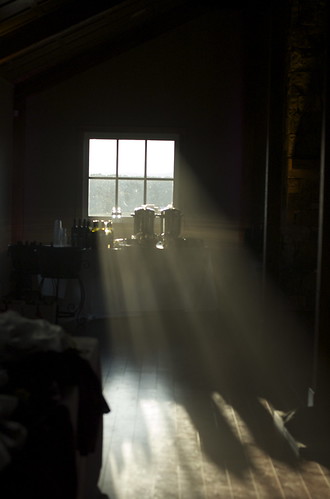
Unlike north and south window, which have roughly the same properties all day long, the light coming from east and west windows changes drastically throughout the day. As a result, the solutions to the problems of eastern and western light can change as well. When trying to decide what to do with a window on an eastern or western wall, it is necessary to ask yourself: how do I use this room? When do I use it? What experience do I want here during the day?
There may be some rooms in your house that you only use at certain times of day, or only on weekends. Most of us are only in the bedroom in the morning and evening, when eastern and western light are most disparate. The office, on the other hand, is typically only used during the day, when light from these windows is bright but a little more diffuse (except in the late afternoon, when western light can be very intense and warm).
 Image via WikipediaIn the early morning, an eastern window will bring in bright, orange to yellow direct light. While this light will be high contrast, this could be a good thing. As I mentioned in the south window post, high contrast can make your eyes tired, but first thing in the morning as you sit and drink your coffee, contemplating the
previous night's dreams (what does it mean that in my dream the suburban street I grew up on looked like the lower east side of NYC?) 15 minutes of high contrast light can be energizing. If your bedroom has an eastern window, ask yourself: do you like being woken by the rising sun, or do you prefer to black out your room and hit the snooze button a few times?
A western window gets that direct orange light in the evening, and here again you have to think about how and when you use the room. At sunset, the average building is as warm as it is going to get, having absorbed sunlight all day long, so that direct western sun can be awfully hot. If you live in the far north in the winter, this may be as pleasant as sitting by the fireplace, and the view of the sky may be spectacular at sunset. In the New Mexico desert, in the middle of August, you probably just want that light to go away and bug somebody else, view or not.
Eastern and Western windows are extremely versatile, and versatile solutions work best. Light blue curtains would cool off and mellow the sun rise and sunset light, while red, orange or yellow curtains would enhance the fireplace effect. Blinds are also ideal for these windows, allowing for complete control of the light. Highly reflective or metallic horizontal blinds allow you to bounce the light up to the ceiling or down to the floor, if you prefer. These windows are more complex, but with complexity comes increased opportunity to shape your experience.

Image taken from TraderZed's Flickr photostream under CC license
Unlike north and south window, which have roughly the same properties all day long, the light coming from east and west windows changes drastically throughout the day. As a result, the solutions to the problems of eastern and western light can change as well. When trying to decide what to do with a window on an eastern or western wall, it is necessary to ask yourself: how do I use this room? When do I use it? What experience do I want here during the day?
There may be some rooms in your house that you only use at certain times of day, or only on weekends. Most of us are only in the bedroom in the morning and evening, when eastern and western light are most disparate. The office, on the other hand, is typically only used during the day, when light from these windows is bright but a little more diffuse (except in the late afternoon, when western light can be very intense and warm).
 Image via Wikipedia
previous night's dreams (what does it mean that in my dream the suburban street I grew up on looked like the lower east side of NYC?) 15 minutes of high contrast light can be energizing. If your bedroom has an eastern window, ask yourself: do you like being woken by the rising sun, or do you prefer to black out your room and hit the snooze button a few times?
A western window gets that direct orange light in the evening, and here again you have to think about how and when you use the room. At sunset, the average building is as warm as it is going to get, having absorbed sunlight all day long, so that direct western sun can be awfully hot. If you live in the far north in the winter, this may be as pleasant as sitting by the fireplace, and the view of the sky may be spectacular at sunset. In the New Mexico desert, in the middle of August, you probably just want that light to go away and bug somebody else, view or not.
Eastern and Western windows are extremely versatile, and versatile solutions work best. Light blue curtains would cool off and mellow the sun rise and sunset light, while red, orange or yellow curtains would enhance the fireplace effect. Blinds are also ideal for these windows, allowing for complete control of the light. Highly reflective or metallic horizontal blinds allow you to bounce the light up to the ceiling or down to the floor, if you prefer. These windows are more complex, but with complexity comes increased opportunity to shape your experience.
Wednesday, January 20, 2010
Northern Windows, Daylighting and Views
Widows on the north side of a building are ideal for views, because everything you are looking at from these windows is facing the sun, and presenting its best lit side to you. For the same reason, a northern window is getting tons of reflected light from the sky and the landscape (or the fence/wall/other building placed just a few feet away) and no direct sunlight at all. So in every way, it is just the opposite of the southern window.
Of course, this means that the problems are just the opposite too. Instead of too much light, you might have the issue of not enough. A good architect/designer/builder will ideally plan for larger northern windows, to take better advantage of the view and the daylight, but for all of the reasons listed previously (and more, suppose the lot to the north is an apartment building, then you have privacy issues and no view) sometimes this ideal plan goes awry.
As an example, the building that I live in now was clearly planned with absolutely no thought given to the cardinal directions. I know this, because the same basic building footprint is repeated about 7 times in the complex, and the orientation is different each time. So here is my "lovely" northern view:

10 feet of concrete, 10 feet of mulch, a mossy fence and an ugly building. No sky, no landscape. But even this one small door window provides ample light for our kitchen. This is a cabinet door opposite the window, and look how clear the shadow is:

Because the light is diffuse, if my hand moves away just a little the shadow disappears. With bright, glossy white cabinets opposite the north window, I never turn the kitchen lights on during the day. Which brings us to the point of this post: maximizing that light.
In terms of daylighting, the worst thing you can do with a northern window is put a lot of large furniture or appliances right next to it. This reduces the angle of light coming in through the window, and therefore the amount of light. If you must put something right by the window, it helps if it is a bright color. The idea is to allow an uninterrupted path for the light to come in through the window at any angle and make it to the far wall, the ceiling, or the two perpendicular walls.
From there, some of the same tricks in the southern window post apply. Namely, mirrors and bright colors. A large mirror opposite a north facing window bounces light back into the room, but also it has the added benefit of making the view accessible from almost anywhere. If you are seated with your back to the window, you can still see the view in the mirror. Mirrors also make the room appear larger, both through the psychological trick of the appearance of more space and because as light fills the room is seems to expand. When the ceiling and corners of a room are dark, it seems to close in on you.
I recommend against curtains or blinds on a north window unless they are necessary for privacy. Putting anything between the window and the room reduces daylighting and obscures the view. Of course, if your bedroom or bathroom is on the north, you may want to fully obscure the view in, but otherwise I say embrace the outside world and leave the view open.
In terms of colors, I would recommend that walls be bright. Blue and yellow have the highest reflective index but any color that is pale (i.e. closer to white) will do well. You can also use high gloss or semi gloss paints in a room that has only northern light, because there is little risk of glare when the light is so diffuse. Ceilings should also be very bright. If you are a renter and you think you have white walls, you may want to take a closer look: building owners love off white colors like Swiss Coffee because they appear white at a glance and don't get dirty as easily, but they are actually tan. This could be reducing the amount of bounced light in your rooms by a great deal, and going for a more true white can significantly improve lighting conditions.
Last note on color: if you want to have a darker accent color on one wall, make it the wall with the window. The window is already providing all the light you need in that direction, so the bounce from that wall is redundant.
When planning a building or home, it is ideal to put the most public spaces and the spaces that you want to have the best views on the north. If you are renting or buying an existing building, however, the designer may not have considered this, or decided something else was more important, in which case a private room might end up on the north. In this case there is not much that you can do to get the privacy you need without blocking at least some of that light. Possibly the best option is an adhesive film that scatters the light a little but lets most of it pass through, like the one in the add there, or at this site. A completely frosted glass or film, however, would reflect almost half of the light back out the window. This option is not very cheap, and the film can be difficult to cut and apply just right, but with a little patience and care it can solve all your privacy concerns without much light lost.
Also, because the film can be difficult to cut just right, consider leaving a one inch gap around the edges. This will not be enough width to see anything through the window, and it can make uneven edges much cleaner looking.
So aside from the privacy concern, the advice is pretty simple: just get out of the way and let the light do the work for you! Avoid obscuring or absorbing that light before it has bounced around a little, and you should have a beautifully lit room from dawn until dusk.
Tuesday, January 19, 2010
Daylighting from Southern Windows
As I stated last time, southern windows get the most light throughout the day. Also, that light is very harsh, very direct, and very high contrast. So even though they get the most light, that light is the hardest to use to your advantage. Here is a picture of my living room/entry early in the morning on a sunny day, the light is coming from a south facing window:

The effect is not that harsh in person, our eyes compensate better than the digital camera in my phone, but that contrast is real, not enhanced in any way. Looking at the room like this will make your eyes tired from compensating for light and darkness, and this can make you feel tired and stressed after a few hours.
So what can we do? Well let me show another picture, the same view taken the same time of day, but the sun has been obscured by some heavy clouds:

Much better, no? The ceiling is still cave like, but the contrast on most stuff is very manageable. This is because the cloud scatters the light, making it more diffuse. It is the contrast that makes southern light so unpleasant. To remove that harsh direct light and shadow, architects and engineers design elaborate shading devices (Courtney just finished designing one for a school project, actually) that only let in indirect light. Adding something like that to an already finished building, however, is often impractical. Furthermore, if you are a tenant in an apartment or worker in an office, that kind of decision is probably not up to you.
So here is something that you can do: hanging light, gauzy white curtains in front of a southern window will scatter the light in all directions, creating a very even, very pleasant light all over the room (if the curtains are too lacy, i.e. with a bunch of small holes, this will not work as well). To illustrate, here is the same view again, same time of day, not a cloud between the sun and my window, but with an ordinary white bed sheet tacked up in front of the window:

The white curtain is a very low tech, very cheap fix for a south facing window. Closed, it provides privacy and diffuse light. On a heavily overcast or rainy day you may want to open it, as the curtain does reduce the total amount of light getting in (some is reflected back out the window again).
There are other, more permanent solutions as well (like using frosted glass) but they are mostly more expensive, and as above, not up to an individual tenant or worker. Also, frosted glass makes a view from the window impossible, while curtains can be drawn back. But here is one more thing that you can do to maximize daylight in a room with a south facing window:

Hang a mirror on the wall opposite the window. Courtney and I have used a pattern of mirror tiles, but one large mirror would be even more affective. This reflects the light that makes it to the far wall back into the room, lighting the other side of objects. To illustrate, here is an image of a piece of paper held just about a foot away from the mirror:

The top half is catching reflected light from the mirror. The further from the mirror you are, the lest distinct that line would be, and about three feet away it would be almost indistinguishable.
Using these two techniques in conjunction, the curtain and the mirror, you can get enough light to fill a room evenly and beautifully. Once the contrast is dealt with, the fact that a southern window gets so much light becomes useful: even a very small window will provide enough light to fill the room most days.

So what can we do? Well let me show another picture, the same view taken the same time of day, but the sun has been obscured by some heavy clouds:

So here is something that you can do: hanging light, gauzy white curtains in front of a southern window will scatter the light in all directions, creating a very even, very pleasant light all over the room (if the curtains are too lacy, i.e. with a bunch of small holes, this will not work as well). To illustrate, here is the same view again, same time of day, not a cloud between the sun and my window, but with an ordinary white bed sheet tacked up in front of the window:

(I think that is Cleo's ear right there ^ )
Even the ceiling is pretty well lit here. True, there is still a fair amount of glare by the window itself, but everything else in the room is beautifully even. This is ideal lighting for most tasks.The white curtain is a very low tech, very cheap fix for a south facing window. Closed, it provides privacy and diffuse light. On a heavily overcast or rainy day you may want to open it, as the curtain does reduce the total amount of light getting in (some is reflected back out the window again).
There are other, more permanent solutions as well (like using frosted glass) but they are mostly more expensive, and as above, not up to an individual tenant or worker. Also, frosted glass makes a view from the window impossible, while curtains can be drawn back. But here is one more thing that you can do to maximize daylight in a room with a south facing window:


Using these two techniques in conjunction, the curtain and the mirror, you can get enough light to fill a room evenly and beautifully. Once the contrast is dealt with, the fact that a southern window gets so much light becomes useful: even a very small window will provide enough light to fill the room most days.
Monday, January 11, 2010
Floors you could eat off
The addition of the lovely little miss Cleopatra (our puppy) to our household has, in short, made a bit of a mess. For those few of you out in the internet who have not heard, dogs are dirty. You might even say filthy. At the Dog Park yesterday I watched with resignation as Cleo chased and fled through, rolled and wrestled in, and even ate (I know, gross) the mud. Luckily she loves jumping in the little stream near the parking lot after a good wrestling match, which makes it a little easier to towel off some of that caked on dirt, but the upholstery in my car is still basically ruined.
Cleo uses our tiny patch of back yard as a bathroom, and half the time when she returns she trails muddy paw prints through our kitchen (I like to think there is nothing in those paw prints but mud, please don't enlighten me if I am wrong). The result of all this is that keeping our floors clean has become a daily struggle. To make matters worse, most commercial cleaning products have either bleach or ammonia in them, or some other substance that is toxic to our pets. So Cleo makes the floors dirtier and makes it harder to clean them.
As a solution, I have started sprinkling baking soda on the floors before sweeping. The results are amazing. I got the idea when I remembered working in the scene shop at UCLA. When they swept the shop, they first sprinkled this stuff that looked like red dirt (I never found out what it actually was) which stuck to the dirt and sawdust and clumped up into easily sweepable clumps. I thought "well I don't have red dirt, but I have baking soda." After this technique, the floors are sparkling, as if I had just mopped with bleach.
The soda turns grey as it adheres to the dust, and I think it helps hold it down too, instead of flying up in the air and causing me to have an allergic fit. I sprinkle it in the corners and along the walls and sweep it towards the center of the room, and this also allows me to see quite clearly where I have swept and where I need to do more. Finally, and most awesomely, the baking soda disinfects as you sweep, and it is totally harmless to the pets. This is important, because as the title of this post suggests, Cleo eats off of the floor all the time.
Keeping our home healthy is part of going green, and since we purchase the baking soda in gigantic bulk bags and it replaces several individual bottles of specialty cleaner, it is reducing waste and consumption.
Just wanted to share that little tid bit with everyone, because it makes me happy every time I clean the kitchen now.
Tuesday, December 15, 2009
Efficient cooking, made complicated!
I was at a fundraiser in Eugene last week, and got in a conversation with a local woman (whose name I did not catch) about the most energy efficient way to cook. She told me that the pressure cooker was the most efficient kitchen appliance. The entire conversation was nagging at me for a few days afterward, however, and it wasn't until just the other day that I realized why. The straightforward way of thinking about this issue was actually totally backwards.
First, here are some of the straightforward facts that she was operating with. When we cook, we either burn some fuel (natural gas, charcoal e.g.) or use electricity to heat our food. Electricity can heat food in a couple of ways: most electric heating elements are just a simple resistor (a material that resists electric current), which turns 100% of the electricity it resists into heat with theoretically perfect efficiency. All electric heating elements have the exact same basic efficiency, from your portable space heater to your hairdryer to your electric stove. Electricity can also be used (as in a pressure cooker) to pump hot steam into a contained space, which increases the temperature even more efficiently. This increase in efficiency is similar to the way that a geothermal heat pump heats a house more efficiently than an electric space heater. Burning anything to cook is less efficient, and also releases more carbon gas.
All of this, however, misses some important points about how we use our homes. The assumption is that the heat will be used to heat the food, and then be lost to the universe. After beginning my first winter in a place that actually gets cold, I realize that this is just not true at all. When the oven is running all day, the thermostat controlled home heating doesn't turn on. The point is, in the winter there is no such thing as 'waste heat.' And since my oven heats the house with the same efficiency as the built in heating system (the apartment has electric heat) there is no functional difference between one and the other. In fact, the oven is more efficient in a way, because the heat is being used for two purposes: first to heat the food and second to heat the home.
Back before the power grid and natural gas hookups, every home had one fire that ran more or less non stop and served every function that requires heat in the home. Over that fire, water was boiled and food was cooked. The fire provided heat for the home, light for that room, and a place for the family to gather all winter long. Today, we have a separate appliance for every function. An oven, a pressure cooker, a crock pot, a toaster oven, a fridge, freezer and heater, not to mention all of the various motors that we need (a blender or a mixer, e.g.), and our countless entertainment devices. All of these things consume energy and use it for one and only one purpose. When you start thinking in this way, it becomes obvious that the pressure cooker is not more efficient in the winter, because there is no "waste" heat going in to your home.
So then what do we do in the summer? When it is too hot for that extra heat to be useful, the issue is reversed. Then that waste heat is really wasteful, because it will cause your AC to work extra hard! So if it is really hot, chilling out with a cold dish is ideal. This is also just obvious when you think about it, summertime is when we want to eat salads and sandwiches and (some of us at least) gazpacho. We want cold food because we are hot. In the winter, when it is freezing outside, it is lovely to have baked goods, homemade soup, etc. all of which requires the oven and stove to be burning away all day long. This is a not a coincidence. When you go back to that one fire scenario above, people didn't want the fire burning all day and night when it was ninety degrees out, and they did want it when it was below freezing. In other words, our habits have been developed over centuries, and the recent innovation in technology has thrown us a little out of whack.
I am not a Luddite, I love technology. But sometimes our really advanced and clever solutions (like using electricity to make your house cold) cause us to forget the really simple solutions that we have been using forever (light linen clothes, cold food and drink). And sometimes those simple solutions are extremely satisfying.
Monday, November 30, 2009
Passive House
In a recent issue of Dwell magazine, there was a home featured which was certified as a Passive House. For those of you who are not familiar with this term, it is a European system for creating and certifying energy efficient homes which has recently come to the US. As one who has studied LEED in depth and frequently lamented the inelegance of LEED for Homes, I was initially seduced by the simplicity of the Passive House system and their consistent results in performance.
A closer look makes it clear, however, why Passive House is so neat where LEED for Homes is so messy: it focuses almost entirely on one aspect of green building, the heating and cooling load. While LEED attempts to cover every relevant topic from sustainable site selection to reusing materials, Passive House is primarily concerned with making the building envelope (ext. walls, roof, windows, doors, and accompanying insulation) as efficient as possible.
While this focus has led Passive House to generate a much easier to follow program with much more consistent results, it can by no means be considered a complete guide to green building. LEED still offer the only comprehensive guide that I know of for addressing all of the many concerns of sustainability (even if it addresses each imperfectly).
That being said, Passive House is still an excellent program. They boast a measured and verified energy savings of about 90% over conventional construction, and many Passive House homes can be heated sufficiently by the waste heat of a hair dryer, or even just the body heat of the occupants. Since Buildings consume a whopping 60% of electricity consumed in this country, that kind of efficiency has a substantial and direct impact on sustainability.
The home featured in Dwell, for example, used a form of passive geo-thermal heating (as opposed to a ground source heat pump), in which the air intake ran through buried coils to be warmed without any energy consumption before it even entered the house. The temperature was maintained with an extremely efficient insulation system. This simple, elegant solution to thermal comfort can be implemented in any climate (coils are buried below the frost line) and works for both heating and cooling, because the temp. below the topsoil is constant, and conveniently a pretty comfortable 60ish degrees F. If the incoming air is that warm, it requires only the slightest additional push to reach cozy levels (hence heating with a hairdryer).
In summary, passive house offers an in depth analysis of one important aspect of green building, and in its focus provides excellent solutions. In conjunction with a more holistic approach like LEED, the result is a vastly more sustainable building.
And after all that serious stuff, here is another BB post about what may be the cutest thing that you will ever see, ever. A little tip: it gets better the more you watch it.
Monday, October 5, 2009
EWEB green and solar homes tour
Yesterday I had the pleasure of helping out at EWEB for their Solar and Green Building Tour (part of the Solar Oregon program. I asked to help out early, so that I could take one of the tours and see some of the green homes Eugene was highlighting.
The first stop (for my group) was the Inkwell Building in Cresent Village, which won LEED Gold certification for the Core and Shell and LEED Platinum for the interior of their office. They followed LEED pretty much to the letter, and the result was a comfortable, beautiful office space. The rest of the tour consisted of three homes, each with completely different approaches to being green.
It was a really fun day, and I especially enjoyed talking with the builders and architects about what strategies they implemented to go green, and why they chose those over other possibilities. It was interesting to learn that many of my favorite methods for energy efficiency in Southern California were not always easy or effective to implement here.
For example, solar thermal water heaters are a snap in SoCal, but you have to purchase really high tech expensive ones in climates that drop below freezing for long periods in the winter. While one house chose to go with this option, the In-Law unit designed by Rainbow Valley did a cost analysis which showed that for their project it would take forever to pay off the initial expense (largely because it was a home for one person who only lived there part of the year). They chose a tankless water heater which was very efficient at providing the small amount of hot water needed.
In speaking with Alec from Rainbow Valley Design, he was lamenting how difficult it is to find valuable information about many of the "green" products available for builders. For example, he told me about a door they sourced which touted that it used locally harvested, sustainable wood. After he bought it, he found out that they did use local wood, but shipped that wood to China to be cut and assembled with cheap labor and then shipped it back. Well the point of local is that you aren't burning oil to ship it across the globe!
I told Alec about another builder on the tour who informed me that the hardwood floors in his house were green something or other certified, I had never heard of the certification he mentioned. I asked what that meant, he said "it's supposed to be better." I asked if it was FSC certified, he replied that he had no idea. So what's green about new maple if it isn't FSC certified?
My favorite home aesthetically speaking was the Sage House, by Arbor South Architecture. It was LEED Platinum, the highest rating offered by the US Green Building Council. The floors and some of the exterior features were done in beautiful re-purposed wood, and the structural beams were a glue lam product that I had not heard of before, which uses the chips and scraps from milling. They also used it as an interior design element to wonderful affect. The exterior features were redwood that was salvaged from the seats of an old theater through BRING Recycling, a fantastic local non-profit.
The In-Law I mentioned above, however, was great because of its extremely efficient use of a tiny square footage. Smaller homes are inherently green because they use less materials, cost less to heat and cool, and generate less waste. This place was 585 square feet, and it felt like at least 800. That is just good design.
The presence of a disabled man on the tour highlighted the issue of accessibility, which is usually not thought of as being a green issue. People get old. Sorry, everyone, that was a downer I know, but it is unavoidably true. People get old, they get injured, they slow down, sometimes they have children who are born with different abilities. Any honest assessment of the life cycle of a building should take this into account, plan for accessibility and easy mobility with a cane, a wheelchair, and even potential space for a care taker. It's not just about the current client, either, it is about resale and future owners.
The best house in terms of accessibility was definitely the "Earth Advantage House" built by David E. Smith. With wide hallways to accommodate wheel chairs and a roll in shower (no curb, just extra tiled floor for a wheelchair or walker to roll right in) in one bathroom, this house was certainly suited to the needs of any potential residents.
The tour finished up at La Perla, a new Pizzeria in town (of the fancy pizza variety) with really excellent, traditional wood oven cooked pizza. Their food was pretty fantastic, and I tortured Courtney by eating several slices in her presence (they had some wheat free food too, so she wasn't starving).
Thinking about the differences in local climate here and in SoCal and how they affect construction choices reminded me of some studies I had done for a sustainability class at UCLA that focused on Los Angeles City's practices, and looking back over them, I think maybe they deserve to see the light of day. So I think I may brush them off, fix them up, and publish them with google docs. If I follow through, I will link to it later.
That's it for now, bravo EWEB, and thanks to everyone who opened their homes and offices for us to see.
Thursday, October 1, 2009
Green Pet Care
Since we have adopted Cleo, we have been confronted with a hundred new choices a day. What food do we buy? Wet, dry or mix? How many toys does she need (a: a lot)? what kind? How do we train her? Crate or no? There is so much that has to be done right away, so many decisions, that how green the choices are doesn't even enter the equation at first.
Truth be told, keeping pets is not really a green practice, in the strictest sense, because you need to feed them and provide them with entertainment, all of which usually takes up energy. One of the main criteria for making decisions for you pets, however, is a big part of going green: health. All green programs contain a substantial portion about the health of people, and pets are people too.
When you choose food for your animals, you want what is good for them, and unfortunately that can be very hard to determine. Every source of information seems to conflict, and most of the advice you get is downright bad. We trusted a pet store clerk who swore by one brand of dog food, and foolishly did not read the ingredients before leaving the store. When we got home and double checked, the second ingredient was corn, followed by wheat.
Although dogs are omnivorous by nature, a much larger portion of their diet is naturally meat, so if some kind of animal protein is not the first ingredient the food is not good. After that protein (usually chicken meal) fruits, vegetables and some grains are okay, but many dogs have difficulty digesting wheat and corn, so grains should be rice, barley, or some other alternative grain. Soy protein is also a big red flag, as soy is no part of a dogs natural diet, and usually it is used instead of some other meat protein.
Toys are a big issue too. We heard (unverified) that the squeaky part of squeak toys can come out if the dog destroys the toy, and they can choke on it (plus squeak toys are annoying). But trying to find a dog toy that doesn't squeak is like trying to find bread that doesn't contain wheat (possible, as anyone who knows us knows, but hard).
Then we came across someone on the web who wrote about making toys from random junk in your house (I think Courtney read that at the Bark). Instead of throwing away old socks, knot them up turn them into chew toys. If you have old water bottles you can stuff them in those old sock (without the cap) as a pit stop before recycling. Of course you have to make sure that you aren't giving your dog something toxic, or something that will break into pieces that she can choke on, but this is just part of the creative process of turning trash into toys. The maker in me loves this idea. Although the person who posted these ideas was talking about saving money, it is also a green practice for all the reasons that I love the make movement.
It seems in general that the more you control what you give your dog, the healthier it will be (kind of obvious, once you state it). For that reason, we have been thinking about making our own food for the dog, a practice that seems crazy at first but makes more sense the more you think about it. Dogs have been with us for thousands of years, and prepackaged dog food has been around for less than a century. So for the thousands of years minus a hundred before that? We fed our dogs similarly to how we fed ourselves, and it worked out fine. We haven't committed yet, but if we do I will be sure to keep everyone updated.
Saturday, August 22, 2009
Used = Green
My wife and I stumbled upon an amazing fact up in Oregon: It is saturated with beautiful antique quality furniture. When we moved up at the beginning of the summer, we didn't want to bring all of our old baggage with us. We got rid of as much as we possibly could, including most of our furniture.
In looking for new furniture, we found that what worked in LA did not necessarily work in Eugene. Craigslist had some decent stuff, but it was pretty bleak compared to SoCal. Then we wandered into a St. Vincent de Paul, which I didn't know was a thing before we moved. We were both amazed, the thrift stores in Eugene are all packed with beautiful furniture. Stuff that would go for thousands of dollars in vintage shops on Melrose Blvd. was more like $100 bucks there.
Then, because Craigslist had to redeem itself, we came across a promising post. I believe all it said was "modern sofa," or something to that effect, and when my wife called, he said he had "s0me more modern stuff." When we arrived, there was a garage full of mid century modern furniture which this guy had culled from all over the Pacific North West. He also knew everything about modern design, and knew the designer of most of the pieces that he was offering. We furnished most of our living room out of his garage. Here are a few of the pieces that we got:
 Dining set by Paul McCobb

 Don't know designer, if you have any ideas please post in comments
In looking for new furniture, we found that what worked in LA did not necessarily work in Eugene. Craigslist had some decent stuff, but it was pretty bleak compared to SoCal. Then we wandered into a St. Vincent de Paul, which I didn't know was a thing before we moved. We were both amazed, the thrift stores in Eugene are all packed with beautiful furniture. Stuff that would go for thousands of dollars in vintage shops on Melrose Blvd. was more like $100 bucks there.
Then, because Craigslist had to redeem itself, we came across a promising post. I believe all it said was "modern sofa," or something to that effect, and when my wife called, he said he had "s0me more modern stuff." When we arrived, there was a garage full of mid century modern furniture which this guy had culled from all over the Pacific North West. He also knew everything about modern design, and knew the designer of most of the pieces that he was offering. We furnished most of our living room out of his garage. Here are a few of the pieces that we got:
 Dining set by Paul McCobb
Sofa by Umanoff, end table by Keal
Don't know designer, if you have any ideas please post in commentsI would be lying if I said that I was thinking about this at the time, but in retrospect this is the most sustainable way we could have furnished our new place, and it is also an excellent example of how you can save money being green. In the past, I have furnished apartments with a bunch of nice looking but really low quality cookie cutter furniture from Ikea and Target, and most of it eventually ended up in the trash.
Cheap furniture is really disposable furniture. When particle board warps, chips, cracks or breaks, it cannot really be repaired, and once it starts down that path it is not long before it ends its life in the landfill. It is usually designed to be put together only once, as well. Pre-drilled holes in the particle board and cam locks made of weak metal ensure that if you disassemble your Ikea desk, it will lose most of its structural integrity when you put it back together.
In the long run, cheap furniture ends up costing you more money, because you have to replace it more frequently. But unless you are paying more in taxes than I make in a year, antique quality furniture is way too expensive, and there isn't really much of an in between.
One great way to get around this dilemma is to buy used furniture. You can tell if it is well made pretty easily: if it is still solid after years of use it will probably be good for many more. Also, solid wood is really easy to repair. With a very small investment in wood glue, a few clamps, and maybe a power drill, you can keep solid wood pieces alive for decades.
Buying used stuff is more sustainable in two ways: first it reduces demand for more new stuff, which means that there is less energy being consumed to produce that new stuff, and second it keeps old stuff out of the waste stream. But more than being green, when you buy used you can afford to get better quality stuff; beautiful, well designed stuff that you will love. And if you love it, you will take care of it: fix it when it breaks and find a good h0me for it when it no longer fits in your life.
Different cities have different channels for finding good used stuff. The thrift stores in Eugene, for example, are a great resource, where in LA they have been completely picked over by people who buy the good stuff, fix it up, and sell it for 10 times as much out of little boutique shops. But, in Los Angeles, the stuff available on Craigslist and at yard sales can be amazing. One way or another, people are always changing their surroundings, and high quality used furniture is available for those who seek it.
Subscribe to:
Posts (Atom)