Number 7 in our list of sustainability related TED Talks, we have Mark Bittman (food writer for NYTimes, author of How to Cook Everything and How to Cook Everything Vegetarian) brings us a very enlightening talk on diet. Specifically, the contemporary western diet and why is bad for the health of both people and the environment.
Bittman approaches the subject of food with love and wit, and makes plain some complex issues of how we arrived at the food system that we have and how we should change our diets to improve both our own health and the environmental impacts of our food systems.
Courtney and I have turned to How to Cook Everything Vegetarian for inspiration in our kitchen for years, and personally came to many of the same conclusions that Mr. Bittman recommends in this talk, but he does such a great job here of summarizing the issues and arriving at the correct conclusions.
Showing posts with label beef. Show all posts
Showing posts with label beef. Show all posts
Sunday, August 12, 2012


Tuesday, October 12, 2010
The Meat in the Vegetarian Argument
As part of October: Unprocessed, and leading up to my guest post on Eating Rules later this month, I thought it would be appropriate to re-post this piece, which details some of the issues of food as it relates to sustainability.
Re-Posted from the iPinion Syndicate
You may have heard that being vegetarian is green. You may also have had a vegan activist tell you that meat is murder and you are killing the planet. While there is definitely some truth to the argument that a vegetarian diet is a little more earth friendly, there is a little devil in the details.
The issues of food production are numerous, from health and humanity to environmental impact and sustainability. Which issue is most important to you probably depends on a number of factors: your age, location, political views, etc. By and large, however, beef does not fare well in any serious analysis of food issues. At least, not conventional beef that is fattened in a concentrated feed lot.
If global warming and climate change are your primary concerns, you’ll be happy to hear that feed lot beef and dairy are the only things that you need to strike off your menu. Chicken, fish and eggs are comparable to vegetables in green house gasses emitted during production and transport. Speaking of fish, however, is opening a whole other can of worms.
If sustainability is what you are after, a lot of sea food is out: over fishing is stressing stocks all over the world, and aside from a few species that are managed responsibly (wild pacific salmon, e.g.) most edible fish populations are dropping at a staggering rate. Seafood doesn’t fare well on the health test either; electronics, fluorescent bulbs and industrial practices have contaminated most seafood populations with levels of mercury that are dangerous for human consumption.
If you are a card carrying member of PETA, or sympathetic to their cause, chicken and eggs are back on the black list. On the humanitarian scale, chicken production is much, much worse than just about anything else out there. Feed lot beef is not much better. If humanitarian concerns are foremost in your mind, you should probably explore expensive alternatives to conventional food at a specialty or kosher butcher shop. If you can’t afford that, then meat is out.
If health is what you are thinking about, then a strictly vegetarian diet might not be a good idea at all. Many people develop anemia, iron deficiency, or other issues when not eating meat, and careful management of protein and iron intake is essential for a healthy meatless diet. Pescatarians (a word I am not entirely comfortable with, I’ll have you know) can get around this quite easily, as salmon and mollusks like clams provide massive doses of protein and iron in tiny portions. But again, mercury is a real threat which much be considered constantly. Farmed clams are better, but farmed salmon are terrible: they are fed other fish from depleting stocks and foul up coastal waters with concentrated waste.
Here is something that your vegan acquaintances will not be quick to point out, however: grass fed and grass finished cows are better in every way. On the humanitarian angle, they are demonstrably healthier and ostensibly happier (in so far as we can tell these things). They produce less methane (a green house gas) and foul up less water during their lives. They are wildly healthier for you, with little saturated fat and more omega 3 fatty acids than salmon. Finally, their waste is not concentrated like feed lot cows, which means that it can be absorbed naturally by the environment they are raised in.
In summation, if all of the issues in this article are important to you, you probably should be vegan. However, if you are willing to do your food homework and buy the right products, you can put the vegan argument out to pasture with the grass fed cows.
Wednesday, May 19, 2010
Alternatives to Beef as Barbecue Season Approaches
Up here in the Pacific North West, when the sun shines you notice. You don't just notice in fact, you suddenly feel like wearing shorts and firing up the grill, even if it is still in the mid 50s outside. So as BBQ season fast approaches, I thought I would try to inspire my handful of readers with a few grilling ideas which do not involve beef or pork.
Now don't get me wrong, I love hamburgers and ribs. I just feel that it is important to limit how much livestock I eat. As good as beef is, feed lot beef is wasteful in a number of ways. But at the same time, I don't want anyone to feel that their barbecue is in any way compromised by the lack of beef. So here are some ideas for successful grilling in a slightly greener fashion.

Vegetables seem to be an afterthought for many 'Qers, but certain veggies for certain people make the meal. Courtney's favorite (and one of mine too) is corn, grilled on the cob and in the husk. It is really easy to do, very low maintenance, and delicious. You literally just throw it on, husk and all, and when the outer layer of the husk is just about burned through, the corn should be done. Other vegetables that can be grilled whole are any kind of peppers (they cook quickly, so keep an eye on them), asparagus (always place them perpendicular to grill), and long string beans (choose big, thick beans for best results). Coating any of these veggies lightly in oil will help them keep their moisture, but is not necessary.
Any kind of zucchini or summer squash is great on the grill too, but should be cut into long, thick slabs first. Eggplant gets the same treatment. Since you are cutting into these vegetables, you should coat them well with oil to keep them from drying out too much on the grill. For the same reason, cook them quickly on the hottest part of the grill for best results. Onions, garlic, or anything similar are great grilled, and after grilling can be used to make sauces and salsas smokier.
Last word on vegetables: you can cook almost anything else in a tinfoil pouch. This is particularly good for root vegetables like sweet potatoes, carrots, beets, etc. Cut larger vegetables into rough cubes so they will cook a little faster, and rub the inside of the tinfoil pouch with oil to seal in the moisture. This is really more like steaming or baking than it is grilling, but since the coals are already hot/ the propane is already burning, why not throw it on. My brother Nathan, who is possibly the best chef who never got paid to cook, does sweet potatoes whole wrapped in tinfoil You can tell when they are done by inserting a toothpick right through the foil on the grill. If it goes all the way through easily, they are ready. And remember, when you are done that tinfoil is recyclable, no matter how dirty it got during its use.
Yeah, but where's the beef? I have a little secret that I want to let you in on: ground beef tastes like nothing. Don't believe me, do you? Try a little experiment. Cook a hamburger with no seasoning, no sauce, no oil, just beef and grill. Eat it like a steak, no bun, no condiments. The result: blander than tofu. My first experience with a garden burger was a real eye opener: if the bun and the condiments are the same, the garden burger tastes just about as good as the real deal.
I draw the line at tofu hot dogs, though. Partially because they really are less flavorful than their meaty counterpart (hot dogs are made with tons of salt and delicious but deadly nitrates), but also because it is a pretty sorry end for some tofu. I think tofu should be treated like tofu, marinated in an Asian or Hawaiian sauce, and grilled in big square slabs. Tofu has its own great tradition, and by trying to make it something it is not we just further convince carnivores that it is bland and boring.

So to sum up the meat replacements, it is all about the sauce. I recently posted my Cross Country BBQ Sauce on Foodista, and I think it is just about the perfect sauce for anything grilled. It also happens to be quick and easy to prepare, and very versatile. Simply adjusting the proportions can make it more sweet, spicy, tangy or salty.
And finally, if you absolutely must have meat, try cooking chicken instead of the bigger polluters: beef and pork. Tomorrow I will post a recipe for cooking a whole bird on the Q.
Now don't get me wrong, I love hamburgers and ribs. I just feel that it is important to limit how much livestock I eat. As good as beef is, feed lot beef is wasteful in a number of ways. But at the same time, I don't want anyone to feel that their barbecue is in any way compromised by the lack of beef. So here are some ideas for successful grilling in a slightly greener fashion.
Vegetables seem to be an afterthought for many 'Qers, but certain veggies for certain people make the meal. Courtney's favorite (and one of mine too) is corn, grilled on the cob and in the husk. It is really easy to do, very low maintenance, and delicious. You literally just throw it on, husk and all, and when the outer layer of the husk is just about burned through, the corn should be done. Other vegetables that can be grilled whole are any kind of peppers (they cook quickly, so keep an eye on them), asparagus (always place them perpendicular to grill), and long string beans (choose big, thick beans for best results). Coating any of these veggies lightly in oil will help them keep their moisture, but is not necessary.
Any kind of zucchini or summer squash is great on the grill too, but should be cut into long, thick slabs first. Eggplant gets the same treatment. Since you are cutting into these vegetables, you should coat them well with oil to keep them from drying out too much on the grill. For the same reason, cook them quickly on the hottest part of the grill for best results. Onions, garlic, or anything similar are great grilled, and after grilling can be used to make sauces and salsas smokier.
Last word on vegetables: you can cook almost anything else in a tinfoil pouch. This is particularly good for root vegetables like sweet potatoes, carrots, beets, etc. Cut larger vegetables into rough cubes so they will cook a little faster, and rub the inside of the tinfoil pouch with oil to seal in the moisture. This is really more like steaming or baking than it is grilling, but since the coals are already hot/ the propane is already burning, why not throw it on. My brother Nathan, who is possibly the best chef who never got paid to cook, does sweet potatoes whole wrapped in tinfoil You can tell when they are done by inserting a toothpick right through the foil on the grill. If it goes all the way through easily, they are ready. And remember, when you are done that tinfoil is recyclable, no matter how dirty it got during its use.
Yeah, but where's the beef? I have a little secret that I want to let you in on: ground beef tastes like nothing. Don't believe me, do you? Try a little experiment. Cook a hamburger with no seasoning, no sauce, no oil, just beef and grill. Eat it like a steak, no bun, no condiments. The result: blander than tofu. My first experience with a garden burger was a real eye opener: if the bun and the condiments are the same, the garden burger tastes just about as good as the real deal.
I draw the line at tofu hot dogs, though. Partially because they really are less flavorful than their meaty counterpart (hot dogs are made with tons of salt and delicious but deadly nitrates), but also because it is a pretty sorry end for some tofu. I think tofu should be treated like tofu, marinated in an Asian or Hawaiian sauce, and grilled in big square slabs. Tofu has its own great tradition, and by trying to make it something it is not we just further convince carnivores that it is bland and boring.

Grilled Tofu w/ Homemade Spicy Teriyaki sauce
To get those perfect grill marks, turn 30 degrees halfway through cooking each side
To get those perfect grill marks, turn 30 degrees halfway through cooking each side
So to sum up the meat replacements, it is all about the sauce. I recently posted my Cross Country BBQ Sauce on Foodista, and I think it is just about the perfect sauce for anything grilled. It also happens to be quick and easy to prepare, and very versatile. Simply adjusting the proportions can make it more sweet, spicy, tangy or salty.
And finally, if you absolutely must have meat, try cooking chicken instead of the bigger polluters: beef and pork. Tomorrow I will post a recipe for cooking a whole bird on the Q.
 Cross Country Bbq Sauce

Monday, February 1, 2010
Feed lot Beef that is Good For the Environment?
I don't believe it. I didn't believe it. I'm still a little suspect, but it seems to be true.
Courtney and I took a trip to Long's Meat Market this weekend to pick up our weekly chicken (likely the only meat we will eat this week), and on the way there we saw a horse drawn carriage, driven by two men in complete western regalia with requisite handlebar mustachios, loaded with several cases of Ninkasi beer. I felt a little like I was living in some weird holiday beer commercial for a moment, but it passed. When we arrived at Long's, we were surprised by a long line outside. At first I thought they were really busy, but soon it became obvious that the line was not to get in, it was leading to a pop up tent where some men were grilling hamburgers and handing out samples of beer. All for free. Needless to say, we got in line.
As we learned eventually, the event was a launch for a new beef company called Oregon Natural Meat. They claimed that their product is more environmentally friendly, because they upcycle grain to feed their cattle. I was highly skeptical, but willing to eat the free food all the same. Shortly before we got to the front of the line, the beer commercial caught up with us. Turns out those cases of Ninkasi we had seen on the way were headed for us. The horse drawn cart pulled into the parking lot, and the cases of beer headed for the sample stand.

I stated in a previous post that Concentrated Feed Lots are really damaging to the environment, and that grass finished beef was significantly more eco-friendly, but sure enough, as soon as you make a rule there is an exception. ONM fattens their cattle on grain before slaughter, but they do it very differently. First of all, they are a small company which only distributes locally, so there isn't the pollution issue of concentrated feed lots. Because they are small and family owned, there is more oversight in the process, and the health of the animals is observed rather than assumed. They are fed a grain diet for richer meat, but unlike the concentrated feed lots the diet is 100% vegetarian, with no antibiotics or growth hormones, no animal byproducts, and (the most disgusting CFL practice, in my opinion) no manure.
A substantial portion of the feed comes in the form of malted barley that has been used to brew beer, a byproduct of the brewing industry (in fact it comes from Ninkasi, hence the horse connection). So the primary ingredient in their diet is something that would be waste, isn't fit for human consumption, but is good for them. They explained this whole concept with a very informative seeming info graphic which actually was just pretty and not really very informative:

Aside from 'upcycling' the used grain, ONM seems to do everything else right as well. They are devoted to sourcing all of their cattle and suppliers locally, and only distribute locally as well. They handle the cattle as humanely as possible, and don't engage in the breakneck speed processing that most large meat packers do (the pace of conventional meat packers reduces quality control and increases the rate of human injuries). The result is beef that is good enough for the finest steak house, produced in an ecological and healthy manner.
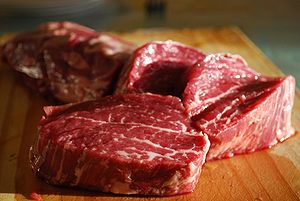 Image via WikipediaWhile grass fed and grass finished beef is still the simple rule for determining environmental impact, it is clear that there are some grain fed cattle that also score excellently on the ecological report card. This is
really great, because while grass fed beef is delicious, it is leaner and a little more gamey. If you know this going in, it is a perfectly wonderful taste, but many restaurants shy away because their customers expect the flavor and texture of grain fed beef. A company like Oregon Natural Meat is a perfect solution, because they produce a product that is superior to conventional beef in every way and is much closer to being sustainable.

Courtney and I took a trip to Long's Meat Market this weekend to pick up our weekly chicken (likely the only meat we will eat this week), and on the way there we saw a horse drawn carriage, driven by two men in complete western regalia with requisite handlebar mustachios, loaded with several cases of Ninkasi beer. I felt a little like I was living in some weird holiday beer commercial for a moment, but it passed. When we arrived at Long's, we were surprised by a long line outside. At first I thought they were really busy, but soon it became obvious that the line was not to get in, it was leading to a pop up tent where some men were grilling hamburgers and handing out samples of beer. All for free. Needless to say, we got in line.
As we learned eventually, the event was a launch for a new beef company called Oregon Natural Meat. They claimed that their product is more environmentally friendly, because they upcycle grain to feed their cattle. I was highly skeptical, but willing to eat the free food all the same. Shortly before we got to the front of the line, the beer commercial caught up with us. Turns out those cases of Ninkasi we had seen on the way were headed for us. The horse drawn cart pulled into the parking lot, and the cases of beer headed for the sample stand.

I stated in a previous post that Concentrated Feed Lots are really damaging to the environment, and that grass finished beef was significantly more eco-friendly, but sure enough, as soon as you make a rule there is an exception. ONM fattens their cattle on grain before slaughter, but they do it very differently. First of all, they are a small company which only distributes locally, so there isn't the pollution issue of concentrated feed lots. Because they are small and family owned, there is more oversight in the process, and the health of the animals is observed rather than assumed. They are fed a grain diet for richer meat, but unlike the concentrated feed lots the diet is 100% vegetarian, with no antibiotics or growth hormones, no animal byproducts, and (the most disgusting CFL practice, in my opinion) no manure.
A substantial portion of the feed comes in the form of malted barley that has been used to brew beer, a byproduct of the brewing industry (in fact it comes from Ninkasi, hence the horse connection). So the primary ingredient in their diet is something that would be waste, isn't fit for human consumption, but is good for them. They explained this whole concept with a very informative seeming info graphic which actually was just pretty and not really very informative:

Aside from 'upcycling' the used grain, ONM seems to do everything else right as well. They are devoted to sourcing all of their cattle and suppliers locally, and only distribute locally as well. They handle the cattle as humanely as possible, and don't engage in the breakneck speed processing that most large meat packers do (the pace of conventional meat packers reduces quality control and increases the rate of human injuries). The result is beef that is good enough for the finest steak house, produced in an ecological and healthy manner.
 Image via Wikipedia
really great, because while grass fed beef is delicious, it is leaner and a little more gamey. If you know this going in, it is a perfectly wonderful taste, but many restaurants shy away because their customers expect the flavor and texture of grain fed beef. A company like Oregon Natural Meat is a perfect solution, because they produce a product that is superior to conventional beef in every way and is much closer to being sustainable.
Friday, October 2, 2009
Sustainable Eats: Greens and Beans Part II
Courtney and I eat meat. We are carnivores. But as carnivores go, we are pretty bad at it. We have frequently committed to a week of vegetarian cooking, or a month of eating meat only once a week (if you count farm raised clams and wild Alaskan salmon as vegetables). We also cook vegan meals from time to time. Why do we do this? Because no matter how much you love meat, you have to recognize that eating large amounts of beef for every meal is not a sustainable practice.
Buying grass finished beef is a little better, but it is very expensive compared to conventional beef. Vegetarian cooking, on the other hand, is significantly cheaper than the cheapest meat. Removing meat from just a few meals a week can greatly improve your food budget. If you are not going completely vegetarian, the health risks (low iron or protein intake) are negligible, especially if you eat beans, legumes, nuts or a meat replacement (tofu, e.g.) with each veggie meal.
Another excellent source of iron is clams, mussels or oysters. Farmed, these delicacies are also highly sustainable. There is nothing simpler than steaming clams in some white wine, with chopped onion and parsley and a little butter. They can be served in their shells with the steaming broth. Clams usually have more iron than similar amounts of beef (note: canned clams may have significantly lower iron content, fresh farmed are best).
If you are going for a vegan trial, however, more planning is required. The two main concerns are how to get the nutrition you need and how to make tasty food. Well, in the taste department I have two bits of advice: oil and sea salt. A lot of the flavor of meat comes from the natural salt and fat content, and when switching to a no meat diet doubling the salt and adding a little extra oil can go a long way. Sea salt specifically contains a number of things which are basically impurities that mimic meat flavor (the blood of most animals is similar chemically to sea water).
Another tip on vegetarian cooking: roast your vegetables. A little browning is vital to a complex flavor without meat, and a little black won't hurt either. Combined with the sea salt, this technique will produce a savory flavor that will make you forget about the lack of meat.
Finally, mushrooms are great in meatless dishes. They provide some texture, some body, and although I think white mushrooms are pretty flavorless, most varieties provide a rich umami flavor that is otherwise hard to come by without some animal product involved.
In terms of nutrition, the biggest concern aside from iron is protein, and for this beans are your best bet. Canned or dried, mashed or whole, beans and other legumes are packed with protein, low in fat and even have some fiber. They tend to soak up whatever flavor is around, so I usually add beans right at the end, otherwise everything else in the dish will lose its flavor.
In the interest of full disclosure, I feel I should tell you that while writing this post, I was planning, preparing, cooking and eating hamburgers. What can I say? I told you I was a carnivore. Besides, it was sunny all day today, and there probably won't be another good day to BBQ until spring. I did use grass fed beef though, and it was the first time that we cooked meat in a week, so I can't feel too bad.
Oregon Trail Part VI: Sweet Home
The final day of our trek up the coast, we wake up in another extremely cute little motel in Klamath, CA, the Ravenwood. We departed from this location after being advised by some locals to stop for lunch in Grant's Pass, OR. The advice came with a warning that in Oregon they love their one way streets, trying to be more European, probably. There was a just a hint of nose turning toward those uppety Oregoneans by the locals here in Northern NorCal. I refrained from asking if they had ever been to San Francisco.
The 199 forked off from the 101 shortly after Klamath, to cut across country and bring us back around to the 5. I don't know if it was just the fresh perspective of a new day, but it seemed to me that the Redwoods along the 199 were even more beautiful than those along the 101.
Within an hour of driving, we crossed the state line in a thoroughly underpopulated patch of forest halfway between the 5 and the 101. Despite there being no obvious change in the landscape, the road signs made it perfectly clear that we were not in Kansas anymore. You can't always put your finger on it, but a subtle difference in the wording of comands gives you the sense that you have entered a different place, like we had driven across the border into Canada.
At the advice of the Klamath locals, we dutifully turned off the freeway at Grant's Pass to get lunch. Unable to make a decision in such a big town, we pulled into the largest and most obvious restaurant near the freeway, and this is what we found:


The Taprock restaurant, right on the Rogue River (unrelated, as I was sad to discover later, to the Rogue Brewery, which is on the coast in Newport, OR). As lunches go, it was 'spendy,' as the locals say, but worth the money. Actually, the view and the ambiance was worth the money, the food was just the icing. After the meal, we walked around the little manicured footpath which serves as a line for the riverboat tours that launch from the restaurant's little dock.
The rest of our trip was a short journey through Normal Rockwell's America, a perfect pastoral landscape book-ended on either side with a perfect pastoral landscape. We were tired and anxious to get home, but we drove a little slow anyway to take in the view.
Driving through the country brings some dormant patriotic feelings out in city dwellers like us. Being close to working farms reminds us of our roots, where this country came from. I have never lived on a farm. I have never worked on a farm. I have never even attempted to garden before moving up here (we are just getting started now, stockpiling compost for next spring and a few hearty winter crops). But the idea of the self sustaining farmer is so deeply embedded in the American subconscious that it is impossible not to feel a kinship, at least with the idea.
Since arriving at our new home, we have been making an effort to buy local, organic food as much as possible. I used to think that organic was just some fruity hippie thing, but the more I look into it, the more I realize that at the least, conventional farming is not sustainable. It kind of boggles the mind that in farming, conventional means planting genetically modified seeds with the terminator gene, spraying them with massive amounts of pesticides and herbicides that they are specifically bred to withstand, and shipping the product all over the world while importing tons of produce along parallel routes. Growing vegetable with natural fertilizer, weeding instead of using herbicide, and selling them locally is what we call the 'fruity hippie' way of farming.
We have also started buying 'grass finished' meat, which is more expensive, but we eat less meat than most anyway. Grass fed and grass finished means that the animal never spent any time in a concentrated feed lot, which seems to be the source of most current food safety concerns (all of those recent vegetable scares can be traced back to original contamination from feed lot waste). Also, it might just be psychological, but I think grass fed beef tastes much, much better than feed lot beef.
It is a little leaner, and I know it has a much higher concentration of omega 3 fatty acids, and it doesn't have that smell that beef from the supermarket usually has. I hate that smell. I got a cut of NY from one of the many local butchers (Springfield is a hunting town, and most hunters don't want to do the labor of butchering their catch) Longs, and grilled it up the way I usually grill a steak: rubbed with pepper and paprika, 4 minutes per side on an extremely hot grill (turning 30-45 degrees halfway through each side to get that crisscross look). It was one of the best steaks I have ever cooked. In my opinion, this is the only way to cook steak, other cuts you can cook however you like, but steak must be seared on a grill. (Note: if you use red pepper, it will turn into pepper spray on the hot grill. I always do this, and end up coughing and hacking through the rest of the meal prep)
Saturday, August 8, 2009
Food: greens and beans, part 1
I intend to post a lot about cooking on this blog, because I love to cook. It is extremely pertinent to a discussion about going green too, because large scale food production is responsible for more green house gas emissions than all of the cars on the road. By a lot. So for anyone who has never heard the link between going green and food, here is a brief overview.
What does food have to do with being green? Well, a lot. For one thing, cows produce methane, which is a green house gas. All animals produce methane actually (including us), but cows produce more than most. Also, because we eat so very much beef in this country, we have developed a lot of unsustainable practices to get that much beef to market. For an intro, see Farmer in Chief by Michael Pollan, an open letter to the new president about food production in this country.
Now I am not one of those conspiracy theorists who think that big business and big brother are evil, I recognize that today's problems all stem from the solutions to yesterday's problems. We have intensive, unsustainable agriculture right now because previous generations were trying to solve the problems of food shortages and hunger. But the fact is that now, we face new problems and need new solutions.
So what can we do? Well, lets start from the easiest and work our way up to the hardest adjustments that we can make to do our part.
For one, we can eat chicken instead of beef every so often. Without getting too technical on you, chicken is the most environmentally friendly meat. Next, in the same vein, we can eat vegetarian once in a while. If you like Indian food, this should be a snap. In India, they have been working on their vegetarian recipes for about two thousand years, and they've gotten pretty good at it.
Third, we can try eating vegan a few times. This is harder, because for people who are used to eating animal products with every meal (even most veggie meals have butter, cheese or milk), most vegan food tastes like cardboard. But try different places, different recipes, and well really just keep trying! And also, don't try so hard. Pasta with olive oil and spices, tossed with some grilled or fried vegetables and a little sea salt is a quick, easy, and delicious vegan dish, for example (I love sea salt, maybe it deserves its own post...).
You've probably heard this a thousand times in some form, but if everybody would do these three basic things on a regular basis, it would have a huge impact. There are a few more difficult/ intensive things that we can do as well, but I will post that stuff later, in part 2.
Subscribe to:
Posts (Atom)