Challenge: find a secure way to lock up our bikes on the cheap. Since Courtney and I moved into the smallest house ever, we can no longer keep our bikes inside. We think they make a pretty tempting treat just hanging out in plain view, so we decided to invest in a rack. Unfortunately, a good rack is very expensive, and a cheap rack is not worth the price tag unless you have additional layers of security (e.g. bikes are already inside a garage). So we decided to hit up our local go to "DIY on the cheap" shop, Bring Recycling. After some deliberation and a lot of poking around, here is what we came up with:
1 staircase handrail
2 concrete masonry units
1 mess of bailing wire
Total price tag: $4
After a quick trip to the local hardware store, we also picked up a bag of Quikrete, $4. I think you can see where I am going with this. We combined these simple ingredients in a pan coated with butter, put it in our easy bake oven for 15 minutes, and this is what came out:
Seriously, though, it was almost that easy. As you can see, we used some cardboard boxes left over from the move to create little forms around the CMUs, put the handrail in the CMU and stuffed the bailing wire in around it (so you can't just take a sledge to it), poured in the Quikrete and let it set. The result is heavy as heck and can't be defeated without some tools and some time (but even the best racks can be defeated with the right tools and some time).
So there you have it, instant bike rack, $8 and about 2 hours total labor (plus 24 hour cure time). It is not the most secure solution ever, but it will deter the average thief pretty effectively.
All about going green. Discussion of how and why to adopt more sustainable practices in daily life, and anecdotes about how I try to apply them to my life.
Showing posts with label project. Show all posts
Sunday, July 10, 2011
Sunday, September 12, 2010
A Few Surprises for My Nothing New Month
This week, I was taken on a surprise camping trip (which is why I have been incommunicado for most of the week). If you are not familiar with the concept of a surprise camping trip, that is because it is not actually a thing. It is not a thing because camping requires lots of planning, and making a camping trip a surprise makes planning impossible.
Of course I am exaggerating. My wife and I had been talking with her parents for a few months about camping before the summer was over, but we have had a great deal of trouble working out our schedules. When we stayed with them last month (while I was attending IFBC), we had all vaguely agreed that it must happen soon, or not at all. Just last weekend, when we realized that we all had some time off, it was suggested that camping might happen. Still, on Sunday at 3pm, when my wife informed me that her parents were driving down right now, and we would be camping as of tomorrow, it felt quite a bit like a surprise camping trip at the time.
My first thought was "how does this fit into my month of nothing new?" Followed quickly by "they are driving all the way down here, is it rude to demand that they follow my arbitrary rules for my blog?" Well, as it turned out, I hardly had to bring up the blog and my Nothing New month, because both they and us owned sufficient camping gear, and we really only had to buy food (which doesn't count) for the trip to be a success.
There were a few hiccups, of course. The first was simply that I had not thought about whether gasoline counted as buying something new. I am still not certain, but I must disclose that I purchased a full tank of gas. Next, we were camping just north of Newport, and Courtney really wanted to go clamming, as the season is just about over and we could not conceivably go again until next spring. All well and good, but I would need some serious waterproof boots.
Well, the local Salvation Army was our salvation on this trip, because they had exactly one pair of knee high waterproof boots that fit me like a hand-me-down glove. As we were checking out, the cashier said "boy, you really lucked out with those, they don't last long here." Since Newport is a coastal town on a bay, known for it's abundance of razor, butter, soft shell, gaper, and cockel clams (and even the odd geoduck), scallops, bay shrimp, and crab, I was not exactly surprised to learn that good second hand galoshes were a hot commodity.
After a few days of camping, clamming, and taking in Newport (which I will surely write about soon, as it is home to the nicest people on earth), the in-laws and we (in-laws and us? anyone?) returned to Springfield with several clams and a surprise agenda. If you are not familiar with the concept of a surprise agenda, that is because you don't have the same in-laws as I (as me? I am having pronoun trouble today).
Apparently, my father in law had heard through the grapevine about our efforts to fix up and sell the Honda, but had not heard about my moderately ambitious plan to not purchase anything new this month. The result is that I found myself overwhelmed with a plan to fix up the paint job and some body damage which involved buying lots of little new things. It was a sound plan financially, of course, the idea was to spend a very small amount of money to get the car into the next condition bracket, but it was antithetical to my plans for September.
My wife Courtney came to the rescue. While I was embarrassed to say that their reasonable, helpful plan didn't fit in with what I was blogging about this month, Courtney explained to her parent that I was trying to fix up the car in the "greenest" way possible, and we ended up adhering to the rules that I set out in my first post. Nothing has been purchased, still, to fix the car. My father in-law borrowed a trickle charger to re-charge the battery, which turned out to be in perfect condition. We also found a mechanic that would charge only $10 to put the battery on a charger for a day or so, so if we couldn't borrow a charger we could have done that. The car (after a good wash) is now running great and ready to sell, body damage, faded paint and all.
The last week, in other words, presented me with some completely unique and bizarre problems, but so far I have not broken the rules as they were originally laid out. Of course, the month is only 1/3 over, and anything can still happen.
Of course I am exaggerating. My wife and I had been talking with her parents for a few months about camping before the summer was over, but we have had a great deal of trouble working out our schedules. When we stayed with them last month (while I was attending IFBC), we had all vaguely agreed that it must happen soon, or not at all. Just last weekend, when we realized that we all had some time off, it was suggested that camping might happen. Still, on Sunday at 3pm, when my wife informed me that her parents were driving down right now, and we would be camping as of tomorrow, it felt quite a bit like a surprise camping trip at the time.
My first thought was "how does this fit into my month of nothing new?" Followed quickly by "they are driving all the way down here, is it rude to demand that they follow my arbitrary rules for my blog?" Well, as it turned out, I hardly had to bring up the blog and my Nothing New month, because both they and us owned sufficient camping gear, and we really only had to buy food (which doesn't count) for the trip to be a success.
There were a few hiccups, of course. The first was simply that I had not thought about whether gasoline counted as buying something new. I am still not certain, but I must disclose that I purchased a full tank of gas. Next, we were camping just north of Newport, and Courtney really wanted to go clamming, as the season is just about over and we could not conceivably go again until next spring. All well and good, but I would need some serious waterproof boots.
Well, the local Salvation Army was our salvation on this trip, because they had exactly one pair of knee high waterproof boots that fit me like a hand-me-down glove. As we were checking out, the cashier said "boy, you really lucked out with those, they don't last long here." Since Newport is a coastal town on a bay, known for it's abundance of razor, butter, soft shell, gaper, and cockel clams (and even the odd geoduck), scallops, bay shrimp, and crab, I was not exactly surprised to learn that good second hand galoshes were a hot commodity.
After a few days of camping, clamming, and taking in Newport (which I will surely write about soon, as it is home to the nicest people on earth), the in-laws and we (in-laws and us? anyone?) returned to Springfield with several clams and a surprise agenda. If you are not familiar with the concept of a surprise agenda, that is because you don't have the same in-laws as I (as me? I am having pronoun trouble today).
Apparently, my father in law had heard through the grapevine about our efforts to fix up and sell the Honda, but had not heard about my moderately ambitious plan to not purchase anything new this month. The result is that I found myself overwhelmed with a plan to fix up the paint job and some body damage which involved buying lots of little new things. It was a sound plan financially, of course, the idea was to spend a very small amount of money to get the car into the next condition bracket, but it was antithetical to my plans for September.
My wife Courtney came to the rescue. While I was embarrassed to say that their reasonable, helpful plan didn't fit in with what I was blogging about this month, Courtney explained to her parent that I was trying to fix up the car in the "greenest" way possible, and we ended up adhering to the rules that I set out in my first post. Nothing has been purchased, still, to fix the car. My father in-law borrowed a trickle charger to re-charge the battery, which turned out to be in perfect condition. We also found a mechanic that would charge only $10 to put the battery on a charger for a day or so, so if we couldn't borrow a charger we could have done that. The car (after a good wash) is now running great and ready to sell, body damage, faded paint and all.
The last week, in other words, presented me with some completely unique and bizarre problems, but so far I have not broken the rules as they were originally laid out. Of course, the month is only 1/3 over, and anything can still happen.
Related articles by Zemanta
- Green Your Camping Trip: Use Designated Campsites (sierraclub.typepad.com)
- How to Reset Your Sleep Schedule, Seriously (projectb14ck.org)
Labels:
diy,
food,
going green,
IFBC,
nothing new,
Oregon,
project,
seafood
Posted by
Gabe Cross
Saturday, September 4, 2010
Nothing New Day 4 -- Coffee and Cars
We are now half way through day 4 of our "nothing new" experiment, and we have only just encountered our first real trial. On the first day we rented a movie, on the second we didn't buy anything at all, and the third day we made a brief stop at the grocery store, no rules broken. First thing this morning I was having two consecutive conflicting thoughts: first, maybe a month was not ambitious enough, maybe this will be too easy; and second, how the heck am I going to fix up the Honda to sell it without buying anything new this weekend?
Image via Wikipedia
Then life threw us a curve ball; our french press coffee maker broke. Anyone who has ever owned, operated, or even looked sideways at a french press should not be surprised by this at all. They break easily. In fact, I think that they are designed to break. There might even be a manufacturers guarantee on the box: "guaranteed to break within one year of purchase or your money back!" Now, the wife and I will not be going coffee-less, as we have a cheapo little drip coffee maker that we have owned since moving in together, but french press coffee is so much better.
For us, this is a real (if garden variety) dilemma: I really hate the idea of owning something that is designed to break (or might as well be), but I really love the flavor of french press coffee. Courtney is currently looking up options for finding replacement beakers used. Meanwhile this is has already spurred a brief debate about why we are doing this in the first place. What is more important, that we accomplish this task without feeling deprived, or that we make some sacrifices to change the way we consume? No concensus has been reached yet, but I will be sure to post the resolution to this dilemma as it arises.
The next big hurdle: today I am tackling the Honda Prelude that has been weighing down our parking lot for the better part of a year. Last week I got it running and adjusted the idle (only new purchase: an extra long screwdriver to open the dash). This week, I have to find out why the battery is not holding a charge. First step is to determine if the fluid level is low, and clean the terminals. If that doesn't work, I may have to replace the fluid entirely, but then I don't know what to do with the old fluid. Well, either way, I will be sure to take pics and keep you all updated. That is it for now.
Then life threw us a curve ball; our french press coffee maker broke. Anyone who has ever owned, operated, or even looked sideways at a french press should not be surprised by this at all. They break easily. In fact, I think that they are designed to break. There might even be a manufacturers guarantee on the box: "guaranteed to break within one year of purchase or your money back!" Now, the wife and I will not be going coffee-less, as we have a cheapo little drip coffee maker that we have owned since moving in together, but french press coffee is so much better.
For us, this is a real (if garden variety) dilemma: I really hate the idea of owning something that is designed to break (or might as well be), but I really love the flavor of french press coffee. Courtney is currently looking up options for finding replacement beakers used. Meanwhile this is has already spurred a brief debate about why we are doing this in the first place. What is more important, that we accomplish this task without feeling deprived, or that we make some sacrifices to change the way we consume? No concensus has been reached yet, but I will be sure to post the resolution to this dilemma as it arises.
The next big hurdle: today I am tackling the Honda Prelude that has been weighing down our parking lot for the better part of a year. Last week I got it running and adjusted the idle (only new purchase: an extra long screwdriver to open the dash). This week, I have to find out why the battery is not holding a charge. First step is to determine if the fluid level is low, and clean the terminals. If that doesn't work, I may have to replace the fluid entirely, but then I don't know what to do with the old fluid. Well, either way, I will be sure to take pics and keep you all updated. That is it for now.
Labels:
consumption,
nothing new,
project
Posted by
Gabe Cross
Tuesday, August 31, 2010
Nothing New -- Courtney and I Vow to Make No New Purchases for One Month
While turning over the Dream Of Less in my head and discussing it with my like minded wife Courtney, we developed a little challenge for ourselves: purchase not one new item for an entire month. At the end of the month, I hope to write the next installment of the dream: To Dream of Less Stuff. Also, if the month goes better than expected, maybe we will extend the challenge for an even greater period of time. For the first installment, however, we will begin on September 1, and attempt to buy nothing new until October 1.
Of course, a challenge like this would be meaningless without some clearly defined terms, some ground rules, and some expectation up front of a reasonable amount of failure. So I describe for you now the plan:
I think that about covers it. I can tell you right now that at some point we will fail, and most likely because of my wife's car, which we are in the process of fixing up to sell. But the failures are an anticipated part of the experiment, and we will not be deterred by a few set backs.
The purpose of this exercise is to actively monitor the amount of stuff we buy, and the amount of waste that we generate, and furthermore attempt to actively reduce those categories. I am very optimistic that we will achieve some success in this endeavor, and I hope against hope that you will find this either a little inspiring or least somewhat entertaining. Either way, I am really doing this for your benefit, so you better read!
Of course, a challenge like this would be meaningless without some clearly defined terms, some ground rules, and some expectation up front of a reasonable amount of failure. So I describe for you now the plan:
- First: food is not counted here, for obvious reasons. What is counted, however, is any kitchen utensil, crockery, flatware, or other durable good associated with the preparation of food.
- Second: semi-durable and disposable goods do count, including napkins, towels, clothing, shoes, kleenex, etc. Also counted are things purchased for us in the process of a service we pay for, such as car maintenance.
- Third: Cleaning products are to be avoided unless absolutely necessary. We will try to use what we have sparingly, and find alternatives (vinegar and baking soda, e.g.) when we run out.
- Fourth: items essential to health care (medicine, bandages) for both ourselves and our pets do not count at all. I will not put myself, my wife, or any of our furry children in harms way for this or any other experiment.
- Fifth: "new" shall be here defined as anything which is not previously owned, not re-purposed or recycled, not refurbished or re-anything-ed in any way.
- 6th: when the need for some stuff arises, we shall follow this rubrick for satisfying the need:
- Try to repair the broken stuff (reuse/repair)
- See if we can make something else work for the same purpose (re-purpose)
- Try to borrow or barter for it
- Try to find it used or refurbished
- Reconsider if we can do without it
- Finally, break down and buy it new
I think that about covers it. I can tell you right now that at some point we will fail, and most likely because of my wife's car, which we are in the process of fixing up to sell. But the failures are an anticipated part of the experiment, and we will not be deterred by a few set backs.
The purpose of this exercise is to actively monitor the amount of stuff we buy, and the amount of waste that we generate, and furthermore attempt to actively reduce those categories. I am very optimistic that we will achieve some success in this endeavor, and I hope against hope that you will find this either a little inspiring or least somewhat entertaining. Either way, I am really doing this for your benefit, so you better read!
Related articles by Zemanta
- Review: The Art of Barter (thesimpledollar.com)
- Conscious Shopper Challenge: Reuse/Repair (greenphonebooth.com)
Labels:
consumption,
dream of less,
going green,
home,
nothing new,
project,
repurpose,
reuse,
sustainability,
waste
Posted by
Gabe Cross
Friday, August 13, 2010
How to do Everything Wrong in the Garden
It's kind of amazing, looking back, that we have anything growing in our garden at all. We have done everything imaginable wrong.
You may remember a post early in Spring about starting from seed? In which I posted a few pictures of our impromptu seed starting station, full of happily sprouting little seedlings? Well, I promised to post updates about our garden thereafter, but was too depressed to do so, as almost all of our seedlings withered and died. Most, we now believe, because we just waited to long to transfer them. The sprouts grew big and tall, and then toppled, then shriveled and dried right out.
Image via WikipediaThe seedlings that survived this first neglect had even worse horrors visited upon them by us amateur gardeners. We failed to harden off our little upstarts before just leaving them out in the elements, and many were shocked by their first frigid night into committing suicide, or whatever the herbaceous equivalent is. The tomatoes, previously only exposed to fluorescent light, were scorched by the brilliant sunlight. Those that had the tenacity to withstand the cold and sunshine, though surely terrified by the treatment they and their fellow sprouts were suffering through, fared better. But not by much.
For our next trick, we watered our plants when the sun was at its zenith, not realizing that we were splashing water all over the leaves and creating little lenses that literally burned the growing leaves alive. We almost lost our strawberries to that one, but luckily they regrew from the roots. Finally, we left on a trip to see family and asked someone to water the plants for us. However, because we were afraid of being a burden, we only asked them to come by every two or three days. As you more experienced gardeners will surely already know, we came back to a bone dry desert.
Not all of the destruction was directly our fault, there were pests, parasites and pestilence as well. Aside from the havoc wreaked by the slugs and the inexplicable deaths that we chalked up to diseases, there was the mysterious case of the disappearing carrot sprouts. We sowed tons of carrot seeds in a little patch, and every day a few would sprout in the morning. By sunset every single one would be gone. No slug trails, no shriveled dried out remnants, just an empty patch of dirt. We couldn't figure out what was going on until one day my cat Whiskey was banging frantically on the glass of the back door. I came over to see what the ruckus was about, and saw a little finch in our carrot patch, hop-hopping around, looking about in that particularly birdy way, and pecking up our carrot sprouts one by one. Peck peck, hop, look around, hop, peck, until there was nothing left but dirt. Apparently he was a bit of a sprout connoisseur, because he neglected every other type of sprout in the garden, just ate the carrots and split.
In short, as first time gardeners, Courtney and I unwittingly perpetrated a tiny vegetable holocaust in our little backyard this spring. We were shamed and saddened by this, of course, but luckily nature's abundance knows no bounds, and there was plenty of summer left for us to give it a second go.
It was too late in the season to start from seed again, so we bought several starts at the Lane County Farmer's Market. We started watering our plants in the evening exclusively, after all the direct sunlight was past, giving the plants all night to soak up water. We potted everything, which helped to reduce slug attacks and diseases. And when we had to make an unexpected trip to Seattle for Family reasons, we were not afraid to ask someone to check on the plants every day. We are still figuring out how to repay her, perhaps a jar of homemade pesto would do the trick...
I sincerely hope that someone out there can learn from our mistakes, and avoid the sad and needless vegetable death that we brought upon ourselves. Just goes to show, I guess, no matter how much research you do, you don't know how to do something until you done it.
You may remember a post early in Spring about starting from seed? In which I posted a few pictures of our impromptu seed starting station, full of happily sprouting little seedlings? Well, I promised to post updates about our garden thereafter, but was too depressed to do so, as almost all of our seedlings withered and died. Most, we now believe, because we just waited to long to transfer them. The sprouts grew big and tall, and then toppled, then shriveled and dried right out.
For our next trick, we watered our plants when the sun was at its zenith, not realizing that we were splashing water all over the leaves and creating little lenses that literally burned the growing leaves alive. We almost lost our strawberries to that one, but luckily they regrew from the roots. Finally, we left on a trip to see family and asked someone to water the plants for us. However, because we were afraid of being a burden, we only asked them to come by every two or three days. As you more experienced gardeners will surely already know, we came back to a bone dry desert.
Not all of the destruction was directly our fault, there were pests, parasites and pestilence as well. Aside from the havoc wreaked by the slugs and the inexplicable deaths that we chalked up to diseases, there was the mysterious case of the disappearing carrot sprouts. We sowed tons of carrot seeds in a little patch, and every day a few would sprout in the morning. By sunset every single one would be gone. No slug trails, no shriveled dried out remnants, just an empty patch of dirt. We couldn't figure out what was going on until one day my cat Whiskey was banging frantically on the glass of the back door. I came over to see what the ruckus was about, and saw a little finch in our carrot patch, hop-hopping around, looking about in that particularly birdy way, and pecking up our carrot sprouts one by one. Peck peck, hop, look around, hop, peck, until there was nothing left but dirt. Apparently he was a bit of a sprout connoisseur, because he neglected every other type of sprout in the garden, just ate the carrots and split.
In short, as first time gardeners, Courtney and I unwittingly perpetrated a tiny vegetable holocaust in our little backyard this spring. We were shamed and saddened by this, of course, but luckily nature's abundance knows no bounds, and there was plenty of summer left for us to give it a second go.
It was too late in the season to start from seed again, so we bought several starts at the Lane County Farmer's Market. We started watering our plants in the evening exclusively, after all the direct sunlight was past, giving the plants all night to soak up water. We potted everything, which helped to reduce slug attacks and diseases. And when we had to make an unexpected trip to Seattle for Family reasons, we were not afraid to ask someone to check on the plants every day. We are still figuring out how to repay her, perhaps a jar of homemade pesto would do the trick...
I sincerely hope that someone out there can learn from our mistakes, and avoid the sad and needless vegetable death that we brought upon ourselves. Just goes to show, I guess, no matter how much research you do, you don't know how to do something until you done it.
Posted by
Gabe Cross
Wednesday, April 28, 2010
Spring is Sprung: Starting seeds and Planting Starts
UPDATE: I started to write this post last week, so if the time line seems a little off that is why.
Three days in a row of beautiful, warm weather, and I think that officially Spring is not just sprung, it is in full swing. Courtney and I missed the first Farmer's Market of the season due to a last minute late season ski trip and the second to the HOPES conference, but we made it to the third. And let me tell you, the time to buy starts for your garden is now. Courtney and I are growing almost everything for our first garden from seed, for the experience if nothing else, but getting starts from local farmers at the farmers market is an excellent idea as well.
While we were at the Lane County FM, half of the booths that normally bring fruits and vegetables to market were brimming with starts of everything from peppers to carrots, squash to onions, etc. to distinctly different etc. And while most of our garden is planned out and prepped for the shoots we are starting from seed (most of which we got for free at the Seed Exchange hosted by Lane Community College) we felt that there was room out front for one tiny fig tree. Because it was so cheap, and figs! For free ! Who can argue with that (no fair pointing out the initial expense)?
Another screaming deal, there was a wild mushroom vendor who had just run out of morels, and was selling the remainder of his harvest (basically the ones that were broken or otherwise not presentable) for $2.50. It was probably about $20 worth by weight, and sold for nearly one tenth of that because they didn't look perfect. I didn't deliberate too long before forking over the two and a half bucks.
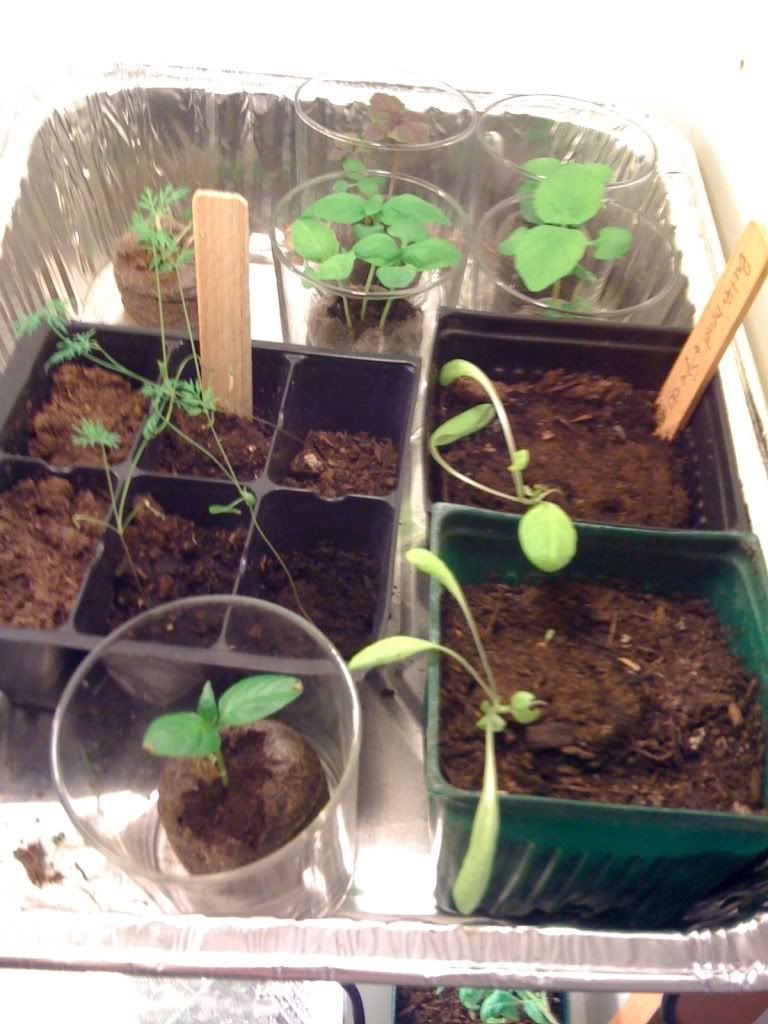
So as stated above, we are starting a garden (mostly) from seed this Spring, and so far it is going pretty well. We are starting most of our seeds in peat pots (about ten cents each) under CFLs in our laundry room, so far to great effect. We have successfully germinated tomatoes, onions, three different kinds of peppers, several spices, some flowers that are supposed to attract bees and other pollinating insects, some lettuces, and a few oddball items that were kind of foisted upon us at the seed exchange (like red orach, which neither one of us had heard of before we had the seeds in our hands). Our success rate has been pretty phenomenal so far, but I think maybe germinating is the easy part, hardening off and planting (or more likely potting for most of our veggies) may prove deadly for many of our heretofore healthy sprouts.
When we decided to start our plants from seed, we did a fair amount of research. Basically, the ideal environment for germinating most seeds (with some notable exceptions) is very warm and humid. There are a number of high buck kits you can buy, and several medium buck plastic tray systems that do the same job, but we decided that the exact same purpose could be served by those cheap, disposable roasting pans that they sell at the grocery store for about 5 bucks for 4 of them. Aluminum bottom, clear plastic top, they are ideal for letting light pass through while locking in the humidity. Also, they are recyclable, easy to pack and store for next season, and may have other uses between seasons, we'll see. So although they were designed to be disposable, they can be used in a greener manner.
Some of the seeds we acquired recommended starting outdoors, so we sowed those directly in our soil. We have been getting most of our instructions from The Backyard Homestead, which is oriented to a much larger scale of gardening, but contains most of the info you will need to run a garden of any size, indoor or out. From testing and prepping your soil to knowing when to harvest, this book covers all the bases of growing your own vegetables. It also goes into some detail about how to keep poultry and livestock, but we don't have the kind of yard that makes sense for keeping any animal stock around. If you are a home brewer you might be surprised to find out how easy it is to grow your own hops (also covered in this book). Or barley for that matter. Maybe the ideal garden for you is just grains and hop vines. Of course, it couldn't hurt to experiment with strange grains, or growing some fruit to flavor a Lambic inspired ale.
So far, the seeds sown outdoors are mostly sprouting as well, some took much longer than others, but the success rate seems pretty good. Mainly it is carrots, radishes and beets, along with a different variety of lettuce. The trouble outside, unfortunately, is that slugs get to everything. I will discuss slug and pest prevention in another post, however, because it is a big topic and this post is already too long.
Three days in a row of beautiful, warm weather, and I think that officially Spring is not just sprung, it is in full swing. Courtney and I missed the first Farmer's Market of the season due to a last minute late season ski trip and the second to the HOPES conference, but we made it to the third. And let me tell you, the time to buy starts for your garden is now. Courtney and I are growing almost everything for our first garden from seed, for the experience if nothing else, but getting starts from local farmers at the farmers market is an excellent idea as well.
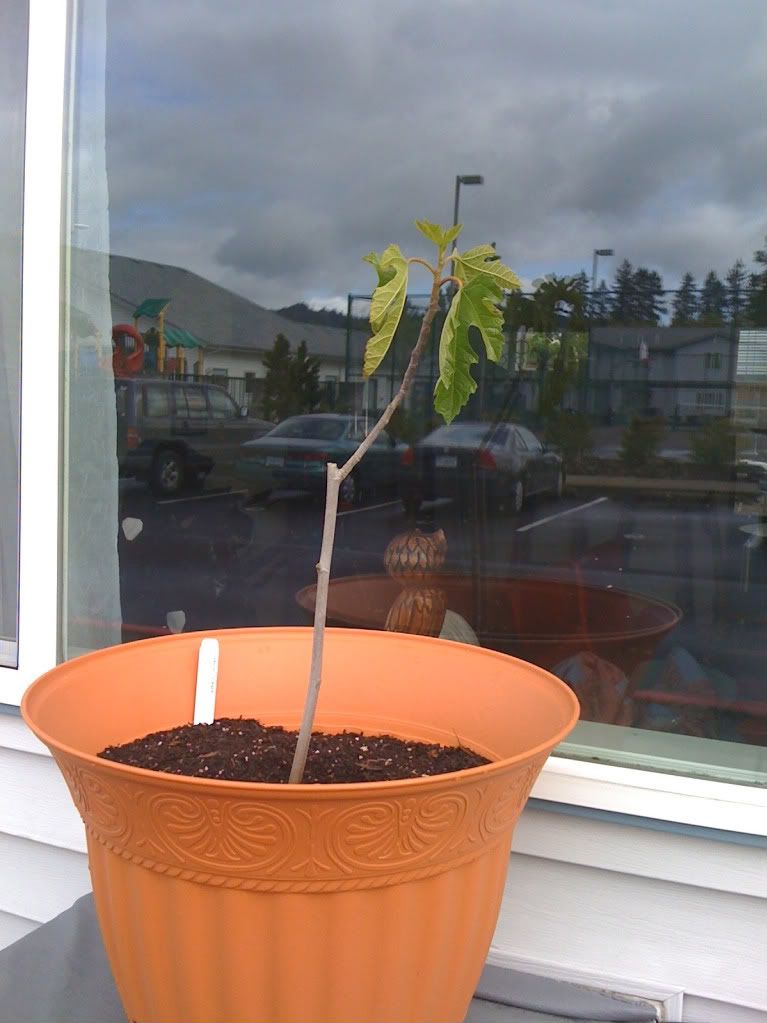
While we were at the Lane County FM, half of the booths that normally bring fruits and vegetables to market were brimming with starts of everything from peppers to carrots, squash to onions, etc. to distinctly different etc. And while most of our garden is planned out and prepped for the shoots we are starting from seed (most of which we got for free at the Seed Exchange hosted by Lane Community College) we felt that there was room out front for one tiny fig tree. Because it was so cheap, and figs! For free ! Who can argue with that (no fair pointing out the initial expense)?
Our baby fig tree
Another screaming deal, there was a wild mushroom vendor who had just run out of morels, and was selling the remainder of his harvest (basically the ones that were broken or otherwise not presentable) for $2.50. It was probably about $20 worth by weight, and sold for nearly one tenth of that because they didn't look perfect. I didn't deliberate too long before forking over the two and a half bucks.
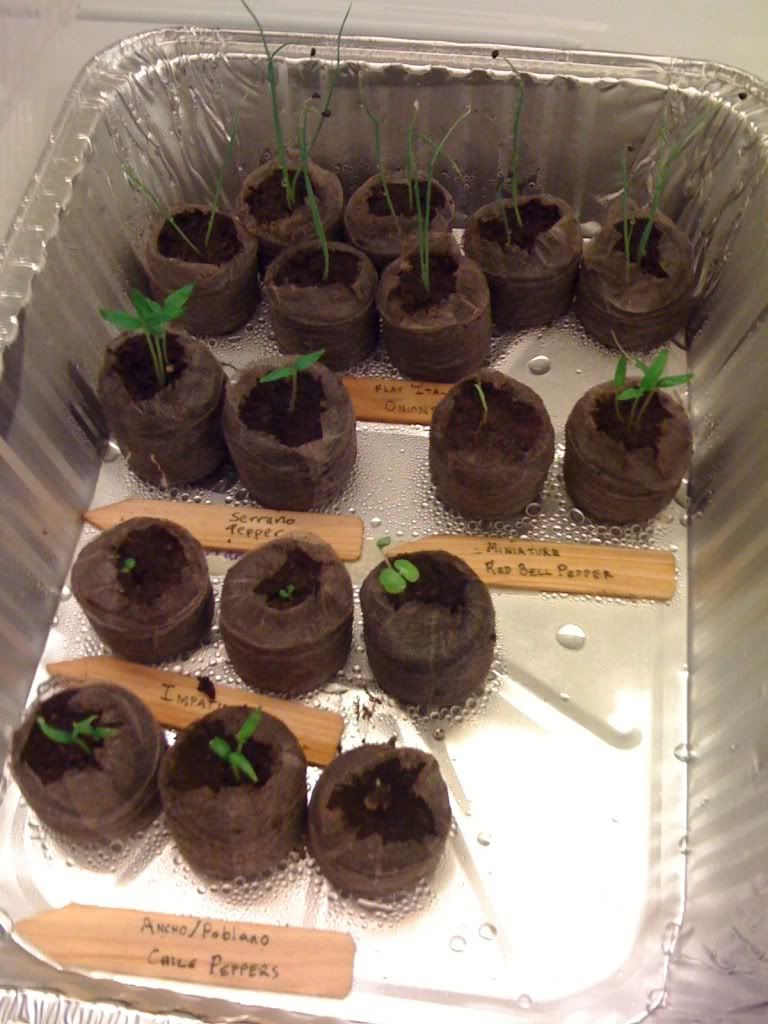
So as stated above, we are starting a garden (mostly) from seed this Spring, and so far it is going pretty well. We are starting most of our seeds in peat pots (about ten cents each) under CFLs in our laundry room, so far to great effect. We have successfully germinated tomatoes, onions, three different kinds of peppers, several spices, some flowers that are supposed to attract bees and other pollinating insects, some lettuces, and a few oddball items that were kind of foisted upon us at the seed exchange (like red orach, which neither one of us had heard of before we had the seeds in our hands). Our success rate has been pretty phenomenal so far, but I think maybe germinating is the easy part, hardening off and planting (or more likely potting for most of our veggies) may prove deadly for many of our heretofore healthy sprouts.
Our seedlings, about a week after sprouting
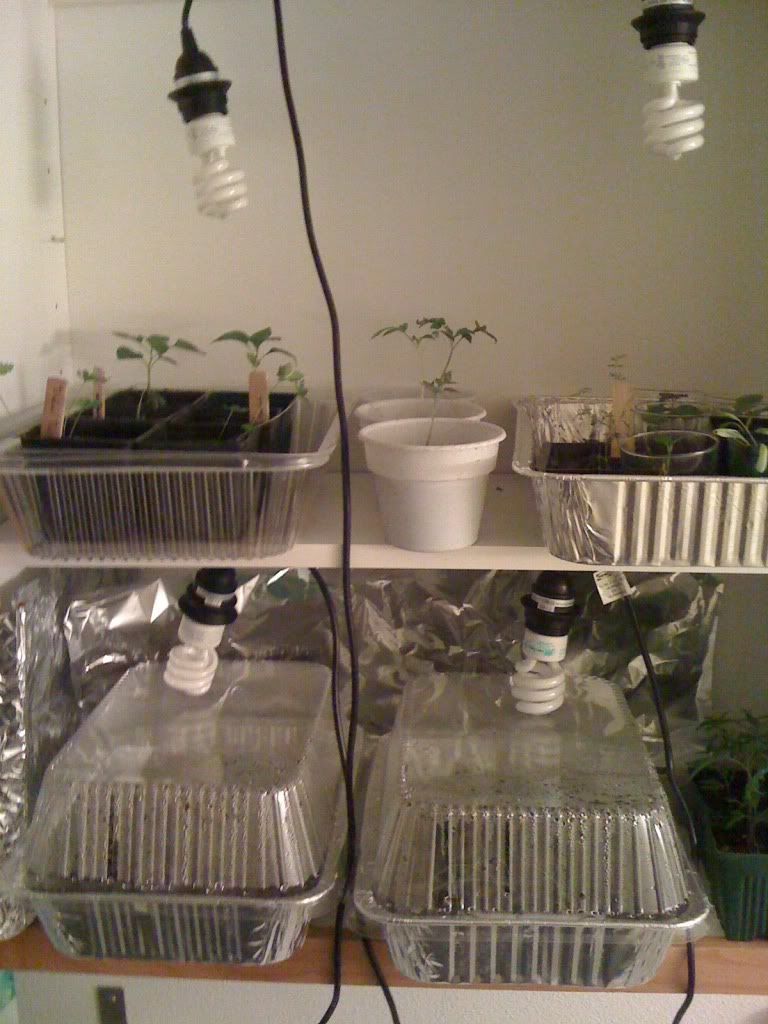
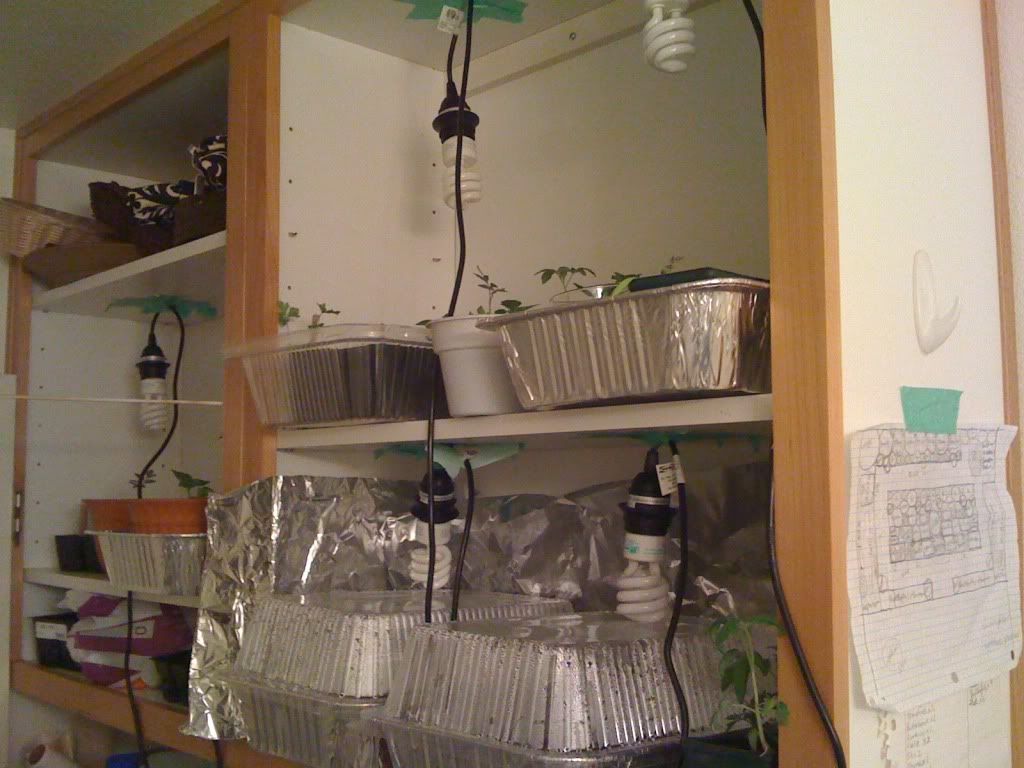
When we decided to start our plants from seed, we did a fair amount of research. Basically, the ideal environment for germinating most seeds (with some notable exceptions) is very warm and humid. There are a number of high buck kits you can buy, and several medium buck plastic tray systems that do the same job, but we decided that the exact same purpose could be served by those cheap, disposable roasting pans that they sell at the grocery store for about 5 bucks for 4 of them. Aluminum bottom, clear plastic top, they are ideal for letting light pass through while locking in the humidity. Also, they are recyclable, easy to pack and store for next season, and may have other uses between seasons, we'll see. So although they were designed to be disposable, they can be used in a greener manner.
Our impromptu growing station
Context: the shelves above our laundry
Some of the seeds we acquired recommended starting outdoors, so we sowed those directly in our soil. We have been getting most of our instructions from The Backyard Homestead, which is oriented to a much larger scale of gardening, but contains most of the info you will need to run a garden of any size, indoor or out. From testing and prepping your soil to knowing when to harvest, this book covers all the bases of growing your own vegetables. It also goes into some detail about how to keep poultry and livestock, but we don't have the kind of yard that makes sense for keeping any animal stock around. If you are a home brewer you might be surprised to find out how easy it is to grow your own hops (also covered in this book). Or barley for that matter. Maybe the ideal garden for you is just grains and hop vines. Of course, it couldn't hurt to experiment with strange grains, or growing some fruit to flavor a Lambic inspired ale.
So far, the seeds sown outdoors are mostly sprouting as well, some took much longer than others, but the success rate seems pretty good. Mainly it is carrots, radishes and beets, along with a different variety of lettuce. The trouble outside, unfortunately, is that slugs get to everything. I will discuss slug and pest prevention in another post, however, because it is a big topic and this post is already too long.
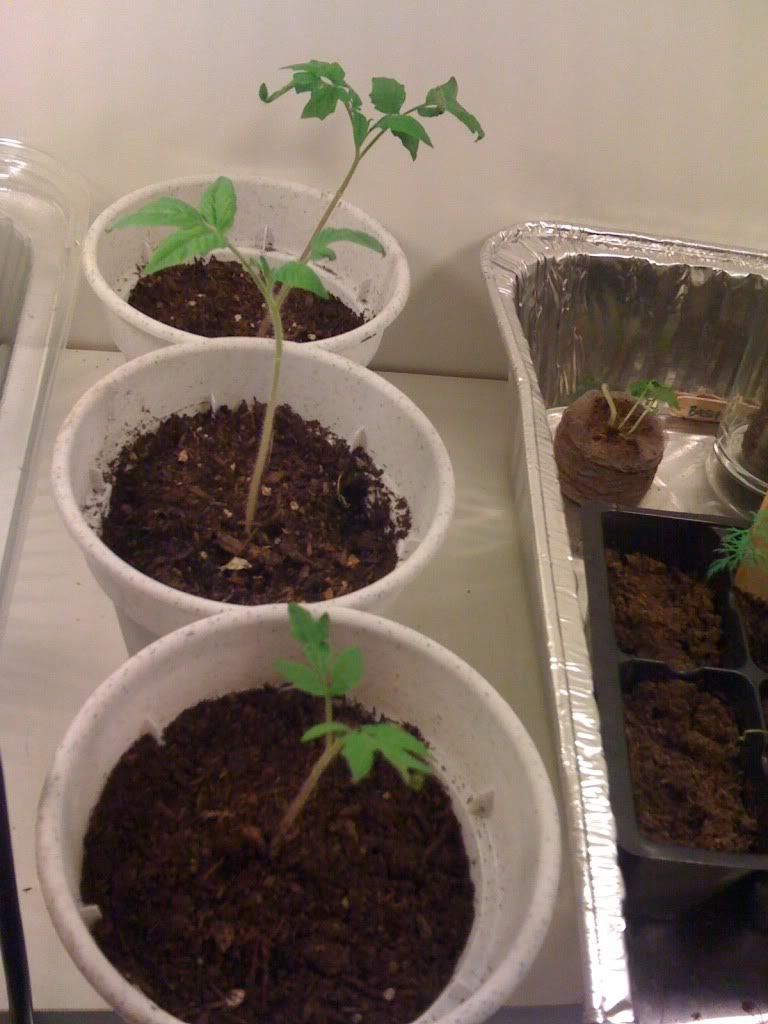
Here are some of our starts after about a month of growth:
Posted by
Gabe Cross
Thursday, August 6, 2009
The Maker Movement - why it is green and why I love it
I don't know if the people who started the Maker Movement intended it to be a green movement, but whether intended or not, it has the potential to do all kinds of green good.
The fact of the matter is that we Americans buy too much junk. And I am not preaching at you here, I am not telling you that you personally are responsible for the over consumption problem, I am saying that too much of the stuff we buy ends up being junk.
So many of the products that we buy are poorly designed, or worse, designed to break. Whats more, when they break, you find that they are impossible to open up and repair. In fact, if you do open one up, your warranty instantly expires, and FBI agents break down your door and cart you off to be prosecuted for theft of intellectual property. Sort of.
Manufacturers have gotten used to the idea that they are selling you a closed system, and if anything ever goes wrong your only options are taking it back to the manufacturer or throwing it out to buy a new one. Planned obsolescence and designing for short product life span ensure that you will need to purchase a replacement widget soon, and the old widget will be useless for any purpose other than filling land.
So what can we possibly do in the face of such an entrenched system? Is there no way out? Well the people at Make Magazine may not have all the answers, but they have a great philosophy for getting more out of your junk, and evaluating whether or not your next purchase is going to be junk.
Make is a Magazine about how to be a modern day tinkerer, how to get more out of those widgets we buy with our hard earned money, and how to turn our landfill fodder into a fun Sunday project. With the purchase of a few basic tools (that should last you the rest of your life), we can conquer our waste stream, open up those busted products to repair them, re purpose them, or possibly even improve them.
Endowing garbage with new value, reusing and re purposing things instead of buying new junk, that is as green as it gets. Also, it's FUN! What former boyscout, amateur engineer, or generally interested person doesn't LOVE the idea of cracking stuff open and messing with the functional parts?
On the purchasing new stuff side, Mr. Jalopy (yes, like an old car) has penned the Maker's Bill of Rights, a simple list of how a product should be presented. In a forum at the UCLA book fair this past spring, he asked the audience: if you can't open something up and tinker with it, do you really own it? Or are you just renting it from the manufacturer? With that in mind, the Maker's bill of rights provides a simple list of rules for products that a Maker will approve of. Some of them are neat little memorable sayings that hold an entire philosophy in a few words, such as the most quotable: "screws are better than glues."
I think that embracing the Maker's philosophy can improve the relationship that people have with their stuff and at the same time reduce unnecessary waste and consumption. I dare say, if more people took the initiative to understand how things work and how to work with them, the positive repercussions could be limitless.
The fact of the matter is that we Americans buy too much junk. And I am not preaching at you here, I am not telling you that you personally are responsible for the over consumption problem, I am saying that too much of the stuff we buy ends up being junk.
So many of the products that we buy are poorly designed, or worse, designed to break. Whats more, when they break, you find that they are impossible to open up and repair. In fact, if you do open one up, your warranty instantly expires, and FBI agents break down your door and cart you off to be prosecuted for theft of intellectual property. Sort of.
Manufacturers have gotten used to the idea that they are selling you a closed system, and if anything ever goes wrong your only options are taking it back to the manufacturer or throwing it out to buy a new one. Planned obsolescence and designing for short product life span ensure that you will need to purchase a replacement widget soon, and the old widget will be useless for any purpose other than filling land.
So what can we possibly do in the face of such an entrenched system? Is there no way out? Well the people at Make Magazine may not have all the answers, but they have a great philosophy for getting more out of your junk, and evaluating whether or not your next purchase is going to be junk.
Make is a Magazine about how to be a modern day tinkerer, how to get more out of those widgets we buy with our hard earned money, and how to turn our landfill fodder into a fun Sunday project. With the purchase of a few basic tools (that should last you the rest of your life), we can conquer our waste stream, open up those busted products to repair them, re purpose them, or possibly even improve them.
Endowing garbage with new value, reusing and re purposing things instead of buying new junk, that is as green as it gets. Also, it's FUN! What former boyscout, amateur engineer, or generally interested person doesn't LOVE the idea of cracking stuff open and messing with the functional parts?
On the purchasing new stuff side, Mr. Jalopy (yes, like an old car) has penned the Maker's Bill of Rights, a simple list of how a product should be presented. In a forum at the UCLA book fair this past spring, he asked the audience: if you can't open something up and tinker with it, do you really own it? Or are you just renting it from the manufacturer? With that in mind, the Maker's bill of rights provides a simple list of rules for products that a Maker will approve of. Some of them are neat little memorable sayings that hold an entire philosophy in a few words, such as the most quotable: "screws are better than glues."
I think that embracing the Maker's philosophy can improve the relationship that people have with their stuff and at the same time reduce unnecessary waste and consumption. I dare say, if more people took the initiative to understand how things work and how to work with them, the positive repercussions could be limitless.
Labels:
consumption,
junk,
make,
maker,
makers,
overconsumption,
project,
repurpose,
reuse,
waste
Posted by
Gabe Cross
Subscribe to:
Posts (Atom)