Number 7 in our list of sustainability related TED Talks, we have Mark Bittman (food writer for NYTimes, author of How to Cook Everything and How to Cook Everything Vegetarian) brings us a very enlightening talk on diet. Specifically, the contemporary western diet and why is bad for the health of both people and the environment.
Bittman approaches the subject of food with love and wit, and makes plain some complex issues of how we arrived at the food system that we have and how we should change our diets to improve both our own health and the environmental impacts of our food systems.
Courtney and I have turned to How to Cook Everything Vegetarian for inspiration in our kitchen for years, and personally came to many of the same conclusions that Mr. Bittman recommends in this talk, but he does such a great job here of summarizing the issues and arriving at the correct conclusions.
Showing posts with label cooking. Show all posts
Showing posts with label cooking. Show all posts
Sunday, August 12, 2012


Wednesday, November 10, 2010
Weekend Meal Planning - Creating All your Meals for the Week in One Day
The key to eating healthy home made food when you have a busy schedule is planning. Sitting down on the weekend and spending 20 minutes planning your meals for the week, and then doing as much cooking and preparation as you can on Saturday or Sunday will save you hours of planning and cooking for the rest of the week. This method has lots of other unintended benefits as well, and the more you develop a routine the more you will see those benefits: less waste, less stress, less expense, more healthy diet.
For some time now, Courtney and I have tried to make a weekly menu before going shopping, starting ingredients that are already in the fridge or pantry. We write this list on a white board in the kitchen, and then write in the date that leftovers were made. Since instituting this simple process, I think we take out the trash about 1/2 as often. Here is what our whiteboard often looks like
If you can avoid prepackaged meals and refrain from eating out for convenience sake (I love eating out, but only when I choose to treat myself), you can save a lot of money while gaining more control over your diet. If you try to plan and cook a meal every night, however, you can quickly become overwhelmed and throw in the towel.
When we decided to do the October: Unprocessed challenge last month, we realized that with our busy schedules we were not going to be able to cook most week nights. Eating out is expensive, but eating healthy and unprocessed foods out is phenomenally expensive. In order to meet the challenge and maintain our savings (what little we have) Courtney and I turned our kitchen into a high efficiency food production facility every Sunday last month, and generally produced enough food in one day to last all week (that is why several of the menu items above have the same date by them). Spending several hours doing intensive cooking is also significantly more efficient in terms of waste and energy. For example, one Sunday, I made a frittata and Courtney cooked cornbread and pumpkin muffins, all at the same time. The oven only heats up once, and there was one temperature change half way though, but over all we had 6 meals worth of food with one meals worth of oven time.
You may think that it would take more energy to refrigerate and freeze all that food, but in fact the opposite is true. The more full your fridge or freezer is, the more efficient it will be. Your fridge works hardest when you open the door, because all of the air it has cooled down escapes, and warm air rushes in. The more stuff you have in the fridge, the less warm air can fill the space. Also, the cold food will help to cool the air, so the actual heat pump doesn't have to work quite as hard.
Our menu over the past few weeks has been pretty extravagant, but our costs and time commitment have been relatively low. We have been eating even less meat, and we feel free to experiment with more ambitious recipes and ideas (this week we plan on making kimchi). One of the keys is making things which are not any more work when scaled up in volume, like soups stews and sauces. The first week we did this, I made a tomato sauce from scratch. A portion was sweetened and turned into pizza sauce that day, the rest was frozen and used variously as the base for enchilada sauce, a pasta sauce, and to make lasagna.
For the rest of the week, Courtney and I are happy to come home and simply reheat our delicious and nutritious food, to wake up and grab left overs on the way out the door. We find we spend less on groceries, since we tend to buy fewer items that can be used for several recipes, and that means less food spoils as well.
We have greatly enjoyed our Sunday cooking days, and hope that it will provide good practice for the extra work that a growing family will (eventually) bring. Also, we are hosting a (very tiny) Thanksgiving here in Eugene for the first time, and our Sunday cooking experiments should serve as good practice for coordinating a large group meal.

For some time now, Courtney and I have tried to make a weekly menu before going shopping, starting ingredients that are already in the fridge or pantry. We write this list on a white board in the kitchen, and then write in the date that leftovers were made. Since instituting this simple process, I think we take out the trash about 1/2 as often. Here is what our whiteboard often looks like
 | |
| Our Home Kitchen Menu |
If you can avoid prepackaged meals and refrain from eating out for convenience sake (I love eating out, but only when I choose to treat myself), you can save a lot of money while gaining more control over your diet. If you try to plan and cook a meal every night, however, you can quickly become overwhelmed and throw in the towel.
When we decided to do the October: Unprocessed challenge last month, we realized that with our busy schedules we were not going to be able to cook most week nights. Eating out is expensive, but eating healthy and unprocessed foods out is phenomenally expensive. In order to meet the challenge and maintain our savings (what little we have) Courtney and I turned our kitchen into a high efficiency food production facility every Sunday last month, and generally produced enough food in one day to last all week (that is why several of the menu items above have the same date by them). Spending several hours doing intensive cooking is also significantly more efficient in terms of waste and energy. For example, one Sunday, I made a frittata and Courtney cooked cornbread and pumpkin muffins, all at the same time. The oven only heats up once, and there was one temperature change half way though, but over all we had 6 meals worth of food with one meals worth of oven time.
You may think that it would take more energy to refrigerate and freeze all that food, but in fact the opposite is true. The more full your fridge or freezer is, the more efficient it will be. Your fridge works hardest when you open the door, because all of the air it has cooled down escapes, and warm air rushes in. The more stuff you have in the fridge, the less warm air can fill the space. Also, the cold food will help to cool the air, so the actual heat pump doesn't have to work quite as hard.
Our menu over the past few weeks has been pretty extravagant, but our costs and time commitment have been relatively low. We have been eating even less meat, and we feel free to experiment with more ambitious recipes and ideas (this week we plan on making kimchi). One of the keys is making things which are not any more work when scaled up in volume, like soups stews and sauces. The first week we did this, I made a tomato sauce from scratch. A portion was sweetened and turned into pizza sauce that day, the rest was frozen and used variously as the base for enchilada sauce, a pasta sauce, and to make lasagna.
 |
| Homemade Tomato Sauce and Pizza with bell pepper and lobster mushrooms |
We have greatly enjoyed our Sunday cooking days, and hope that it will provide good practice for the extra work that a growing family will (eventually) bring. Also, we are hosting a (very tiny) Thanksgiving here in Eugene for the first time, and our Sunday cooking experiments should serve as good practice for coordinating a large group meal.
Saturday, October 2, 2010
Lane County Farmers' Market, FTW!
 Image via Wikipedia
Aside from the abundance of obvious, well known 'shrooms that grow wild all over the Willamette Valley (chanterelles, maitakes, and truffles, to name a few. . . ooooh truffles), the climate is also perfect for some lesser known and truly delicious delicacies. Today I picked up a few, including the chicken of the woods, which believe or not actually tastes and has a texture similar to chicken. Also, I grabbed a few lobster mushrooms, which aside from being red on the outside and white on the inside, actually have a distinct seafood flavor that lends them their name.
 |
| Chicken of the Forest - actually tastes like chicken |
 |
| Lobster Mushroom - actually tastes like lobster |
There was much talk today amongst strangers at the market about how best to cook these delectable fungi, sauteed in butter or tossed in a pasta e.g., but my favorite thing to do with just about any mushroom is make risotto, which I will surely be doing this weekend, as it fits nicely with the October: Unprocessed challenge. For a basic risotto recipe, see my post on Wild Mushroom Risotto from last year. The wonderful thing about this dish is that the risotto provides a rich creamy base that supports the mushroom flavor, lifts it to the fore and lets it shine. The slight crunch of al dente rice is also a nice backdrop for the unique textures that the variety of wild mushrooms have to offer. This is not a dish for the feint of heart, but for those with clear arteries and good exercise routines, it is the ultimate in sinful savory satisfaction.

Nothing New except October: Unprocessed
As the sun sets on my Month of Nothing New, it dawns on October: Unprocessed. The last month went by rather quickly and uneventfully in terms of my challenge, and after thinking it through, I have decided that one month of making no new purchases (excluding food and medicine) is just too easy. It was not really a challenge at all. There were a few minor hiccups, but not one real sense of sacrifice or brilliant solution to a difficult problem. In short, it was not the fodder for good writing that I had hoped it would be. All this has led me to the conclusion that I should extend the challenge, keep it going for perhaps six months. In half a year, I am bound to run into a number of problems that force me to consider breaking the rules, and probably doing it at least once.

 |
| Take the Pledge! Learn More Here. |
In the next month, however, I will focus on the October: Unprocessed pledge, and so I will probably be writing a little more about food. Two things cropped up in September, however, that I felt it would be inappropriate to post in my month of nothing new, so keep your eyes open this October for news about the Unprocessed Pledge and a special treat for my readers. As I promised at the beginning of last month, the next installment of To Dream of Less will be out soon. Also, if you don't know about October: Unprocessed, check it out! Click on the logo above, take the pledge, you still can, join up any time in October and finish the month with Eating Rules, myself, and about 30 other bloggers who have taken the Pledge and agreed to write about it on Andrew Wilder's site.
Sunday, September 12, 2010
Spicy Watermelon and Cucumber Gazpacho -- a Raw, Vegan Recipe
 Image via Wikipedia
Along with the FM watermelon, I used a cucumber from a friend's garden to add crunch, a small red onion for that allium bite, and the juice of a few limes for their tangy citric acid. The lime juice and a pinch of sea salt also helped to break the fruit and veggies down and infuse the individual ingredients with each others' flavors, and to infiltrate them with several peppery additions to the mix. The finishing touch: finely chopped cilantro for an aromatic character that excites the sense of smell before the soup even touches your tongue.
 Image via Wikipedia
It may seem a little late in the season for cold soups, but for the home gardener and the FM shopper the fruit has been ripening all summer and now is definitely the time to use it all up before it spoils. The raw aspect means that there is no energy used at home to prepare the meal, and the fact that it is vegan means that no animals were harmed during the creation of this recipe (I did scold Cleo for trying to eat the onion, but that was for her own good; onions are poisonous to dogs).
 Image via Wikipedia
Spicy Watermelon and Cucumber Gazpacho
Ingredients:
1 small Watermelon
1 Cucumber
1 Red Onion
Juice of 2 Limes
1 fresh Chili, slightly spicy
1 handful fresh Cilantro
Red, Black and White Pepper to taste
A pinch of Sea Salt
Serves 6 as appetizer, 3 or 4 as main course.
Cut the watermelon into slices, and then dice finely. Try to retain as much juice as possible and add with the watermelon to a bowl large enough to hold all ingredients. Dice the red onion, chili and cucumber, and add to the bowl. Finely chop or tear cilantro and add to the other ingredients Add the spices, salt and lime juice, and refrigerate, covered, for at least an hour.
Serve in small cups or mugs, garnish with more cilantro if desired.

Tuesday, August 31, 2010
A Weekend at Theo Chocolate with the IFBC -- Day 1
 |
| Taken from theMaykazine's Flickr Photostream under CC license |
Saturday morning, 6:25am, I walked into the conference hall at Theo Chocolate and found a dozen or so people bustling around in very efficient form, carrying things, moving things, cleaning things, generally doing things to other things in a near frantic state -- the sense of 'panic on the verge' that overwhelms the front line of employees at any conference. Within a minute of arriving, I was carrying cartloads of POM drinks from Theo's industrial fridge to the hall. Being one of only two male volunteers, I figured that I was in for some heavy lifting (people under duress default to traditional gender roles very quickly).
When my first task was completed, I asked about coffee, and was met with a deeply apologetic, wearied, hangdog look. "The coffee vendor isn't here yet, but as soon as they are, you can drop whatever you are doing and get some coffee." I was not about to argue with the severity of that expression, particularly because it came from staffer Reno, who aside from this one moment was the most persistently upbeat and cool guy I met at IFBC.
 Image via Wikipedia
Then some people spoke, it was cool, but the real point, I think, was lunch (just kidding, of course, Barnaby Dorfman gave a very informative talk on SEO; I missed the other morning sessions due to duties). Four wines from the Walla Walla region were paired with small plate offerings from Seattle Chefs. There was also a well received GF table, but since I was flying solo (without the GF wife), I did not partake.
The winner for lunch, in my opinion, was a plate of spicy citrus chick peas topped with a whole marinated baby octopus. The texture of the purple and white octopus was just about indescribable: slightly tough like squid on the outside, a little crunch on the inside, and wholly unique. The red tinged spicy chick peas were a perfect accompaniment to the octopus too, for both their tooth pleasing combination of crunch and give, as well as the acidic tang of the (I think) lime juice. It was prepared by Chef Shannon Galusha from Bastille Cafe and Bar.
After lunch, I was able to sneak away from my volunteer duties to see the session on the Law and Ethics of Food Blogging, which was largely about copyright. The rock star of that talk was Robin Goldstein (sorry Barnaby and Robert) whose presentation was titled "Reducing Bullshit in Wine Writing," if memory serves. As desperately as I wanted to stay for dinner, being completely floored by the fare thus far, I was exhausted and ready to be "off" for the day. If it was a one day event, I might have pushed through, but I could not bear the thought of missing the food trucks on Sunday.
I could write a whole seperate blog post about the Walla Walla Wines, but I will post some links instead. Hopefully that will help to reduce the overall level of Bullshit in Wine Writing.

Tuesday, August 17, 2010
Poaching Eggs: a Few Tips and Pics

 Image via Wikipedia
First of all, you should select the freshest eggs you can find, as fresh eggs coagulate better and less fresh eggs tend to dissipate in the water. Since it is hard to tell when a supermarket egg was collected, I recommend buying from a Farmer's Market or local farm, as they can tell you exactly how fresh the eggs are. Fresh, organic eggs are more expensive, so this is a special treat for anyone who isn't raising their own chickens.
First, fill a large frying pan and a smaller pan with water, about 2 inches deep. Bring them both to a very low boil. Add a little vinegar to the large pan, as the acid will help the encourage the eggs to stay together while cooking. Add a little salt to the small pan, and turn it down to a simmer. This second pan is just a bath to rinse the vinegar and add a little salt when the eggs are done cooking.
When the two pans of water are ready, start the eggs one at a time like so:


- Crack the egg onto a small saucer
- Slide the egg into the acidified water, with the saucer as close as possible to the surface of the water
- Using a slotted spoon, gently roll the white around the yolk as the white hardens
- Repeat, until up to four eggs are in the water
When the eggs are done, gently lift them out of the acidified water and drop them briefly into the salted water, then transfer them to a clean kitchen towel or cloth napkin. Serve before the eggs cool, on buttered toast or muffin, or as your favorite variation of eggs benedict.

Monday, August 16, 2010
The Lovely Town of Oakridge, and What To Do With Fresh Eggs
 Image via Wikipedia
After a swim and picnic by the river, and after picking up more trash than we made (apparently other swimmers had been a little less conscientious), we packed up and headed back to our friends' place to visit with their chickens. Hens which are raised and socialized by people are very friendly, and love to be held and pet. They make sounds kind of like purring cats when you scratch their neck. They also, as you may have heard, lay eggs.
When you see eggs from chickens on a small farm or from a home garden it suddenly becomes very odd that eggs in the grocery store are all white or uniformly brown, and all exactly the same size. This is most unnatural. Our hosts in Oakridge provided us with a dozen eggs, most of which were either brown or speckled brown, and one of which was green. No two eggs were the same size or color.
 |
2/3 of a dozen fresh eggs (the four missing were used in today's breakfast) |
White hens lay white eggs, brown hens lay brown eggs, and green hens... you get the idea, I think. The point is that the eggs resemble their hens, and a dozen eggs that are all identical speaks to our drive to master nature, make it uniformly productive and predictable. Several shelves of cartons and flats of eggs from several different 'farms' that are identical speaks volumes, and is a pretty good picture of what industrial agriculture is all about.
Fresh, organic eggs taste quite different as well. I don't really know how to describe it except to say that they taste 'cleaner.' The best way to experience this difference in flavor is to poach the eggs, and serve simply with a dash of salt and pepper with (or on top of) buttered toast. Poaching has the least influence on the flavor of the eggs, and is the easiest way to get perfectly cooked whites with completely soft yolks. It can be a little stressful if you have never done it before, but the results are well worth it.
Eggs should be poached in just barely boiling water which has been slightly acidified with a bit of plain white vinegar. The Cooks Book (my kitchen bible) recommends cracking the eggs onto a saucer one at a time and gently sliding them into the water, to minimize the splashing effect. Then, using a slotted spoon, gently roll the white over the yolk until it is enveloped. Repeat with the next egg, up to about 4 at a time. Cook them for 2 minutes or so, and then plunge them into a simmering pan of salted water to remove the vinegar and season a little. Set on a dish towel to drain for a few seconds and serve immediately. With fresh eggs, very little seasoning is required, and Hollandaise sauce is kind of overkill (though delicious overkill...).
Unfortunately, fresh organic eggs are pretty expensive, so we are very lucky to have friends producing their own. Still, for a special occasion, perhaps to impress your significant other on valentines day, fresh eggs are a relatively inexpensive and effective splurge. You can find them at most Farmer's Markets.
Eggs should be poached in just barely boiling water which has been slightly acidified with a bit of plain white vinegar. The Cooks Book
(my kitchen bible) recommends cracking the eggs onto a saucer one at a time and gently sliding them into the water, to minimize the splashing effect. Then, using a slotted spoon, gently roll the white over the yolk until it is enveloped. Repeat with the next egg, up to about 4 at a time. Cook them for 2 minutes or so, and then plunge them into a simmering pan of salted water to remove the vinegar and season a little. Set on a dish towel to drain for a few seconds and serve immediately. With fresh eggs, very little seasoning is required, and Hollandaise sauce is kind of overkill (though delicious overkill...).Unfortunately, fresh organic eggs are pretty expensive, so we are very lucky to have friends producing their own. Still, for a special occasion, perhaps to impress your significant other on valentines day, fresh eggs are a relatively inexpensive and effective splurge. You can find them at most Farmer's Markets.
 Image by woodleywonderworks via Flickr
Thursday, July 1, 2010
A few more green BBQ ideas for the 4th of July
Earlier in the season I posted about alternatives to meat for the BBQ, but if you are not a vegetarian already I hardly expect that you will become one this week, and I wouldn't dream of asking anyone to give up meat on the 4th of July. That would be unpatriotic. But what I would dream of asking is that you provide more variety and reduce the amount of beef and pork on the grill, that at least I think is reasonable.
First off, burgers need not all be beef. Turkey burgers are also delicious, and they taste pretty similar. Salmon burgers are absolutely wonderful, though they taste completely different (obviously, they taste like fish). If you get salmon, make sure that it is wild (more sustainable), preferably Alaskan (less mercury). Chicken breasts make an excellent sandwich as well. Finally, if there are any vegetarians in attendance, garden burgers are pretty tasty. Many people grill whole portobello mushrooms like burger patties, and while this is not to my taste, they seem to love it.


Frankfurters are a must for most grillers, but consider replacing a few dogs with a flavored chicken sausage or two. There are tons of varieties, meeting the needs of every palette: sweet, smokey, spicy, etc. Maybe chicken bratwurst with sauerkraut and stone ground mustard catches your taste buds, or chicken apple sausage with diced onion and Dijon. Even if neither of those sounds like your style, I guarantee there is a chicken sausage that will suite your palette.
If you are feeling really adventurous, check out my whole brined chicken recipe. Less, but still a little adventurous? I did the exact same recipe with a pack of chicken thighs to great effect recently. It is much easier to manage on the grill than a whole bird.
And remember, it doesn't have to be all about the meat. If you only grill burgers and dogs, people will eat more of them, but if you also provide some crowd pleasing vegetables like corn on the cob, you don't have to provide as much meat. That should save you a few bucks too. See link at the beginning of this post for a few more ideas.
Finally a note on fuel. Propane is vastly more efficient than burning coal, both in production and end use. Of course I am a huge hypocrite because I love the smokey flavor of real charcoal, and don't plan on replacing my little Webber for some time. I am told you can get a similar smokey effect with liquid smoke, but I cannot vouch for it myself (I haven't tested it because I don't have a propane grill), and don't really know how to use it (does it go in the marinade? added at the end? comment if you know).
If you just happen to be in the market for a new BBQ, and also just happen to have a lot of disposable income, check out the Big Green Egg. Although they are very expensive, they are very, very well reviewed. The design allows for extremely fuel efficient cooking; many people report using one tenth the coal as they would in a conventional metal 'Q. If you figure out how to find one used, let me know.

First off, burgers need not all be beef. Turkey burgers are also delicious, and they taste pretty similar. Salmon burgers are absolutely wonderful, though they taste completely different (obviously, they taste like fish). If you get salmon, make sure that it is wild (more sustainable), preferably Alaskan (less mercury). Chicken breasts make an excellent sandwich as well. Finally, if there are any vegetarians in attendance, garden burgers are pretty tasty. Many people grill whole portobello mushrooms like burger patties, and while this is not to my taste, they seem to love it.

A Delicious Looking Salmon Burger
Image taken from robtrent's Flickr photostream under CC license.

A portobello mushroom burger
Image taken from karitsu's Flickr photostream under CC licence
Frankfurters are a must for most grillers, but consider replacing a few dogs with a flavored chicken sausage or two. There are tons of varieties, meeting the needs of every palette: sweet, smokey, spicy, etc. Maybe chicken bratwurst with sauerkraut and stone ground mustard catches your taste buds, or chicken apple sausage with diced onion and Dijon. Even if neither of those sounds like your style, I guarantee there is a chicken sausage that will suite your palette.
If you are feeling really adventurous, check out my whole brined chicken recipe. Less, but still a little adventurous? I did the exact same recipe with a pack of chicken thighs to great effect recently. It is much easier to manage on the grill than a whole bird.
And remember, it doesn't have to be all about the meat. If you only grill burgers and dogs, people will eat more of them, but if you also provide some crowd pleasing vegetables like corn on the cob, you don't have to provide as much meat. That should save you a few bucks too. See link at the beginning of this post for a few more ideas.
Finally a note on fuel. Propane is vastly more efficient than burning coal, both in production and end use. Of course I am a huge hypocrite because I love the smokey flavor of real charcoal, and don't plan on replacing my little Webber for some time. I am told you can get a similar smokey effect with liquid smoke, but I cannot vouch for it myself (I haven't tested it because I don't have a propane grill), and don't really know how to use it (does it go in the marinade? added at the end? comment if you know).
If you just happen to be in the market for a new BBQ, and also just happen to have a lot of disposable income, check out the Big Green Egg. Although they are very expensive, they are very, very well reviewed. The design allows for extremely fuel efficient cooking; many people report using one tenth the coal as they would in a conventional metal 'Q. If you figure out how to find one used, let me know.
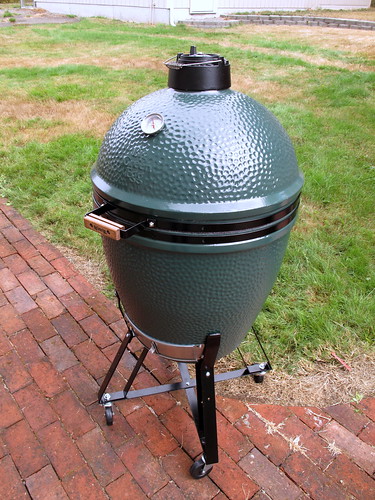
A 'Big Green Egg' BBQ and smoker
Image taken from DerekL1963's photostream under CC license
That is it for now, enjoy the food friends and family on your fourth.
Sunday, May 30, 2010
Cannellini Marbella: a Vegan Spin on a Traditional Mediterranean Dish
The first time that my wife cooked for me, back when we were dating, she made Chicken Marbella. It was delicious. Little did I know it was one of only a handful of things she knew how to cook! Of course now she is as good a cook as me (largely due to my tutelage). But the Marbella is still a wonderful dish, and we still make it occasionally. Courtney got it from her mother, Jan, who contributed it to a state department cookbook many years ago.
Last night we decided to give it a new twist. We didn't have any meat in the house, as we are trying to eat vegetarian as often as possible, so we decided to give Cannellini Beans Marbella a try. It was a delightful experiment, and one we are sure to repeat. The base of the sauce is chopped prunes, crushed olives and capers, simmered in white wine and red wine vinegar. It is sweet, salty, and tangy, providing a complex and exciting glaze to liven up the Cannellinis, The process is pretty simple and the cooking time is very quick, making this an excellent weeknight meal. The fact that it is vegan makes this a very green weeknight meal.
While Chicken Marbella is a baked dish, this version is all prepared in one pan on the stove top.
Cannellini Beans Marbella:
(Serves 4)
2 Cup Precooked Cannellini Beans, or 1 Can
2 or 3 tbsp. Olive Oil
2 Cloves Garlic
1/4 cup Chopped Prunes
1/4 cup Green Olives, pitted and crushed
2 tbsp. Capers, with brine
2 Bay Leaves
1 tsp Oregano
1 tsp Parsley
1/4 cup White Wine
1/4 cup Red Wine Vinegar
2 tbsp Brown Sugar (or demerara)
Salt and Freshly Ground Pepper to taste
Saute the garlic and prunes in the olive oil until garlic is softened, but not browned. Add the rest of the ingredients except the beans, and bring the liquid to a boil. Bring down to a simmer until the liquid reduces to a syrupy glaze, about 15 minutes. Taste and adjust seasoning as needed. Add the beans and stir to coat with the sauce. Continue stirring until beans are heated through, about 5 minutes. Serve immediately.
Last night we decided to give it a new twist. We didn't have any meat in the house, as we are trying to eat vegetarian as often as possible, so we decided to give Cannellini Beans Marbella a try. It was a delightful experiment, and one we are sure to repeat. The base of the sauce is chopped prunes, crushed olives and capers, simmered in white wine and red wine vinegar. It is sweet, salty, and tangy, providing a complex and exciting glaze to liven up the Cannellinis, The process is pretty simple and the cooking time is very quick, making this an excellent weeknight meal. The fact that it is vegan makes this a very green weeknight meal.
While Chicken Marbella is a baked dish, this version is all prepared in one pan on the stove top.
Cannellini Beans Marbella:
(Serves 4)
2 Cup Precooked Cannellini Beans, or 1 Can
2 or 3 tbsp. Olive Oil
2 Cloves Garlic
1/4 cup Chopped Prunes
1/4 cup Green Olives, pitted and crushed
2 tbsp. Capers, with brine
2 Bay Leaves
1 tsp Oregano
1 tsp Parsley
1/4 cup White Wine
1/4 cup Red Wine Vinegar
2 tbsp Brown Sugar (or demerara)
Salt and Freshly Ground Pepper to taste
Saute the garlic and prunes in the olive oil until garlic is softened, but not browned. Add the rest of the ingredients except the beans, and bring the liquid to a boil. Bring down to a simmer until the liquid reduces to a syrupy glaze, about 15 minutes. Taste and adjust seasoning as needed. Add the beans and stir to coat with the sauce. Continue stirring until beans are heated through, about 5 minutes. Serve immediately.
 Cannellini Beans Marbella
Thursday, May 20, 2010
Brining, Butterflying and BBQing a Whole Bird
Chicken is a slightly more sustainable option than beef, pork, or any other livestock. Less water and grain go into raising them, they produce less hydrocarbon gases in their lives, and they come to harvest much more quickly and efficiently. Also, BBQed chicken is extremely tasty. A well marinated piece of chicken from the Q is much preferable, in my (ok, not so) humble opinion to an ordinary burger or dog.
While cooking meat over coals in your yard is not the most sustainable way to heat food, it happens to be delicious. Also, there is a little trade off to cooking inside during the summer if your oven is competing with your AC. Depending on where your oven and stove are located in your house, they can warm the place up as much as a fire place or small furnace. This may be lovely in the middle of winter, but in the summer months it means cranking up the AC or suffering miserable consequences. Getting out doors and heating your food there can help you avoid turning the AC on, perhaps even all day.
So here is my recipe, tested on a recent sunny day here in Oregon. It came out absolutely delicious. The brining adds tons of flavor and keeps the chicken superbly moist on the grill. Combine that with the smokey aroma and the texture of the crispy grilled skin, and you have the ultimate BBQed meat experience.
Brined, Butterflied and Barbecued Bird:
Ingredients:
1 Whole Chicken, raw
1/2 Gallon Cold Water
1/2 Cup Kosher or Sea Salt (not iodized)
1/2 cup Brown Sugar or 1/3 cup Honey
1/4 Cup Vinegar
2 Bay leafs
Tools:
Large Pot (~2 gallon) with Lid
Very Sharp Chef's Knife or Poultry Shears
4 Long Metal Skewers

The night before cooking, prepare the brine by mixing all of the above ingredients except the chicken in a pot large enough to hold everything. Stir until salt and sugar are dissolved. It might be easier to dissolve these ingredients in a cup of the water and all the vinegar over a gentle heat, and then stir into the rest of the cold water. Avoid heating the brine too much, however, it should be kept as cool as possible. When brine is ready, add the chicken, upside down (legs pointing up). Make sure that it is completely submerged, and that the cavity is filled with brine. If there is not enough brine to cover the bird, add more water and salt at a ratio of 1 cup water to 1 tablespoon salt until the bird is covered. The bird may have to be weighted down to remain submerged. Cover and keep in the refrigerator over night.
The next day, remove the chicken from the brine and wipe of any excess liquid. Discard the brine, do not reuse or incorporate into another recipe. On a large cutting board, set the chicken upright and with a very sharp, large knife, cut out the backbone. From top to bottom separate the spine from the rest of the bird first down one side, then the other. Alternatively, use poultry shears to cut out the backbone.
With the spine removed, pull open the bird and flatten it out, so what was the inside is now down, and the meat is all up. Press down firmly on the breasts, cracking the ribs to make the bird flatter. This will allow for more even cooking on the grill.
Use 4 metal skewers to hold the bird in this flat position, and to hold the wings and legs as much as possible apart from the breasts and thighs. Make sure that the bird can be lifted from these skewers and remain flat. Cut a few slits in the thickest part of meat to speed cooking. Coat the entire chicken, both sides, with olive oil, especially around the slits and where pierced by the skewers.
Sear both sides on a very high heat grill. Next, move it to a medium heat part of the grill and allow to cook through, approximately one hour, turning and rotating every 15 minutes. Covering will make heat more even, but coals will burn at a lower temperature, slowing cooking time.
Test for doneness by sticking a toothpick or another skewer into the joints between the leg and thigh, the wing and breast, and into the thickest parts of meat. Test in several locations. If any redness is still in the liquid that runs out of any test holes, continue to cook until all new test holes produce only clear liquid.
When it is done, remove from the grill and cut into breasts, wings, thighs and drumsticks. If any red liquid is found when cutting, put the pieces back on the grill, or wrap in tinfoil and finish in the oven. If not, serve immediately.
Variations:
You can add almost any herbs, dried or fresh, to the brine. Check out Foodista for tons of brine recipes. A little goes a long way, it will completely infuse the meat.
Smaller birds will work even better: pheasant, quail, and game hen. They will cook much quicker, however, in proportion to their size.

While cooking meat over coals in your yard is not the most sustainable way to heat food, it happens to be delicious. Also, there is a little trade off to cooking inside during the summer if your oven is competing with your AC. Depending on where your oven and stove are located in your house, they can warm the place up as much as a fire place or small furnace. This may be lovely in the middle of winter, but in the summer months it means cranking up the AC or suffering miserable consequences. Getting out doors and heating your food there can help you avoid turning the AC on, perhaps even all day.
So here is my recipe, tested on a recent sunny day here in Oregon. It came out absolutely delicious. The brining adds tons of flavor and keeps the chicken superbly moist on the grill. Combine that with the smokey aroma and the texture of the crispy grilled skin, and you have the ultimate BBQed meat experience.
Brined, Butterflied and Barbecued Bird:
Ingredients:
1 Whole Chicken, raw
1/2 Gallon Cold Water
1/2 Cup Kosher or Sea Salt (not iodized)
1/2 cup Brown Sugar or 1/3 cup Honey
1/4 Cup Vinegar
2 Bay leafs
Tools:
Large Pot (~2 gallon) with Lid
Very Sharp Chef's Knife or Poultry Shears
4 Long Metal Skewers

(promise more pics the next time I make this)
The night before cooking, prepare the brine by mixing all of the above ingredients except the chicken in a pot large enough to hold everything. Stir until salt and sugar are dissolved. It might be easier to dissolve these ingredients in a cup of the water and all the vinegar over a gentle heat, and then stir into the rest of the cold water. Avoid heating the brine too much, however, it should be kept as cool as possible. When brine is ready, add the chicken, upside down (legs pointing up). Make sure that it is completely submerged, and that the cavity is filled with brine. If there is not enough brine to cover the bird, add more water and salt at a ratio of 1 cup water to 1 tablespoon salt until the bird is covered. The bird may have to be weighted down to remain submerged. Cover and keep in the refrigerator over night.
The next day, remove the chicken from the brine and wipe of any excess liquid. Discard the brine, do not reuse or incorporate into another recipe. On a large cutting board, set the chicken upright and with a very sharp, large knife, cut out the backbone. From top to bottom separate the spine from the rest of the bird first down one side, then the other. Alternatively, use poultry shears to cut out the backbone.
With the spine removed, pull open the bird and flatten it out, so what was the inside is now down, and the meat is all up. Press down firmly on the breasts, cracking the ribs to make the bird flatter. This will allow for more even cooking on the grill.
Use 4 metal skewers to hold the bird in this flat position, and to hold the wings and legs as much as possible apart from the breasts and thighs. Make sure that the bird can be lifted from these skewers and remain flat. Cut a few slits in the thickest part of meat to speed cooking. Coat the entire chicken, both sides, with olive oil, especially around the slits and where pierced by the skewers.
Sear both sides on a very high heat grill. Next, move it to a medium heat part of the grill and allow to cook through, approximately one hour, turning and rotating every 15 minutes. Covering will make heat more even, but coals will burn at a lower temperature, slowing cooking time.
Test for doneness by sticking a toothpick or another skewer into the joints between the leg and thigh, the wing and breast, and into the thickest parts of meat. Test in several locations. If any redness is still in the liquid that runs out of any test holes, continue to cook until all new test holes produce only clear liquid.
When it is done, remove from the grill and cut into breasts, wings, thighs and drumsticks. If any red liquid is found when cutting, put the pieces back on the grill, or wrap in tinfoil and finish in the oven. If not, serve immediately.
Variations:
You can add almost any herbs, dried or fresh, to the brine. Check out Foodista for tons of brine recipes. A little goes a long way, it will completely infuse the meat.
Smaller birds will work even better: pheasant, quail, and game hen. They will cook much quicker, however, in proportion to their size.

Wednesday, May 19, 2010
Alternatives to Beef as Barbecue Season Approaches
Up here in the Pacific North West, when the sun shines you notice. You don't just notice in fact, you suddenly feel like wearing shorts and firing up the grill, even if it is still in the mid 50s outside. So as BBQ season fast approaches, I thought I would try to inspire my handful of readers with a few grilling ideas which do not involve beef or pork.
Now don't get me wrong, I love hamburgers and ribs. I just feel that it is important to limit how much livestock I eat. As good as beef is, feed lot beef is wasteful in a number of ways. But at the same time, I don't want anyone to feel that their barbecue is in any way compromised by the lack of beef. So here are some ideas for successful grilling in a slightly greener fashion.

Vegetables seem to be an afterthought for many 'Qers, but certain veggies for certain people make the meal. Courtney's favorite (and one of mine too) is corn, grilled on the cob and in the husk. It is really easy to do, very low maintenance, and delicious. You literally just throw it on, husk and all, and when the outer layer of the husk is just about burned through, the corn should be done. Other vegetables that can be grilled whole are any kind of peppers (they cook quickly, so keep an eye on them), asparagus (always place them perpendicular to grill), and long string beans (choose big, thick beans for best results). Coating any of these veggies lightly in oil will help them keep their moisture, but is not necessary.
Any kind of zucchini or summer squash is great on the grill too, but should be cut into long, thick slabs first. Eggplant gets the same treatment. Since you are cutting into these vegetables, you should coat them well with oil to keep them from drying out too much on the grill. For the same reason, cook them quickly on the hottest part of the grill for best results. Onions, garlic, or anything similar are great grilled, and after grilling can be used to make sauces and salsas smokier.
Last word on vegetables: you can cook almost anything else in a tinfoil pouch. This is particularly good for root vegetables like sweet potatoes, carrots, beets, etc. Cut larger vegetables into rough cubes so they will cook a little faster, and rub the inside of the tinfoil pouch with oil to seal in the moisture. This is really more like steaming or baking than it is grilling, but since the coals are already hot/ the propane is already burning, why not throw it on. My brother Nathan, who is possibly the best chef who never got paid to cook, does sweet potatoes whole wrapped in tinfoil You can tell when they are done by inserting a toothpick right through the foil on the grill. If it goes all the way through easily, they are ready. And remember, when you are done that tinfoil is recyclable, no matter how dirty it got during its use.
Yeah, but where's the beef? I have a little secret that I want to let you in on: ground beef tastes like nothing. Don't believe me, do you? Try a little experiment. Cook a hamburger with no seasoning, no sauce, no oil, just beef and grill. Eat it like a steak, no bun, no condiments. The result: blander than tofu. My first experience with a garden burger was a real eye opener: if the bun and the condiments are the same, the garden burger tastes just about as good as the real deal.
I draw the line at tofu hot dogs, though. Partially because they really are less flavorful than their meaty counterpart (hot dogs are made with tons of salt and delicious but deadly nitrates), but also because it is a pretty sorry end for some tofu. I think tofu should be treated like tofu, marinated in an Asian or Hawaiian sauce, and grilled in big square slabs. Tofu has its own great tradition, and by trying to make it something it is not we just further convince carnivores that it is bland and boring.

So to sum up the meat replacements, it is all about the sauce. I recently posted my Cross Country BBQ Sauce on Foodista, and I think it is just about the perfect sauce for anything grilled. It also happens to be quick and easy to prepare, and very versatile. Simply adjusting the proportions can make it more sweet, spicy, tangy or salty.
And finally, if you absolutely must have meat, try cooking chicken instead of the bigger polluters: beef and pork. Tomorrow I will post a recipe for cooking a whole bird on the Q.
Now don't get me wrong, I love hamburgers and ribs. I just feel that it is important to limit how much livestock I eat. As good as beef is, feed lot beef is wasteful in a number of ways. But at the same time, I don't want anyone to feel that their barbecue is in any way compromised by the lack of beef. So here are some ideas for successful grilling in a slightly greener fashion.

Vegetables seem to be an afterthought for many 'Qers, but certain veggies for certain people make the meal. Courtney's favorite (and one of mine too) is corn, grilled on the cob and in the husk. It is really easy to do, very low maintenance, and delicious. You literally just throw it on, husk and all, and when the outer layer of the husk is just about burned through, the corn should be done. Other vegetables that can be grilled whole are any kind of peppers (they cook quickly, so keep an eye on them), asparagus (always place them perpendicular to grill), and long string beans (choose big, thick beans for best results). Coating any of these veggies lightly in oil will help them keep their moisture, but is not necessary.
Any kind of zucchini or summer squash is great on the grill too, but should be cut into long, thick slabs first. Eggplant gets the same treatment. Since you are cutting into these vegetables, you should coat them well with oil to keep them from drying out too much on the grill. For the same reason, cook them quickly on the hottest part of the grill for best results. Onions, garlic, or anything similar are great grilled, and after grilling can be used to make sauces and salsas smokier.
Last word on vegetables: you can cook almost anything else in a tinfoil pouch. This is particularly good for root vegetables like sweet potatoes, carrots, beets, etc. Cut larger vegetables into rough cubes so they will cook a little faster, and rub the inside of the tinfoil pouch with oil to seal in the moisture. This is really more like steaming or baking than it is grilling, but since the coals are already hot/ the propane is already burning, why not throw it on. My brother Nathan, who is possibly the best chef who never got paid to cook, does sweet potatoes whole wrapped in tinfoil You can tell when they are done by inserting a toothpick right through the foil on the grill. If it goes all the way through easily, they are ready. And remember, when you are done that tinfoil is recyclable, no matter how dirty it got during its use.
Yeah, but where's the beef? I have a little secret that I want to let you in on: ground beef tastes like nothing. Don't believe me, do you? Try a little experiment. Cook a hamburger with no seasoning, no sauce, no oil, just beef and grill. Eat it like a steak, no bun, no condiments. The result: blander than tofu. My first experience with a garden burger was a real eye opener: if the bun and the condiments are the same, the garden burger tastes just about as good as the real deal.
I draw the line at tofu hot dogs, though. Partially because they really are less flavorful than their meaty counterpart (hot dogs are made with tons of salt and delicious but deadly nitrates), but also because it is a pretty sorry end for some tofu. I think tofu should be treated like tofu, marinated in an Asian or Hawaiian sauce, and grilled in big square slabs. Tofu has its own great tradition, and by trying to make it something it is not we just further convince carnivores that it is bland and boring.

Grilled Tofu w/ Homemade Spicy Teriyaki sauce
To get those perfect grill marks, turn 30 degrees halfway through cooking each side
To get those perfect grill marks, turn 30 degrees halfway through cooking each side
So to sum up the meat replacements, it is all about the sauce. I recently posted my Cross Country BBQ Sauce on Foodista, and I think it is just about the perfect sauce for anything grilled. It also happens to be quick and easy to prepare, and very versatile. Simply adjusting the proportions can make it more sweet, spicy, tangy or salty.
And finally, if you absolutely must have meat, try cooking chicken instead of the bigger polluters: beef and pork. Tomorrow I will post a recipe for cooking a whole bird on the Q.


Friday, April 2, 2010
Vegetarian Lasagna (Gluten Free, of course)
After an unplanned, unannounced and unceremonious sabbatical from blogging, I am returning to my few but faithful readers with a recipe, in part to point out that I am a finalist in the Foodista 'Best of Food Blogs' cookbook contest. If I am selected, one (or two?) of my recipes will be included in a real world published cookbook (BTW, I finally added pictures to my gumbo recipe for anyone who is interested). I didn't start this blog to be about food entirely, but as cooking is one of my passions the blog became at least partially about food as it relates to sustainability, and I am glad that it did, because cooking (and eating) good food brings me great joy.
A few days back, Courtney and I made one of those throw together weeknight meals that usually succeed only at sustaining one's body for another day or two, but we were pleasantly surprised by the results. We made lasagna with some brown rice pasta noodles that had been sitting in our cupboard for some time, and by adding a few choice ingredients we took it form the realm of 'bland though filling' to 'can't wait to have that recipe again.' Basically, we prepared a straight forward lasagna but threw in to each layer a sporadic sprinkling of fresh red bell pepper (chopped finely) and fresh basil leaves (whole).
Italian cuisine is ideal for communal cooking. I am reminded of the scene in Good Fellas when the main character serves a short prison sentence and the mobsters all have their own private, minimum security wing. They spend all day, every day, preparing elaborate meals with the finest ingredients they can bribe the guards to bring them. One guy does the sauce, one guy does the pasta, etc. The work is easy to break up, most of it is fairly simple, and you can socialize in the kitchen while doing it. Lasagna is particularly good for a small group or a family to prepare together, as you assemble the layers each person can be responsible for one or two ingredients.
And of course, cooking vegetarian makes this a greener meal, since no methane producing grain eating animals were harvested to bring it to table. So, without further ado,
Vegetarian Lasagna (Gluten Free):

Ingredients:
1 package Gluten Free Brown Rice Lasagna Noodles
3 or 4 cups of your favorite Canned Pasta Sauce, or homemade
2 cup Ricotta Cheese (or more as needed)
2 cup Mozzarella cheese, grated (or more as needed)
1 cup Chopped Spinach (frozen is fine)
1 Red Bell Pepper, julienne or diced
1 hand full Fresh Basil Leaves
1 tsp. Sea Salt (or to taste)
1 tsp. Cracked Black Pepper (or to taste)
1 tbsp. Olive Oil
Optional: Cayenne pepper and Paprika to taste
Cook the noodles in a large pot filled with boiling water for several minutes, until they are soft enough to work with but still quite al dente, as they will continue to cook in the oven and it is easy to over cook rice noodles. In a small sauce pan, bring the tomato sauce to a boil, then add the spinach. While the noodles and spinach are cooking, prepare the other ingredients: wash and chop the bell pepper, wash the basil leaves, grate the mozzarella, etc. When noodles are ready, empty pot into a strainer and rinse noodles with cold water to arrest cooking.
Preheat Oven to 400F. Grease a 9x12 (or sized to your noodles) pan with the olive oil, and lay one layer of noodles on the bottom. Cover the noodles with a portion of the sauce and spinach mixture. Over the sauce, sprinkle some of the mozzarella and ricotta cheeses, Some of the Red Bell Pepper and the Basil. Cover with another layer of noodles and repeat until out of ingredients. Make sure to reserve a portion of cheese large enough to cover the top layer, as it will melt and form a golden brown crust in the oven.
Bake the assembled lasagna in the oven for about 30 minutes. Check periodically, when the cheese on top forms a gratin-like crust, it is done. Remove from the oven and let stand for 10 minutes before serving. Should make about 6 portions. Refrigerate for several days, or freeze for-almost-ever (use common sense). Reheats very well in the oven or microwave.
Variations:
This recipe is extremely versatile. Add one or two of whatever vegetables you have around, as a replacement for or in addition to the bell pepper and spinach. Hard, root vegetables (like potatoes) should be par cooked.
For some protein, consider adding pine nuts, crushed walnuts, or cooked beans to the layers. Any ground meat or sausage will also go well, but then the meal would be less green. Similarly, canned tuna or other flaky fish will work well.
For more variety in your variety, try replacing the sauce with pesto (result will be dryer), Alfredo or other cream sauce. I recommend against Vodka sauce, or any other sauce with a lot of cheese added, as there is a ton of cheese in the recipe already.
Speaking of cheese, Parmesan also goes very well. Replace some or all of the Mozzarella with grated Parmesan if preferred.
A few days back, Courtney and I made one of those throw together weeknight meals that usually succeed only at sustaining one's body for another day or two, but we were pleasantly surprised by the results. We made lasagna with some brown rice pasta noodles that had been sitting in our cupboard for some time, and by adding a few choice ingredients we took it form the realm of 'bland though filling' to 'can't wait to have that recipe again.' Basically, we prepared a straight forward lasagna but threw in to each layer a sporadic sprinkling of fresh red bell pepper (chopped finely) and fresh basil leaves (whole).
Italian cuisine is ideal for communal cooking. I am reminded of the scene in Good Fellas when the main character serves a short prison sentence and the mobsters all have their own private, minimum security wing. They spend all day, every day, preparing elaborate meals with the finest ingredients they can bribe the guards to bring them. One guy does the sauce, one guy does the pasta, etc. The work is easy to break up, most of it is fairly simple, and you can socialize in the kitchen while doing it. Lasagna is particularly good for a small group or a family to prepare together, as you assemble the layers each person can be responsible for one or two ingredients.
And of course, cooking vegetarian makes this a greener meal, since no methane producing grain eating animals were harvested to bring it to table. So, without further ado,
Vegetarian Lasagna (Gluten Free):

Ingredients:
1 package Gluten Free Brown Rice Lasagna Noodles
3 or 4 cups of your favorite Canned Pasta Sauce, or homemade
2 cup Ricotta Cheese (or more as needed)
2 cup Mozzarella cheese, grated (or more as needed)
1 cup Chopped Spinach (frozen is fine)
1 Red Bell Pepper, julienne or diced
1 hand full Fresh Basil Leaves
1 tsp. Sea Salt (or to taste)
1 tsp. Cracked Black Pepper (or to taste)
1 tbsp. Olive Oil
Optional: Cayenne pepper and Paprika to taste
Cook the noodles in a large pot filled with boiling water for several minutes, until they are soft enough to work with but still quite al dente, as they will continue to cook in the oven and it is easy to over cook rice noodles. In a small sauce pan, bring the tomato sauce to a boil, then add the spinach. While the noodles and spinach are cooking, prepare the other ingredients: wash and chop the bell pepper, wash the basil leaves, grate the mozzarella, etc. When noodles are ready, empty pot into a strainer and rinse noodles with cold water to arrest cooking.
Preheat Oven to 400F. Grease a 9x12 (or sized to your noodles) pan with the olive oil, and lay one layer of noodles on the bottom. Cover the noodles with a portion of the sauce and spinach mixture. Over the sauce, sprinkle some of the mozzarella and ricotta cheeses, Some of the Red Bell Pepper and the Basil. Cover with another layer of noodles and repeat until out of ingredients. Make sure to reserve a portion of cheese large enough to cover the top layer, as it will melt and form a golden brown crust in the oven.
Bake the assembled lasagna in the oven for about 30 minutes. Check periodically, when the cheese on top forms a gratin-like crust, it is done. Remove from the oven and let stand for 10 minutes before serving. Should make about 6 portions. Refrigerate for several days, or freeze for-almost-ever (use common sense). Reheats very well in the oven or microwave.
Variations:
This recipe is extremely versatile. Add one or two of whatever vegetables you have around, as a replacement for or in addition to the bell pepper and spinach. Hard, root vegetables (like potatoes) should be par cooked.
For some protein, consider adding pine nuts, crushed walnuts, or cooked beans to the layers. Any ground meat or sausage will also go well, but then the meal would be less green. Similarly, canned tuna or other flaky fish will work well.
For more variety in your variety, try replacing the sauce with pesto (result will be dryer), Alfredo or other cream sauce. I recommend against Vodka sauce, or any other sauce with a lot of cheese added, as there is a ton of cheese in the recipe already.
Speaking of cheese, Parmesan also goes very well. Replace some or all of the Mozzarella with grated Parmesan if preferred.
Wednesday, February 17, 2010
The Valentine's Menu: Black Truffle and Wild Scallops on Mashed White Beans
Some lament the commercialization of holidays like Valentines day, others decry that it is a made up Hallmark Holiday, and while these arguments cannot be refuted, they also shouldn't stop us from having fun.
For our part, we avoid buying each other presents or cards and instead focus on having a lovely, romantic day. Though we have dined out in the past we now prefer to cook at home, making a meal that is decadent and fun. Decadent does not have to mean environmentally unhealthy, however, especially when you live in an area that produces truffles which some believe rival the Italian. Both black and white truffles grow abundantly in Oregon and Northern California, and though they are quite expensive the flavor is phenomenal and unique. Wild scallops, which have been unsustainable in the past, have seen massive increases in population size recently, and most sources now say that scallops can be fished sustainably and are okay for environmentalists to eat (though if you can find out the info, individually caught is better than dredged).

It is important for us to use every excuse to spend time with and honor the people we love, regardless of whether the excuse is tradition or Hallmark made. The way we do this, however, is up to us and not the card companies or the traditions. Cooking a meal made from the best available local and sustainable ingredients instead of purchasing cards and chocolate boxes and dining out turns our expression of our love for each other into a reinforcement of the way we choose to live. And personally I think it is more fun. Speaking of fun, for desert we made a chocolate Fondue, dipping homemade donut pieces from that morning along with some fancy marshmallows

So, for your scrutiny, here is the dinner recipe:
Wild Scallops with Black Truffle Brandy Reduction and Mashed Great Northern Beans
Serves Two
 Image via Wikipedia
Ingredients:
1 small Black Truffle (~1/2 oz.)
6 medium to large Wild Scallops (~1/2 lbs.)
1/2 lbs Dry Great Northern Beans (or Cannellini)
1 large Shallot
3 oz VSOP Brandy
2 tbsp dry White Wine
6 tbsp Olive Oil
4 tbsp butter
1 Green Onion, finely chopped
The night before cooking, rinse the beans and visually inspect for rocks. Cover the beans with water in a sauce pan and leave to soak overnight. The following day, discard the soaking liquid and rinse the beans once more. Cover with water and bring to a boil, then reduce to a simmer and cook until beans are tender, about 1 hour.
Chop the black truffle very finely. Alternatively, you can use a mandolin, cheese grater or vegetable peeler to get smaller and more regular pieces. Melt 2 tbsp butter into 2 tbsp olive oil in a small pan, and add the truffle. Simmer over a low heat until well browned. This will mellow the funkiness of the black truffle and draw out its flavor (this step is not necessary with white truffles). When truffle pieces are well browned, cover and keep nearby.
When the beans are done, drain the cooking liquid, reserving about a half cup. Using a food processor or blender, mash the beans with 1 tbsp olive oil, the white wine, 1 oz of Brandy, and a pinch of salt and pepper. If needed, add the cooking liquid a little at a time to control consistency. When beans are well blended, return to the sauce pan and keep warm over a low heat.
Dice the shallot finely and brown in 1 tbsp olive oil. When it is well browned, add it to the beans along with half of the black truffle and oil mixture, stirring well.
Sear the scallops over medium-high heat in 2 tbsp olive oil, about 5 minutes per side. When scallops are finished, place them on a bed of the mashed beans on serving plates. Quickly deglaze the pan with the remaining 2 oz of brandy, add the remaining truffle and oil mixture, remove from heat and stir the remaining 2 tbsp of butter to finish the pan sauce. Pour the sauce over the scallops and mashed beans, garnish with green onion, serve immediately.


For our part, we avoid buying each other presents or cards and instead focus on having a lovely, romantic day. Though we have dined out in the past we now prefer to cook at home, making a meal that is decadent and fun. Decadent does not have to mean environmentally unhealthy, however, especially when you live in an area that produces truffles which some believe rival the Italian. Both black and white truffles grow abundantly in Oregon and Northern California, and though they are quite expensive the flavor is phenomenal and unique. Wild scallops, which have been unsustainable in the past, have seen massive increases in population size recently, and most sources now say that scallops can be fished sustainably and are okay for environmentalists to eat (though if you can find out the info, individually caught is better than dredged).

Valentine's Day Dinner
It is important for us to use every excuse to spend time with and honor the people we love, regardless of whether the excuse is tradition or Hallmark made. The way we do this, however, is up to us and not the card companies or the traditions. Cooking a meal made from the best available local and sustainable ingredients instead of purchasing cards and chocolate boxes and dining out turns our expression of our love for each other into a reinforcement of the way we choose to live. And personally I think it is more fun. Speaking of fun, for desert we made a chocolate Fondue, dipping homemade donut pieces from that morning along with some fancy marshmallows

Our Valentine's Breakfast
So, for your scrutiny, here is the dinner recipe:
Wild Scallops with Black Truffle Brandy Reduction and Mashed Great Northern Beans
Serves Two
 Image via Wikipedia
Ingredients:
1 small Black Truffle (~1/2 oz.)
6 medium to large Wild Scallops (~1/2 lbs.)
1/2 lbs Dry Great Northern Beans (or Cannellini)
1 large Shallot
3 oz VSOP Brandy
2 tbsp dry White Wine
6 tbsp Olive Oil
4 tbsp butter
1 Green Onion, finely chopped
The night before cooking, rinse the beans and visually inspect for rocks. Cover the beans with water in a sauce pan and leave to soak overnight. The following day, discard the soaking liquid and rinse the beans once more. Cover with water and bring to a boil, then reduce to a simmer and cook until beans are tender, about 1 hour.
Chop the black truffle very finely. Alternatively, you can use a mandolin, cheese grater or vegetable peeler to get smaller and more regular pieces. Melt 2 tbsp butter into 2 tbsp olive oil in a small pan, and add the truffle. Simmer over a low heat until well browned. This will mellow the funkiness of the black truffle and draw out its flavor (this step is not necessary with white truffles). When truffle pieces are well browned, cover and keep nearby.
When the beans are done, drain the cooking liquid, reserving about a half cup. Using a food processor or blender, mash the beans with 1 tbsp olive oil, the white wine, 1 oz of Brandy, and a pinch of salt and pepper. If needed, add the cooking liquid a little at a time to control consistency. When beans are well blended, return to the sauce pan and keep warm over a low heat.
Dice the shallot finely and brown in 1 tbsp olive oil. When it is well browned, add it to the beans along with half of the black truffle and oil mixture, stirring well.
Sear the scallops over medium-high heat in 2 tbsp olive oil, about 5 minutes per side. When scallops are finished, place them on a bed of the mashed beans on serving plates. Quickly deglaze the pan with the remaining 2 oz of brandy, add the remaining truffle and oil mixture, remove from heat and stir the remaining 2 tbsp of butter to finish the pan sauce. Pour the sauce over the scallops and mashed beans, garnish with green onion, serve immediately.

The Final Product
Monday, February 1, 2010
Healthy gluten free Pancakes
That's right, I said it, healthy pancakes. Don't believe me? Read on.
Courtney and I (though mostly Courtney) have been making these pancakes for some time now, and they are delicious. Despite the fact that they are more healthy, the texture and flavor are not sacrificed in any way. Here is how we came up with this recipe.
Because of Courtney's allergies, we can't use wheat flour. So in searching for alternative grains, we studied the different characteristics that different flours have: some have more protein, some more fiber, etc. We also learned that almond meal, flax seed meal, and various other dried ground protein sources can be substituted for a certain amount of grain flour in most recipes. Flax seed adds tons of fiber (and a lot of omega 3 fatty acids), and almond meal is pure protein. They also both add oil naturally, eliminating the need for added fat. We replace half of the grain flour with almond meal in our pancakes, and add flax seed instead of oil.
But you still cover them in butter and maple syrup right? So how can that be healthy? Well, actually we don't use butter or maple syrup (okay, sometimes, but we try not to). Instead, we top our pancakes with yogurt and some kind of fruit sauce. Pictured below: Trader Joe's Apple Cranberry Butter.

I love maple syrup, but since it is basically just pure sugar I really can't justify having it all that often. I used to think that pancakes and syrup must be eaten together, but Courtney opened my eyes to the possibilities of alternative toppings, and now I don't know how I could have been so blind before. The Apple Cranberry Butter has only 6g of carbs per tbsp (although there are probably 2 or 3 tablespoons on the plate), which is much better than maple syrup, which has 14g in the same volume. We use unflavored yogurt, which adds a little protein and some live active cultures without adding any sugar.
Since we eat vegetarian more often than not, the addition of almond meal, yogurt, and flax seed meal provides some much needed protein to our diet. There is also a vegan variation below, for maximum positive environmental impact.
So, half the carbs of regular pancakes plus vastly more protein and lots of healthy stuff like omega 3 fatty acids and probiotics, and I am sure that you won't believe until you try it, but they taste just as good as regular pancakes. I bet if I served them to you without telling you the ingredients, you wouldn't expect they were healthy at all. The almond meal in these pancakes makes them very, very filling, so I recommend making them small and only eating a few. So, here is the recipe. Enjoy.
Gluten Free, healthy pancakes
Yield: 8-10 small pancakes
Ingredients:
1 cup GF Pancake Mix (we use Arrowhead Mills Gluten-Free Pancake & Baking Mix, 28-Ounce Packages (Pack of 3) ) or Buckwheat
1 cup Almond Meal
4 tbsp Flax Seed Meal
2 eggs, beaten
~1 cup milk, milk substitute or water
2 tbsp Honey (optional)
Sweet Spices (optional) such as cinnamon, clove, nutmeg, etc.
~1 cup Yogurt
~1 cup fruit sauce (anything that strikes your fancy, canned or homemade)
Canola or other high heat Oil (for greasing the pan)
Combine all of the dry ingredients and whisk together, breaking up any lumps. Separately, combine the egg, honey, and about half of the liquid (milk, water, etc.), and whisk together.
Add the wet ingredients to the dry, and whisk together until thoroughly mixed. Add more liquid, a little at a time, until batter is the right consistency. It should be a little runny, so that the batter will flatten out into a circle quickly when put on the griddle, and not doughy as you would make bread dough.
Pour about a third of a cup of the batter onto a hot griddle or skillet (cast iron works very well). When bubbles appear in the pancake (about 2 minutes over medium heat), use a spatula to test how well it is holding together on the bottom. If the bottom is solid, flip it right away. After about the same time on the other side, it is ready to serve. You can make as many at a time as you have room for. If you can only make one or two at a time, keep them warm in a very low oven (around 180 F). They will keep very well in the oven for as long as it takes to cook the whole batch.
When all of the batter is used up, serve two pancakes per plate topped with yogurt and fruit sauce. Leftovers will keep in the freezer or fridge and microwave quite well.
Vegan variation:
Replace egg with 1 tbsp extra flax seed meal, and soak flax seed meal in water for a few minutes before combining with the other ingredients.
Instead of yogurt, try a coconut milk or soy yogurt substitute Alternatively, just double the fruit sauce or syrup and leave the yogurt out entirely, or use Earth Balance spread as you would butter.

Courtney and I (though mostly Courtney) have been making these pancakes for some time now, and they are delicious. Despite the fact that they are more healthy, the texture and flavor are not sacrificed in any way. Here is how we came up with this recipe.
Because of Courtney's allergies, we can't use wheat flour. So in searching for alternative grains, we studied the different characteristics that different flours have: some have more protein, some more fiber, etc. We also learned that almond meal, flax seed meal, and various other dried ground protein sources can be substituted for a certain amount of grain flour in most recipes. Flax seed adds tons of fiber (and a lot of omega 3 fatty acids), and almond meal is pure protein. They also both add oil naturally, eliminating the need for added fat. We replace half of the grain flour with almond meal in our pancakes, and add flax seed instead of oil.
But you still cover them in butter and maple syrup right? So how can that be healthy? Well, actually we don't use butter or maple syrup (okay, sometimes, but we try not to). Instead, we top our pancakes with yogurt and some kind of fruit sauce. Pictured below: Trader Joe's Apple Cranberry Butter.

I love maple syrup, but since it is basically just pure sugar I really can't justify having it all that often. I used to think that pancakes and syrup must be eaten together, but Courtney opened my eyes to the possibilities of alternative toppings, and now I don't know how I could have been so blind before. The Apple Cranberry Butter has only 6g of carbs per tbsp (although there are probably 2 or 3 tablespoons on the plate), which is much better than maple syrup, which has 14g in the same volume. We use unflavored yogurt, which adds a little protein and some live active cultures without adding any sugar.
Since we eat vegetarian more often than not, the addition of almond meal, yogurt, and flax seed meal provides some much needed protein to our diet. There is also a vegan variation below, for maximum positive environmental impact.
So, half the carbs of regular pancakes plus vastly more protein and lots of healthy stuff like omega 3 fatty acids and probiotics, and I am sure that you won't believe until you try it, but they taste just as good as regular pancakes. I bet if I served them to you without telling you the ingredients, you wouldn't expect they were healthy at all. The almond meal in these pancakes makes them very, very filling, so I recommend making them small and only eating a few. So, here is the recipe. Enjoy.
Gluten Free, healthy pancakes
Yield: 8-10 small pancakes
Ingredients:
1 cup GF Pancake Mix (we use Arrowhead Mills Gluten-Free Pancake & Baking Mix, 28-Ounce Packages (Pack of 3)
) or Buckwheat1 cup Almond Meal
4 tbsp Flax Seed Meal
2 eggs, beaten
~1 cup milk, milk substitute or water
2 tbsp Honey (optional)
Sweet Spices (optional) such as cinnamon, clove, nutmeg, etc.
~1 cup Yogurt
~1 cup fruit sauce (anything that strikes your fancy, canned or homemade)
Canola or other high heat Oil (for greasing the pan)
Combine all of the dry ingredients and whisk together, breaking up any lumps. Separately, combine the egg, honey, and about half of the liquid (milk, water, etc.), and whisk together.
Add the wet ingredients to the dry, and whisk together until thoroughly mixed. Add more liquid, a little at a time, until batter is the right consistency. It should be a little runny, so that the batter will flatten out into a circle quickly when put on the griddle, and not doughy as you would make bread dough.
Pour about a third of a cup of the batter onto a hot griddle or skillet (cast iron works very well). When bubbles appear in the pancake (about 2 minutes over medium heat), use a spatula to test how well it is holding together on the bottom. If the bottom is solid, flip it right away. After about the same time on the other side, it is ready to serve. You can make as many at a time as you have room for. If you can only make one or two at a time, keep them warm in a very low oven (around 180 F). They will keep very well in the oven for as long as it takes to cook the whole batch.
When all of the batter is used up, serve two pancakes per plate topped with yogurt and fruit sauce. Leftovers will keep in the freezer or fridge and microwave quite well.
Vegan variation:
Replace egg with 1 tbsp extra flax seed meal, and soak flax seed meal in water for a few minutes before combining with the other ingredients.
Instead of yogurt, try a coconut milk or soy yogurt substitute Alternatively, just double the fruit sauce or syrup and leave the yogurt out entirely, or use Earth Balance spread as you would butter.
Subscribe to:
Posts (Atom)